• TalkBass has been independent since 1998. Add your voice.
    Create a free account to reply to discussions, view embedded media, and browse with fewer display ads.
    Join freeLog in
    Want zero display ads or expanded classifieds tools? Compare plans.

String overtones or dual note sounding

Perhaps this has been covered before. I have noticed that while playing a new Bass in a store occasionally there are two notes sounding together on the the D or G string up around the twelfth fret. This is actually the string sounding both notes on each side of the fret, that is, the note to the bridge and the note to the nut.

The same thing occurred after changing to a different set of strings on one my favorite Basses which was perfect and quiet before with the old strings. Any thoughts??

Thanks,
Bill D.
IMG_0142.JPG
 
Thanks for your reply. No, I'm just fingering the note and it's sounding from both sides. Like descending from the A down to the twelvfth fret G, I'm getting two notes. I'm hearing the harmonic note back to the nut.
I'm sure it's string hight or neck curve.
As I said, I noticed it on badly setup Basses.
Thanks
 
I am having a similar problem with my E and A strings when played at 12th fret or above. Been trying to figure out what the issue is called so I can search Talkbass. It's like a fast chorus oscillating between 2 different pitches. I've tried changing strings, adjusting intonation, truss rod, saddle height, pickup height...to no avail.
 
I am having a similar problem with my E and A strings when played at 12th fret or above. Been trying to figure out what the issue is called so I can search Talkbass. It's like a fast chorus oscillating between 2 different pitches. I've tried changing strings, adjusting intonation, truss rod, saddle height, pickup height...to no avail.

Yes, sounds like we're experiencing the same thing. I posted this on the Luthier Corner, which is were I think the answer will come from, but they moved it. It all started when I changed strings on one of my five basses, so I know it can be fixed, I just wanted to know which direction to start.

Thanks for the reply.
 
Id check neck relief, pick up height, and string height from 15th to 17th fret-this is bridge height. If you went a different gauged string, you might also want to check nut height to the first fret? If youre good with a ruler and feeler gauges, you can save yourself money. You should be able to find basic setup specs from the manufacture
If you don't feel confident, or don't have the tools, take it to your nearest trusty tech.
 
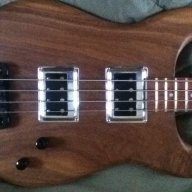
Solved my E and A string "dual pitches above the 12th fret" problem...did some more research...this problem is called "wolf tones." I had lowered my pickups a little bit while troubleshooting, which hadn't made any discernable difference. After reading up on the issue, I decided to try lowering my pickups even more...they are Dimarzio Model P's and have a very powerful output...I lowered the E/A pickup way down so that the top edge of the E side was 1/8" above the pickguard and the top edge of the A side is 1/4" above the pickguard. No more wolf tones. Pitches are true all the way up to the last fret now on all 4 strings. And I haven't lost any noticeable volume, even after such a drastic reduction in pickup height.
20180408_142245.jpg
 
Last edited:
  • Like
Reactions: 96tbird
This normally only happens when playing acoustically, it's just an effect of how strings as a thing work. Normally the fretted note gets more output when playing amplified or out of an acoustic body but the second tone from your finger to the nut is always there. If this is happening while you're playing amped, I'd advise to scrape any EMG logos off of your neck.
 
This normally only happens when playing acoustically, it's just an effect of how strings as a thing work. Normally the fretted note gets more output when playing amplified or out of an acoustic body but the second tone from your finger to the nut is always there. If this is happening while you're playing amped, I'd advise to scrape any EMG logos off of your neck.

Thanks for your reply.
As it turns out, I first noticed the dual tone while playing a new Bass in a store acoustically. After changing strings on one of my Basses I heard it again, but only acoustically! I was concerned because all of my Basses are very quiet, so I assumed it was the strings and their setup.

Your reply was helpful in reminding me that it was an acoustic context and that I need to work on the setup of that Bass.

Thanks,
Bill D.
 
Glad to help! I learned this just by tapping on my basses unplugged at home, I heard a second tone then I just muted the side of the string that went from my finger to the nut and this was just a place where that knowledge applied.
 

Latest posts