• TalkBass has been independent since 1998. Add your voice.
    Create a free account to reply to discussions, view embedded media, and browse with fewer display ads.
    Join freeLog in
    Want zero display ads or expanded classifieds tools? Compare plans.

String tone uneven?

Personally, I embrace the fact that each string on a bass can have a distinct character. Compared to other stringed instruments, there is a wild difference in diameter between the strings, so it's just inevitable that the strings are going to have different tone, sustain, response, etc. I tune in fifths, so the difference is even more pronounced on my instruments.

In the DB world it is very common to mix sets because we are actually looking for significantly different character between the high strings and the low string(s). It gives the instrument versatility.

I suggest not to get too hung up on evenness of tone, and just accept that it is the nature of the instrument that each string is going to have its own character, strengths and weaknesses. Your fingers ultimately have to do most of the work in evening things out, when the music calls for it.
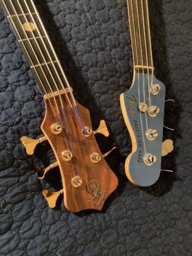
 
I've been using D'Addario Chromes on both of my basses the last few years, and have really liked their quietness, as well as brightness if you dial it in. Lately however, I'm a little irritated at a deader than the rest, B-string, right out of the box.
 
try a thinner / lighter E and A string ... Fat low strings makes them boomy ... lighter lower strings brings out more midrange overtones
The issue is only with the G. The D is consistent with the others. Thats whats odd to me. Other mentioned pickup height. I already tried but will check again. The tone is so different from the 2 adjacent strings is kid of like the difference between the wound and unwound strings on a guitar.
 
Personally, I embrace the fact that each string on a bass can have a distinct character. Compared to other stringed instruments, there is a wild difference in diameter between the strings, so it's just inevitable that the strings are going to have different tone, sustain, response, etc. I tune in fifths, so the difference is even more pronounced on my instruments.

In the DB world it is very common to mix sets because we are actually looking for significantly different character between the high strings and the low string(s). It gives the instrument versatility.

I suggest not to get too hung up on evenness of tone, and just accept that it is the nature of the instrument that each string is going to have its own character, strengths and weaknesses. Your fingers ultimately have to do most of the work in evening things out, when the music calls for it.
What you say makes sense to me. I actually thought about letting it go and embrace it, but at this point for what i would like to be my sound i want more even tone across the strings. Its like having a 3 string bass and some random sound i call pull out of nowhere, again interesting idea, not for now. At the very least if I want that kind of versatility I know how to get it.
 
  • Like
Reactions: BarfanyShart
My experience with Cobalt flats is they age with very uneven tone. The sound guy asked me why he only hears certain notes. I told him that the strings needing changing. What I didn't tell him is I'm protesting the BL for donating my pay (what little we make in the past couple of years) to the unfortunate in these pandemic times. She'll email all of us and say we got paid, and she's donating it unless we decide otherwise. The only replies are supporting her.

She's crazy and that was inappropriate and borderline theft. She should make those suggestions once she distributes the pay.
 
The switch from Rumble 25 to Rumble 40 would give more power and more volume, but they are essentially the same tone from the Fender circuitry. Different drivers though. For a different tone I would have switched brands, but not without trying the amps out first.
 
The issue is only with the G. The D is consistent with the others. Thats whats odd to me. Other mentioned pickup height. I already tried but will check again. The tone is so different from the 2 adjacent strings is kid of like the difference between the wound and unwound strings on a guitar.

I like to play thin light gauge strings and sometimes the G is too weak sounding, but I love the wat the other strings sound, So I am experimenting with a fatter G string on a light gauge set.
 
There are two general things that will make different strings on the same bass sound different from each other:

1) Comb filtering - the position of your pickups imparts a wavelength filter on your strings. As each string has a different propagation velocity, this means, in the frequency domain, that each string also has a different frequency response - each string has its own "voice", if you will. No matter what you do, unless you tune all your strings to the same note (which is an interesting thing to ponder, but I wouldn't advise it), there is literally no way to get rid of this. As a result, playing the same note on different strings will always have a different timbre. This is something you have to, at some point, accept - you can't fix it. Part of why we play notes in different positions is to take advantage of this - it's something you live with and work with.

2) String construction and condition - flats vs rounds is the obvious example here, but the physical characteristics of a string affect its timbre - most obviously in the high frequencies and the decay of harmonics. This is where you can do things that might make you a bit happier - see above suggestions. Just know that, at the end of the day, even if you find strings that do as much as they can, they can't undo #1.

If you want to make your G sound more like the rest of the set, my suggestion (I've done this with B strings) is to try a different kind of G string. If it's too bright and twangy, try a Pressurewound G string with the rest of the set as rounds. GHS will sell you singles - on their web site.
 
The switch from Rumble 25 to Rumble 40 would give more power and more volume, but they are essentially the same tone from the Fender circuitry. Different drivers though. For a different tone I would have switched brands, but not without trying the amps out first.
You are correct. They dont sound massively different, but the 10" vs 8" has a bit deeper low, to me, not a lot but some. Another reason I tried it is because it has the split mid controls (low and hi mids). There aren't many amps around to try so i need to order and return. I can do that, but its a pain.
Either way, it helped me hone it down to the strings.
 
There are two general things that will make different strings on the same bass sound different from each other:

1) Comb filtering - the position of your pickups imparts a wavelength filter on your strings. As each string has a different propagation velocity, this means, in the frequency domain, that each string also has a different frequency response - each string has its own "voice", if you will. No matter what you do, unless you tune all your strings to the same note (which is an interesting thing to ponder, but I wouldn't advise it), there is literally no way to get rid of this. As a result, playing the same note on different strings will always have a different timbre. This is something you have to, at some point, accept - you can't fix it. Part of why we play notes in different positions is to take advantage of this - it's something you live with and work with.

2) String construction and condition - flats vs rounds is the obvious example here, but the physical characteristics of a string affect its timbre - most obviously in the high frequencies and the decay of harmonics. This is where you can do things that might make you a bit happier - see above suggestions. Just know that, at the end of the day, even if you find strings that do as much as they can, they can't undo #1.

Thanks for this explanation. I just dont understand how 3 strings have the same tonal characteristic and one is so different. Like i said on another reply, its like on a guitar where you have the wound strings and the unwound, how different tonally the sound. If the regular boomers are supposed to sound like that, thats fine.
When i go to the stores to try other basses, they have the standard strings on, maybe a bit bright for my taste, but seem to have consistent tone. maybe i shouldve stuck with those.
 
Thanks for this explanation. I just dont understand how 3 strings have the same tonal characteristic and one is so different. Like i said on another reply, its like on a guitar where you have the wound strings and the unwound, how different tonally the sound. If the regular boomers are supposed to sound like that, thats fine.
When i go to the stores to try other basses, they have the standard strings on, maybe a bit bright for my taste, but seem to have consistent tone. maybe i shouldve stuck with those.

If you like the strings on a bass in the store, find out what kind of strings they are, and buy some of those.
 
You are correct. They dont sound massively different, but the 10" vs 8" has a bit deeper low, to me, not a lot but some. Another reason I tried it is because it has the split mid controls (low and hi mids). There aren't many amps around to try so i need to order and return. I can do that, but its a pain.
Either way, it helped me hone it down to the strings.
Ampeg, Hartke, Peavey and others make amps in that size range. They all have their signature tone.
 
If you like the strings on a bass in the store, find out what kind of strings they are, and buy some of those.
I didn't really like them, hence i went with the boomers because i was familiar with them from my guitars. I know, not the same, but seemed like a good idea at the time. Again, e, a and d strings sound warm. g sounds bright.
 
There is no BEST string, only preference.

If you prefer rounds (and yes, that is OK), try DR Sun Beams or Hi Beams if you like a brighter sound. Or Stringjoy, you have to order them direct. Or if you want to take a leap to something really great but not low cost, Thomastik Infeld Jazz Rounds are very uniform sounding across all points.

But---
First make sure your pickups are adjusted. Maybe raise the G side, just loosen the screws holding the pickup a half turn. Try it, it's free. Because GHS makes good strings too.

Good luck.
 
I've had that problem with other strings.

I now get a good rounded tone with Dunlops nickel....I use super brights. Not as bright as the name would imply.

They're decently priced to boot.
 
There have been some good suggestions here.

I saw some mention of trying DR Strings.
If you are going to try DRs you should look at Pure Blues they are the best of both Nickle and Steel.
If you are already concerned about brightness I would avoid Low Riders and HiBeams will probably have a "break-in" period before you like them.

IDK what style you are going for or if you are married to round wound strings but Flats and Tapewounds can be a nice way to "knock the edge off".

If you are just looking for balance you might try a different gauge. Most Boomer varieties are 45-105 you could try sets with heavier G's. I know D'Adderio makes a set of 50-105s and GHS Heavy's are 50-115. Going to a heavy set will make all the strings bigger and may not fix your balance issue, plus changing gauges will require an intonation adjustment and on the bigger strings, may require a nut slot adjustment.

You might also try a treble side pickup adjustment, you may be able to get the strings balanced by lowering the pickups on just the G string side and/or raising on the E string side.

You could also consider a bass modification. Your tone knob "rolls off" treble frequencies based on the size of the capacitor it's connected to. Moving up to a .033 or .047uf capacitor will help unbrighten your tone but will require some soldering. Stellartone make a multi-select tone pot called the tonestyler which would give you several uf options but is still a mod that requires soldering.

Lastly, you said in the OP that you tried EQ and it makes your tone muddy. That might be because you're not taking the best approach to EQing. Here's a link to a post with some EQ guidelines.

However, I found these Rumble amp specs:

Between Gain and Drive are three preset button-activated EQ shapes: Bright (adds ‘presence and shimmer’ at the top end via +13dB@10kHz), Contour (scooped mids, or -13dB@670Hz, +1dB@80Hz, +2dB@8kHz) and Vintage (which squashes your tone and darkens the midrange via up to -9dB dynamic compression with low pass). There’s also a simple four-band EQ numbering Bass (+/-15dB@80Hz), Low-Mid (+/-12dB@280Hz), High-Mid (+/[email protected]) and Treble (+/-15dB@10kHz).

You'll notice there is no adjustment for 2k-4khz which is probably where your issue is, so the addition of an EQ pedal or multifx unit with (semi)parametric EQ might help you dial-in a better tone.

Sorry, I know that is alot.