
hi everybody! I'm writing today because I'm in a momentary indecision about this particular bass.
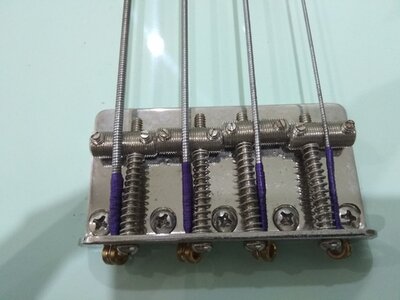
mine is a Custom Shop 1951 NOS (pics attached) that I started using with its original strings, Fender 9050M (flatwound, 55-70-90-105), which I liked but didn't fell for them, and then switched to GHS Precision Flatwound in the same gauge, which I get is the original gauge of the Fender Mastersound strings when they were stock on Fender basses (but not on the first '51, who had rounds).
after one year and a half I've grown tired of those flats because, in some way, I think that they limit the sound of this particular instrument: the '51 is bright, more like a Jazz Bass with the neck pickup than a Precision with the split coil, and flats on this bass sound good but I prefer them on the split coil.
so I was thinking of restringing it with rounds, but the real question, as in the topic's title, is related to the intonation.
before acquiring this bass I've owned a japanese model from the 2000's and tried some different sets of strings, but encountered intonation problems due to the bridge that only has two saddles.
if the E string is good, the A string isn't.
if the D string is good, the G string isn't
by far, the Fender 7150M (pure nickel) and the 9050 both M and R (45-100, 55-105) gave me the most precise intonation, which doesn't mean perfect intonation on every string, but at least a non-noticeable +/- few cents on one of the string of the couple.
other sets gave me real issues, like 15/20cent out of tune on the frets. in particular on the E string, because in most sets it's the string that intonate the farther from the neck.
right now the GHS 55-105 flats intonate "good", and the lack of sustain from the E string and it's "thud" helps hiding the small intonation issue.
however, thinking about rounds, all the strings sustain, so I need a set that doesn't shag up the intonation without changing the bridge
what do you use on this particular style of instrument?
mine is a Custom Shop 1951 NOS (pics attached) that I started using with its original strings, Fender 9050M (flatwound, 55-70-90-105), which I liked but didn't fell for them, and then switched to GHS Precision Flatwound in the same gauge, which I get is the original gauge of the Fender Mastersound strings when they were stock on Fender basses (but not on the first '51, who had rounds).
after one year and a half I've grown tired of those flats because, in some way, I think that they limit the sound of this particular instrument: the '51 is bright, more like a Jazz Bass with the neck pickup than a Precision with the split coil, and flats on this bass sound good but I prefer them on the split coil.
so I was thinking of restringing it with rounds, but the real question, as in the topic's title, is related to the intonation.
before acquiring this bass I've owned a japanese model from the 2000's and tried some different sets of strings, but encountered intonation problems due to the bridge that only has two saddles.
if the E string is good, the A string isn't.
if the D string is good, the G string isn't
by far, the Fender 7150M (pure nickel) and the 9050 both M and R (45-100, 55-105) gave me the most precise intonation, which doesn't mean perfect intonation on every string, but at least a non-noticeable +/- few cents on one of the string of the couple.
other sets gave me real issues, like 15/20cent out of tune on the frets. in particular on the E string, because in most sets it's the string that intonate the farther from the neck.
right now the GHS 55-105 flats intonate "good", and the lack of sustain from the E string and it's "thud" helps hiding the small intonation issue.
however, thinking about rounds, all the strings sustain, so I need a set that doesn't shag up the intonation without changing the bridge
what do you use on this particular style of instrument?
Attachments
-
 Fender Precision CS1951 Limited Edition Nocaster Blonde NOS (1).jpeg2 MB · Views: 50
 -
 Fender Precision CS1951 Limited Edition Nocaster Blonde NOS (8).jpeg1.4 MB · Views: 39
 -
 Fender Precision CS1951 Limited Edition Nocaster Blonde NOS (14).jpeg2 MB · Views: 37
 -
 Fender Precision CS1951 Limited Edition Nocaster Blonde NOS (16).jpeg1.6 MB · Views: 44









 I have other basses, up to modern 6 strings, and this one lives for it's design and flaws, which are part of the sound.