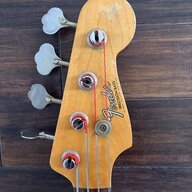
To quote him “whatever came on the bass when I got it”.What Flats did Bernard Edwards (Chic) play with?
The shipped with GHS strings in the 70s from memory.
source: Music Man Bass Global - 1978 Hangtag Manual

TalkBass has been independent since 1998. Add your voice.
Create a free account to reply to discussions, view embedded media, and browse with fewer display ads.
Join free Log in
Want zero display ads or expanded classifieds tools? Compare plans.
To quote him “whatever came on the bass when I got it”.What Flats did Bernard Edwards (Chic) play with?

I went from HiBeams to FatBeams and never looked back

GHS Brite Flats, the original OEM strings in the '70s


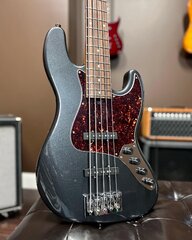
GHS Balanced Nickels, without a doubt. They’re slightly on the darker-sounding side, and have a little bit lower output. They’re perfect for any bright, aggressive bass that you want to tame. I used them on the Stingray Special I used to have.Hello,
For years I loved my Sting Ray with maple fingerboard and fresh Ernie Ball regular Slinky strings for an aggressive and nasty tone I wanted for the type of music I mainly played.
Now I am seldom playing that genre, and for the others I play I feel I would like a smoother/rounder/mellow/more gentle tone. Not really a darker one; I still want some presence and brightness.
I got some good results by changing the EQ on the bass or outboard, but I would like to see what different strings may bring.
I play with fingers and pick, some slap.
Any suggestions?
I tried reading some threads in this Forum; am I in the right direction with DR Sunbeams or stabilized(*) Hi Beams?
Thank you!
(*) By “stabilized” I mean that, to my understanding from what I read, the Hi Beams are too bright when new and they deliver their best after some use.

Stingrays don't have a tone knob.Tone knob?

GHS Balanced Nickels, without a doubt. They’re slightly on the darker-sounding side, and have a little bit lower output. They’re perfect for any bright, aggressive bass that you want to tame. I used them on the Stingray Special I used to have.
I really liked EB Cobalt Flats on my Stingray. Generally smooth sounding, but bright when you play harder.Hello,
For years I loved my Sting Ray with maple fingerboard and fresh Ernie Ball regular Slinky strings for an aggressive and nasty tone I wanted for the type of music I mainly played.
Now I am seldom playing that genre, and for the others I play I feel I would like a smoother/rounder/mellow/more gentle tone. Not really a darker one; I still want some presence and brightness.
I got some good results by changing the EQ on the bass or outboard, but I would like to see what different strings may bring.
I play with fingers and pick, some slap.
Any suggestions?
I tried reading some threads in this Forum; am I in the right direction with DR Sunbeams or stabilized(*) Hi Beams?
Thank you!
(*) By “stabilized” I mean that, to my understanding from what I read, the Hi Beams are too bright when new and they deliver their best after some use.

I don't agree. Sometimes the sound of extremely new strings is what you're after. For instance, I *love* new roundwound Rotosounds. They still sound fine for three months or so (even longer, depending on how much I play on that specific bass) but the sound of brand new Rotos is something I truly adore. When I record, I almost always make a point of installing new SB66s right before recording. Also, I love TI flats when new. They still sound fine after being broken in, but I love their combination of smoothness and brightness they have right out of the box.I don't know why many folks don't seem to get this, but all strings start out at their brightest. Fairly quickly, they lose some of that initial brightness, and then for a good long while, they are fairly stable at a reduced brightness - they are getting duller, but VERY slowly. At some point, they will become dull enough that you decide it's time to change them - they don't really "die", you just decided one day they aren't what you want any more.
So, given that life cycle, if you put strings on that are "just right" at first, unless you have a deal with unlimited free strings and a roadie to change them every day, YOU HAVE BOUGHT THE WRONG STRINGS!!!. If that is your initial reaction, in not too long, when the initial zing dies out, you'll be running around telling everyone that "those strings die fast". No, they don't "die fast" - you bought the wrong strings.
The right strings, when you put them on, are too bright. You turn down the tone controls on your bass and your amp or pedalboard, you play them for a while, and then....a week or two later, you turn the knobs back to their normal positions, and... the strings sound great. Congratulations! You have bought the right strings - by buying strings that are too bright initially, you now have the benefit of enjoying that long, relatively stable period, and the strings sound good for a good long time.
I never play a gig with new strings - I always make sure they get played at least a week before I play a gig (this means I need multiple basses (reason #42 for why you need another bass). That way, I am never trying to coax the sound in my head out of a bass that is too bright - if you end up in that situation, you tend to play timidly, which is not a good thing.
Anyway, the short lesson here is: When you try the right strings, you won't know it for a while - you need to leave them on long enough to have them settled before you know if you've go the right strings. If they sound too dull or just right when you first put them on, however, you know you don't have the right strings.

By the way, some strings do die faster than others. It's not just about the inherent tone of the strings. Otherwise, the whole idea behind coated strings (which stop the grime from entering in between the gaps) would be a sham, but coated strings do last measurably longer. Rotos, I suspect, die faster because they have a much coarser winding, which also give them their "chainsaw" tone quality.

When I do this I turn the amp up to compensate. So I'm sending a slightly more mellow tone to the amp but not losing any volume. I tend to have a soft touch but bass volume at 10 has a little too much aggression in the character of the sound at times.Strange, I experienced the opposite... if I have a low signal going to the amp I instinctively play harder to compensate, which results in a less mellow/round tone. In fact I even recently added a booster pedal that I use for my two active basses.
I actually have a set of new La Bella RX that I haven't yet installed on my Warwick Corvette 5 (this also currently strung with EB Slinkys)