
• TalkBass has been independent since 1998. Add your voice.
    Create a free account to reply to discussions, view embedded media, and browse with fewer display ads.
    Join freeLog in
    Want zero display ads or expanded classifieds tools? Compare plans.

Studio Monitors

Let's see... you were probably plugged into a good direct box, directly into a studio-grade preamp and channel strip equalization, played back through a $4K pair of highly engineered, bi-amped studio monitors, in what was probably a fairly optimal acoustic environment? I'm thinking that particular experience might be difficult to replicate in a live situation. :D Having said that, @gtirard's suggestions are good... or maybe something like a Genzler bass array cab might get you there. But the so-called FRFR world is where you want to look. Six or eight of those JBL 708s would probably be loud enough for using in a live setting.
^^^ This right here.

There's a HUGE difference between highly directional Near-field reference monitors that go for about $2000 per monitor, that are designed to be used in stereo pairs, surround arrays, or ambisonic arrays, with a specific focal point in a highly treated control room, and a bass amp & cabinet designed to fill a room with bass guitar sounds.

Even if you hypothetically put two of these in a venue as a stereo pair, set up basically how they were in the studio, it would only sound good a few feet away, and only at the focal point of the two speakers. (And that's not getting into the logistics of actually being loud enough and the size of the venue, all the studio gear you used between your bass and the monitors, etc etc.)

I'm gonna +1 on what @gtirard and @redbrang said. To get a more "crisp" clear and immediate tone, look for amps and cabs that are transparent and "Full Range, Flat Response" (FRFR) style speakers.

Genzler or Bergantino or Trickfish amps & cabinets; Jule M series amps with no pre or EQ section.
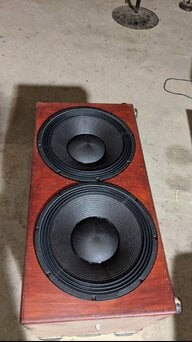
 
It's not hard to get high fidelity sound at volume these days. The better powered PA tops use the same type of dsp processing found in high-end studio monitors.

RCF is the lowest priced entry for a large format, high quality compression driver with an appropriately low crossover to a 12"-15" midbass driver. Very flat frequency response, linear phase, and constant directivity. Distortion is low for the output capabilities.

If that's the sound you like, it's readily available in an easy plug & play setup.
 
I recently did a studio gig where they had me play in the control room instead of out in the studio so I was listening to myself through the studio monitors. What a sound!!
The monitors were JBL 708P's. I'm not normally a fan of JBL speakers but these things sounded gorgeous. The best way I could describe the sound is "crisp". I was thinking that it would be great to have a speaker setup that had the same clarity that these monitors had but that could hold up to bass guitar. I don't even know if this is a practical idea. I don't know if the sound of the studio monitors would work well in a band setting. Anybody out there have any experience with something like this?
I have tried this :) many years ago. It was "ok" at very low volume (this was a fairly quiet gig literally in a museum, with an acoustic band). But even still not great. They tend not to throw long distances very well, and they tend to be very directional. Also they're not usually designed to be transported very easily (no handles) and they generally aren't "road durable" to be moved around a lot. For example, there is no protection on the corners of most of them. Speakers and tweeters are often exposed or just lightly protected. I imagine they'd get trashed pretty quickly during the course of normal gigging.
 
  • Like
Reactions: REV
The JBL monitor mentioned by the OP is closer in design to a modern PA top than a traditional nearfield monitor from the last century.

It has very even controlled wide dispersion compared to a 1" tweeter on a flat baffle. Much like a good modern PA design.

The scaled up version uses a 15" woofer and large format compression driver crossed over at 800hz...again, similar to high quality PA tops. This is a classic combo spanning nearly 100 years derived from the film industry.
 
  • Like
Reactions: REV
I recently did a studio gig where they had me play in the control room instead of out in the studio so I was listening to myself through the studio monitors. What a sound!!
The monitors were JBL 708P's. I'm not normally a fan of JBL speakers but these things sounded gorgeous. The best way I could describe the sound is "crisp". I was thinking that it would be great to have a speaker setup that had the same clarity that these monitors had but that could hold up to bass guitar. I don't even know if this is a practical idea. I don't know if the sound of the studio monitors would work well in a band setting. Anybody out there have any experience with something like this?

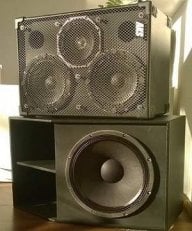
Well, the system from my avatar (especially the 210 with coaxial mid/high driver) brings you studio-monitor quality on stage. It's extremely neutral sounding so all colouration will come from the (pre-)amp and effects.
 
  • Like
Reactions: fast slapper
Conversely musical instrument gear tends to be woolly and loose down low in comparison to HiFi gear. With HiFi, the lows seem tighter and more focused, but are also smooth.

I have played on some pretty high-end PA gear and none of it seemed to reproduce the same qualities I heard in HiFi gear. I have assembled a few rigs that achieved some of the qualities I was after, but not all.

For the proceeding I am basically saying that there seems to be some tangible differences in the way HiFi and MI gear speaks that is independent of frequency response.

Absolutely. In many cases this is by design. The vast majority of HiFi gear is trying to exactly reproduce what's on the recording. Gear is differentiated by how well it can do this, and since engineering is always about compromises, what exactly the compromises are in trying to reach that goal. There are exceptions (e.g., some people still want tube amps that most definitely color the sound) but usually the goal is accuracy.

The goal of most MI gear is to achieve differentiation by actually coloring the response. You do NOT get out exactly what you put in. Ampeg has a particular sound. Fender Rumbles have a particular sound. The coloration is a feature, not a bug. Again, there are exceptions (e.g., Barefaced 12", but not 10", cabs) but generally the goal is for different brands to have identifiable house sounds.

I came from the HiFi world before I started playing bass and I was surprised by the differences in perspective—took me a while to get used to that.

My understanding is when there are two sound sources playing the same frequency, you only perceive the louder of the two sound sources.

Not wrong, but it's much more complicated than that. Loud sounds don't just mask other sounds of the same frequency but other sounds of nearby frequencies as well. It's not symmetric, either—the masking distribution is generally positively skewed, meaning that, say, a 500Hz tone won't do much masking down at 250Hz but will still have significant masking effects even up to 4kHz. The overall width of the distribution is itself frequency-dependent. Low-frequency sounds have a wider effect than high-frequency sounds.

So, yes, playing in a nice acoustically-damped studio with near-field monitors is a LOT different than playing in a noisy bar. And playing in Joe's noisy bar will be different than playing in Mary's noisy bar.
 
  • Like
Reactions: hbarcat and Wasnex
Ideally, you'll be using a HPF plus using some additional EQ to tailor the sound to alter certain frequencies. In most live situations, generally for the electric bass, anything above 5,000 or 6,000 Hz is useless, while anything below about 50 Hz is usually undesirable.

As an experienced live sound tech and studio recording, mixing, and mastering tech, I know that when listening to an isolated bass track* it doesn't sound very hifi at all.

The entire band when mixed together sounds awesome in the PA (when it's mixed properly, of course) but the bass itself doesn't need all that frequency space. If you want to spend extra money for a more complicated bass cabinet that's studio quality flat from 20 Hz to 20,000 Hz, then there's no reason why you can't have that. It's your money.

But it's completely unnecessary, and if you're using it to reproduce sound below 50 Hz or so, then you're almost certainly creating problems for the room mix (usually by interfering with the kick drum) and also wasting a lot of amplifier power for nothing.

In a live setting, most bassists are only using their cabinet as a stage monitor for their bass, anyway. So, if you think it sounds better to your ears as the bassist, then by all means, get a hi-fi cabinet. But literally nobody else in the room will care, or even notice.

By the way, I've experimented with hifi cabinets for bass before. I have a pair of 15" 3 way cabs that have a flat frequency response from 35 Hz to 22,000 Hz. The bass sounds unnatural and weird.


* Unless you're Les Claypool. His isolated bass tracks take up the full frequency spectrum. But most people aren't Les Claypool.
Well, as an experienced sound, recording, mixing, and mastering engineer, I can tell you whole heartedly that the sound of your bass cabinet doesn't mesh with the mix. The tailored sound of the bass in the PA, with the rest of the band, is what sounds good. What I do to it (or not, depending) is no different than what any bass player would do to his signal. A little compression, a little eq, etc. Same as anyone playing bass into anything. If he likes a flat studio response (which JBL is notorious for not producing), he should go for it.
 
Last edited:
  • Like
Reactions: hbarcat

Latest posts