• TalkBass has been independent since 1998. Add your voice.
    Create a free account to reply to discussions, view embedded media, and browse with fewer display ads.
    Join freeLog in
    Want zero display ads or expanded classifieds tools? Compare plans.

Studybass.com, Fretting

Mar 25, 2023
240
308
Disclosures
None
Halfway through Ed Friedland's Method Book 2 and I still have very limited fret coverage with my left hand. Over a four fret span the accomplished bass players I've watched on YouTube generally need only depress the fingers to stop the string; by and large they don't have to move their fingertips great distances along the fret-board to get on target; I do, it's a major impediment to progress, I thought there was no way I could resolve it and I found no instruction on how to make the attempt until last week when I found the linked Part 2 (of a three part video series on fretting) which gave me precisely the coaching I needed.


A week in and it's clear that the development I seek will take a good bit of time, effort and focus so I'm essentially suspending other exercises for the entire month of February (or however long it takes) to work on it. It is gratifying that five days of work has generated noticable improvement; I have miles and miles to go but I am definitely making progress.

As an aside, I think Andrew Pouska is an outstanding instructor.
 
Halfway through Ed Friedland's Method Book 2 and I still have very limited fret coverage with my left hand. Over a four fret span the accomplished bass players I've watched on YouTube generally need only depress the fingers to stop the string; by and large they don't have to move their fingertips great distances along the fret-board to get on target; I do, it's a major impediment to progress, I thought there was no way I could resolve it and I found no instruction on how to make the attempt until last week when I found the linked Part 2 (of a three part video series on fretting) which gave me precisely the coaching I needed.


A week in and it's clear that the development I seek will take a good bit of time, effort and focus so I'm essentially suspending other exercises for the entire month of February (or however long it takes) to work on it. It is gratifying that five days of work has generated noticable improvement; I have miles and miles to go but I am definitely making progress.

As an aside, I think Andrew Pouska is an outstanding instructor.
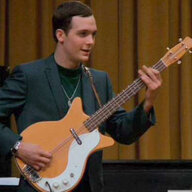
Which technique are you focused on learning? I like to tell myself I use one finger per feet, but my upright technique bleeds over. I love his advice on keeping your hand loose and relaxed. That’s the key. Also, not lifting unused fingers too far from the fingerboard. Economy of movement is good too.

Another thing that will help, if you haven’t done it already, is a proper setup. Strings that are closer to the frets will make the whole process easier.
 
In a major scale, play a 1-3-5. The index and middle fingers are naturally over the first two stops but I have neither the stretch nor coordination to pre-position my pinky over the 5-stop; a lot of hand/finger mass has to unwind and move a great distance to make the 5-stop. I have the same limitation with my ring finger and, say, a 1-3-5 flat. This obviously applies all over the place and it generates severe limitations. Related discussion/drills are not present in the books I'm using though I'm now finding YouTube videos focused on the issue.

It is, for me, a foundational problem requiring much improvement before meaningful progress can be made so that's where I'll be for a good while.
 
Last edited:
major scale, play a 1-3-5. The index and middle fingers are naturally over the first two stops but I have neither the stretch nor coordination to pre-position my pinky over the 5-stop; a lot of hand/finger mass has to unwind and move a great distance to make the 5-stop.
You could try shifting from the 1 to the 3 (or m3) with pinky on the same string then 5 with first finger on the next higher string. Or playing over 3 strings, pinky for the 1, ring for 3 (or middle for m3) and index for 5?
 
In a major scale, play a 1-3-5. The index and middle fingers are naturally over the first two stops but I have neither the stretch nor coordination to pre-position my pinky over the 5-stop; a lot of hand/finger mass has to unwind and move a great distance to make the 5-stop. I have the same limitation with my ring finger and, say, a 1-3-5 flat. This obviously applies all over the place and it generates severe limitations. Related discussion/drills are not present in the books I'm using though I'm now finding YouTube videos focused on the issue..

How do you place your thumb? If you place it behind the neck behind the middle finger (that is on the third fret) and rotate finger 1 and 4 with the thumb you can reach frets 1 and 5.

Can you make video to show the problem?
 
Thanks for the feedback and perspectives Steve and Les!

There are many places in the linked video where you can see what I'm after but between the 2:00 & 2:10 points is one location, if not the best.

My fingers are bunched up when playing and I have very little facility to spread them. That said, I've made some progress over this first week of working on the problem, up around the 12th fret. I'm getting better control of uncontrolled finger flying when I move other fingers, I'm starting to develop a little bit of stretch ability and I'm improving with respect to how you shape the fingers.

While I'm aware of leveraging alternate fingerings in general, that won't address what I feel is a fundamental deficit in my left hand ability.

Thumb behind middle finger: I have been playing with thumb behind index finger but a quick few seconds as you suggest and I can see some ability to cover more territory by pivoting. But, I still need to be able to stretch my hand, or my fingers, over a larger span. That is not meant to depreciate the tip you just gave me at all; it's not natural feeling right now but 30 seconds into messing with it and I think you may have just given me some gold! In that same 30 seconds I see that maybe that positioning supports a little more stretch, natively. Not sure but I'll be messing with it and get back.

Thank you both!

 
Progress is slow and gradual, as one would expect, but gratifying. I figure Feb 1 is the date I started this training so I’m ten days in to this month effort.

Our hands evolved to grasp things, not contort and perform gymnastics on a stringed instrument so I’m coming up with simple stretching and finger control exercises to address this application. Improved stretch/reach, hand/finger shaping, and individual finger control are obviously foundational.

Off the instrument, and after warming up via general hand movement, I’m using my right hand to gradually spread my fingers (all combinations of them) apart both in a flat plane and with various finger curvatures; I’m also working on control and isolation of individual finger movement.

On the instrument, pinky at or near the 12th fret, I’m applying all of that to movement on the fretboard. Often I use my right hand to limit flying finger movement as an aid development of the necessary neuromuscular control. I move my fingers slowly, sometimes very, in an effort to sharpen focus on the control aspect.

While there is a long way to go I’m seeing definite improvement. Idle fingers don’t fly around as much, general fingertip placement & isolated finger control are improving, I’m able to maintain hand/finger shape and close proximity to the strings better, my functional finger span has increased a little (but still meaningfully) and to the point that I can do a modestly decent job of a major scale 1-3-5, continuing the 3-5 pattern on the next string up. All of that is giving me a taste of what it’s like to need only push a finger pretty much straight down to stop a string; even at this early juncture the advantages of that over having to quickly move a finger a relatively great distance are glaring.

I’m also getting my thumb used to being closer to my middle finger than before and am noticing that the general angle of incidence of arm and hand to the neck matters and differs depending on where you are and which way you’re going, at least at this point.

So, good progress, a promising detour and I’m enjoying the ride.
 
Last edited:
  • Love
Reactions: Les Fret
My month+ fretting detour has yielded meaningful improvement. I doubt I'll ever be able to span all four finger tips over four lower frets simultaneously but via this exercise my fingertips are closer than before, so the larger scale movement for each stop has been reduced. In the middle to high fret range I can span four with all fingertips over each fret simultaneously. It's not pretty, automatic or seamless but the rudiments are working and should improve with time. It was a very worthwhile effort and is now part of my more general practice.
 
  • Like
Reactions: SteveCS
First off, I’m very glad to read that you feel that you’re making progress. I also think that Ed’s books are very worthwhile and well written.
My take, for what it’s worth, is that the Fender bass guitar, using that term in a generic sense was introduced as a way for double bassists to have a more portable instrument and perhaps produce a louder sound with no feedback. In producing this instrument, the scale length favored the fingering that nearly all double bassists learned back in the day, that of 1,2, 3&4 together. This is in stark contrast to the classical guitar fingering and scale length. Yes, hand size can be taken into consideration, but, if you want to play the bass guitar as a guitar, perhaps a shorter scale length is the way to go. This should improve one’s technique and minimize finger stretching injury.
Hand shifting is common to both instruments, as it is common to all string instruments. Indeed, proper shifting is at the core- it is the essence of all string instrument performance.
With all due respect to everyone, I believe that more practice time should be spent on learning music, that is, actual musical content, and less time trying to figure out with obsessive/ compulsive endless precision how to produce the notes.
There’s no point in learning how to talk if you have nothing to say.
 
  • Like
Reactions: tonym
