• TalkBass has been independent since 1998. Add your voice.
    Create a free account to reply to discussions, view embedded media, and browse with fewer display ads.
    Join freeLog in
    Want zero display ads or expanded classifieds tools? Compare plans.

Summer ‘24 Oddball

Alright, my pickup is a failure, and that’s ok. I didn’t think I would get that plate done so all my circuit gear and cords were at school. So I had a broken cord and just attached the pickup right to it. Not pretty, but I just wanted to get a tap out of it.
IMG_9895.jpeg


And I did! But only from the sides!!

I propped a bass above it, sounds nice! BUT it only picks up appreciably from the sides. It was quiet (no hum, strong output), so the hum-cancelling concept seems sound, but the direction of the magnetism travels through the coils away from the magnets, or so it seems to my layman’s brain. Any insight from the learned folks?

So this is a design failure, but that’s ok, I have other ideas to try.
 
Last edited:
Not one of the learned folks, but I would try disconnecting one of the coils to check if they are cancelling each other’s signal.
I'm going to try a few things tonight now that I have my wiring gear and some working cords back home. I also have some discussions scheduled with some of my physics colleagues who may be able to help with general magnetic principles as it applies to this situation.

I started putting a more conventional thought together in the meantime.
 
As I start getting more comfortable in my cad software, I feel a bit more confident designing parts. I made two sets of keepers to act as a spacer (like those in a p90). One set is more robust, one is very thin. Don’t know what will work best so I made both.

I also made a top and bottom that will tightly fit the 1/4” magnets like a fender. Everything should line up, will see how the printer did later. This idea is not as out there as my last one.
IMG_9896.jpeg
IMG_9897.jpeg
IMG_9898.jpeg
 
I was able to do a better test on the old design after the kids went to bed, and no matter the combo the results were the same. Both coils functioned together and individually, and the humbucking principle worked as it should (no hum).


But as you can hear in the video the bulk of the output comes from the magnetized baseplate going through the coils. There is certainly a signal from the rod magnets, but it doesn’t compare to the output right at the coils.

Very interesting. I am curious why it works exactly like this. If I reversed the arrangement, putting the magnets at the coil ends and using slugs in the middle, I would have a sidewinder. It makes me wonder if that is why the original sidewinder was so overwound. Maybe it needed that massive output to get a usable signal. Or maybe the magnetism travelled towards the slugs, more efficiently picking up the field disruption at the strings.
 
You could try moving half the magnets on each side (or the full set if you have more on hand) to the coil ends and put a hunk of steel (just a bar, rather than rods, for a quick test anyway) in the middle to try it that way, I think?

 
  • Like
Reactions: Verner
I'm pondering pickups and having fun looking into the ultimate experimental pickup rabbit hole: Magnets & Copper Wire: A Pickup Building Thread

So while that percolates, @RLK very helpfully sent me some tweaks to my rough body concept, and they were really great. I asked the family one by one and they all picked the same one I did (I didn't let them know until after of course, don't want to bias the focus group). So I suppose when I make my millions from this i'll have to split the riches.

I tiled the image using an online tiling site. I use macs, and adobe doesn't tile on macs anymore. I happen to have an ancient warmoth jazz neck hanging around, 22 fret. The final neck will be neither a bolt on or a fender headstock, but here is an idea.

15th fret join:
IMG_9935.jpeg
IMG_9936.jpeg


16th fret join:
IMG_9933.jpeg
IMG_9937.jpeg


I don't know that I will have 22 frets, or if the end of the board will be squared or swept. I don't spend a ton of time at the end of the board, so as this will be tailored to my general style, I'm not too worried about access to the highest frets. I may actually have to make the body a bit bigger to accommodate my bridge plans.
 
Summer has arrived for my kids, softball and tee ball are done, and they are away for a few days while my year winds up. So I can finally get back to building!

I have been working on pickup design since the failure of my first design, and the folks at magnets and copper wire: a pickup building thread have been really helpful and patient. I learned a great deal and came up with some working prototypes for this project. (https://www.talkbass.com/posts/28531778/)

So first I need a test bed for all the parameters, mostly the electronics, but I also want to see what this bass feels like to hold. The pickups will be inside the bass, you won’t see them at all.

I grabbed some 2x4 scraps and made a blank, unfortunately the belt broke on my thickness sander. I have to say, the adjustment, moving bed, and metal construction make this a superior machine to my old homemade sander, but the belts on that machine never broke (hook and loop). This thing is a pain with wide wood.

So anyway, it is flat enough, I’m not loading up another belt for a pine prototype.
IMG_0038.jpeg
IMG_0039.jpeg


Glued down a body template, and I have a jazz neck hanging around so I can get measurements. The actual bass will not have a fender headstock or bolt on neck, it will be an original design and neck-through.
IMG_0042.jpeg


With the neck placed I can make marks for the neck pocket, bridge, and pickups.

The pickups are split hum canceling units with very powerful neodymium magnets. They are both wound to be stronger than a typical J pickup, with tall coils to fit the extra windings of 42 gauge wire. I am trying out two designs, one for 1/4” magnets and one with 3/8” magnets. They both have a comparable output to a normal bass on my test rig, which has the pickups under 1/4” of wood and a total of 1/2” away from the strings. With this dummy bass I am making I can test pickup placement, top thickness, and other design features.
 
Last edited:
Every year seems to get busier. Finally managed some shop time, threw together the prototype pine body with a jazz bass neck. I sunk the bridge a bit and buried the neck right to the fretboard (3/4” neck pocket).

IMG_0112.jpeg


I just cut holes through th entire body for pickups and wiring cavity. I have a 1/8” acrylic topper to mount the pickups under.
IMG_0114.jpeg
IMG_0116.jpeg
IMG_0117.jpeg
IMG_0118.jpeg
IMG_0119.jpeg
IMG_0120.jpeg


Because of where the waist sits compared to a jazz bass, there isn’t that feeling of having to stretch towards the neck when sitting down

The output is comparable (although quieter) to my jazz bass, I have to try using some double sided tape to keep the pole pieces in line with the strings. I just direct-wired each pickup individually and then together to the jack, it sounds really good. Actually, it sounds pretty much like a jazz bass. It seems to favor the mids and highs more then the jazz bass it is sitting next to, I still have some experimenting to do with the pickups as well, but as a proof of concept I would say we are in business.

So I’ll make some more prototype electronics and see if any improvements can be made.
 
Last edited:
I tweaked a few things and got some very promising results. The first thing I changed was to add some double sided tape to keep the pole pieces right under the strings. I also used some foam rubber to tension the pickups against the guard.
IMG_0121.jpeg


Then I added a very crude ground wire.
IMG_0122.jpeg


Excellent hum-cancelling, although they need to be potted. These are prototype pickups though, no hurry there.

Finally, I spent some time in the setup and got the strings nice and low. Tweaking the string height on this design really influenced the output, and it is equal in volume to my jazz bass now. Very cool sound, but the strings are really old on the jazz bass so it isn’t a fair comparison yet. It is very snappy though, would make a great slap machine except the strings are so close to the body that slapping is uncomfortable.
IMG_0124.jpeg


The strings are about 3/8” away from the neck pickup, a little more for the bridge. Have to get a switch in there or two volumes so I can see how far apart the levels are.


I have never designed an instrument like this. The body shape sits nicely, even without any contours yet. The headstock doesn’t fit the design, I have a few designs in mind. This is showing me that the evolution of an original design is like a series of doors that you didn’t even know existed. Every solution opens up new possibilities and problems.
 
Aside from slap-ability, how do you like having the fingerboard almost flush with the body? I'm intrigued by the ergonomic intent of the 'ramps' that some basses have to limit space under the strings, but they don't look good to me. Bringing the whole face of the body up to the fingerboard sounds like a more aesthetically pleasing way to accomplish the same thing.
 
  • Like
Reactions: Verner
Aside from slap-ability, how do you like having the fingerboard almost flush with the body? I'm intrigued by the ergonomic intent of the 'ramps' that some basses have to limit space under the strings, but they don't look good to me. Bringing the whole face of the body up to the fingerboard sounds like a more aesthetically pleasing way to accomplish the same thing.
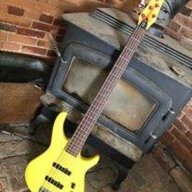
It is interesting, it brings up some issues to solve though. I am finding I anchor my thumb on the E string for all the other strings, but not having a pickup for my thumb-rest is odd. It is actually a very interesting feel outside of that. I've been pondering solutions, and I think I will probably route one or more concave depressions along the E string path for thumb rests. They wouldn't have to be all that deep to function and would fit the aesthetic of the conceptual knobs. I am also pondering a depression in the area at the end of the fingerboard where one 'pops' the G string, but I am not sure that slapping is a high enough priority for the initial concept yet.

Because of the way I made this conceptual prototype, I may not be able to test this out on this body as-is. I may have to make a wood cap to rout into, the acrylic top may shatter if I take a big router bit to it.
 
Alright, so having had a few days to sit with this brings some things into focus. Firstly, I think this may need to be a bolt-on design. I want the fluid lines of a neck though design, but I can’t think of any way to make this an efficient yet serviceable design. With a bolt-on design I can sink the neck in right to the tang of the frets or beyond, but still take it out for fretwork in the future.

That would also give me the option of making a uniform-thickness cap for the body, avoiding the potentially catastrophic action of routing into an almost-completed neck-through body to only 1/8” or so.

Not 100% on this yet, I’ll keep pondering. Any thoughts are welcome!
 
Last edited:
  • Like
Reactions: Matt Liebenau