Is there a certain type of 7025/12AX7/12AX7A/5751 that has higher current capacity? Do long plates, short plates, different brands come into play, or is the current capacity a fixed value depending on the tube (like 1.2ma for a 12AX7 no matter what)?
The simple answer is that you can have tubes from different companies all labeled 12AX7 and the specs can be different. You have to consult the spec sheets for each brand. Also within each brand, the specs of the same model will vary. Even within manufacturing runs. This is why some sellers sort and rate their tubes.
There is a 12A?7 family of tubes. Each have different specs and relatives. Some of them are: 12AU7 (mu=17-20), 12AV7 (37-41), 12AY7 (42-44), 5965A (45-47), 12AT7 (60-70), 5751 (70), 12AZ7 (59-60), 12AX7 (100-115). The differences are not just amplification factor. Some are more microphonic or noisy than others. There are different plate resistances, etc. Manufacturers have produced many versions of the 12AX7. In addition to the 7025 there is the 12DT7, 12DM7, 12DF7, 6681, 7729, and 12AD7. These are all low hum/low noise versions of the 12AX7. Versions were developed for specific applications such as military, mobile communications, space, and home appliances. Variations were developed to be cycled on and off, long service life, temperature extremes, power efficiency, high altitude, etc. The list goes on. All their spec vary to some extent.
People often substitute the 12AT7 for the 12AX7 in phase inverter applications. The 12AT7 has a plate current spec of 10 mA, much higher than the 12AX7's 1.2 mA. I doubt that you would gain anything by substituting an 12AT7 for the 12AX7 phase inverter in your SVT. As I said earlier, if the 12AX7 PI is running out of current capacity, substituting with a tube that can provide a little more plate current might provide you with a little more headroom.
In the case of your SVT, power amp stage is composed of the 12AX7 phase inverter, the 12BH7 drivers, and then the power tubes. The 12BH7 tubes have a relatively high plate current capacity (11.5 mA), even more so than the 12AT7. This allows them to fully drive the power tubes.
There is a problem. Modern tubes tend to not meet the spec of the NOS tubes. So if you buy a modern 12AX7, although the spec says it should have a mu of 100, there is a chance that your new tube is going to have a lower mu. Let's say 85 as an example. As a result, your amp is going to be performing under spec and could be distorting at lower volumes. If your 12BH7 tubes are under spec and can't produce the specified plate current, again, lack of headroom and distortion.
Does mutual conductance matter when it comes to the current? Say you have a tube that was "tested" at 42/42 and another tested at 48/48 on a Hickok tester (where minimun is 32/32 for this tube), would the 48/48 provide more current capacity, or are those numbers just a sign of the life of the tube?
This is getting complicated but in an attempt to answer your question... Mutual conductance is not based on a single parameter like measuring a voltage. Plate resistance and amplification factor tie into it. Mutual conductance = amplification factor/plate resistance. It is tying together the voltage of the input grid, the plate current and the plate voltage. These are all things that effect the conduction of the tube.
The bottom line is that a 48/48 is not necessarily better than a 42/42. The plate resistance may not be same and this will affect how the tube works. If the 48/48 tube had a low plate resistance than spec, the gain would be lower. You have to test them in your amp to know which you like best. All this complicates things.
Also, does anyone know of a cross-compare-table for various tube tester results? Like some testers will give a value like 1600gm, whereas another tube tester will give 44. How can you compare?
When you see a number like 44 you are looking at an amplification factor (mu). A number like 1600 is mutual conductance (gm).
The value of a tube tester is in comparing one tube to another. Even then it can let you down because they often do not test the tube under the same conditions such as plate voltage or load that it sees in the amp. Using a tester is not as good as testing the tube in the amp itself.
Testers do not adhere to a standard. If you read the same tube on multiple testers you would get results that would not match. This makes it difficult to compare results. There are some good testers out there like this one (
Invalid Link Removed).


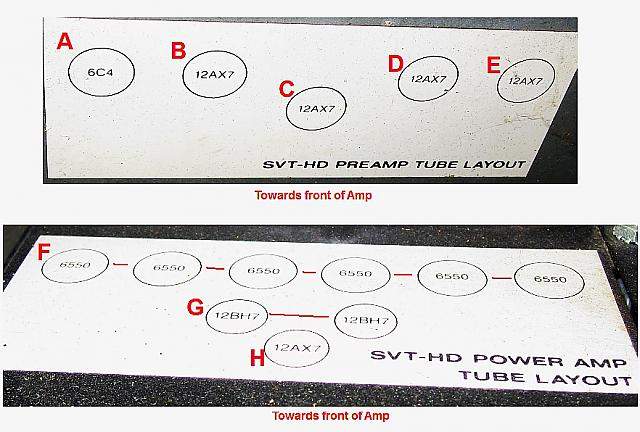
 - The above references to the Vx (Valve Numbers) are based off a 70's schematic found online, and the other information has been added by use bases on discussion with other members on TB. I'll edit/add the information as additions/and or corrections are made.






