
Enjoy the benefits of a premium membership!
Upgrade Account
-
TalkBass has been independent since 1998. Add your voice.
Create a free account to reply to discussions, view embedded media, and browse with fewer display ads.
Join free Log in
Want zero display ads or expanded classifieds tools? Compare plans.
You are using an out of date browser. It may not display this or other websites correctly.
You should upgrade or use an alternative browser.
You should upgrade or use an alternative browser.
Switching from 4 string to 5 string....
- Thread starter CM63
- Start date
More options
Who Replied?I enjoy playing a 5 string even though I play it very much like a 4 string, I occasionally use the low D and Eb and very seldom below that, but that would depend on the type of music you play, you may be needing those low notes. The reason I went to 5 was at the time I was doing quite a bit of theater work requiring a lot of reading mostly in flat keys, having the low F on the 6th fret B string makes reading those kinds of scores a lot easier, there is a much bigger range of notes under one position.
If there is one tip I could give it would be to allow yourself quite a bit of time to get used to 5 strings, it can take longer than one would realise, it's not so much the extra string it's that the E string becomes the reference point, for me it did, now that string is a B and open E is like the A string. I found it quite easy to play what I did on 4 string on the 5 when I was in my room and I could concentrate, it was on the gig when I had to make a quick shift that I would often go to the wrong string. It comes right eventually, I can switch from 5 to 6 string quite easily but 4 to 5 string for me was a big learning curve.
Good luck with a five.
If there is one tip I could give it would be to allow yourself quite a bit of time to get used to 5 strings, it can take longer than one would realise, it's not so much the extra string it's that the E string becomes the reference point, for me it did, now that string is a B and open E is like the A string. I found it quite easy to play what I did on 4 string on the 5 when I was in my room and I could concentrate, it was on the gig when I had to make a quick shift that I would often go to the wrong string. It comes right eventually, I can switch from 5 to 6 string quite easily but 4 to 5 string for me was a big learning curve.
Good luck with a five.

I found that my biggest challenge was muting. My 4-string muting technique was fine but with 5 strings, there was always one string droning away. I just didn't play them cleanly.
- Keith -
- Keith -

Any tips? Suggestions, et al?
You posed this question in the "Technique" forum for a reason, I suppose. I assume it's to solicit technique suggestions.
I'm in process of making this very transition myself. And I'm finding that the main challenge to making that transition successfully isn't a technique issue per se. It has much more to do with reconceptualization - reorienting oneself mentally to the expanded fretboard territory, and learning how to make maximum musical use of the additional space.

For me, one of the greatest blessings of the five-string, relative to the four-string, is the newfound ability to play familiar "old" notes in novel "new" positions, thereby allowing me to get "under" root notes played on the E string or A string, by an interval of an added fifth or even octave, that I could never execute before making the transition. For a similar reason, the five-string allows me to play the bass parts to some familiar old tunes as much as an octave lower than the original - thus opening up a whole new level of different vibe & feel to that music, and a new dimension of creative reinterpretation.
MM

I didn't find the transition that difficult. I just made sure that songs I learned on the 4, I never played on the 5 and vice versa, at least at first.
I go back and forth all the time and it's just not that big of a deal to me. My 5 has different string spacing as well, and one makes the transition it seems very quickly.
I go back and forth all the time and it's just not that big of a deal to me. My 5 has different string spacing as well, and one makes the transition it seems very quickly.
Any tips? Suggestions, et al?
The only big deal is probably going to be your plucking hand technique. In particular, muting is going to drive you crazy on a 5+ if you don't already have it built-in to your plucking technique.
One option is the floating thumb (this is what I use), and I picked it up from Todd Johnson's excellent tutorial on it:
Other methods are using the remaining fingers on the plucking hand along with the heel of the hand to quiet the non-used strings down. Bunny Brunel and Ed Friedland are two examples where I've seen that method used and possibly Roy Vogt also. That seems to work great also.
Depending on the bass, you may have to adjust to a narrower string spacing, but there's nothing really special to do there. That just comes with playing it.
Else, musically and otherwise, don't sweat anything else about it. It's much easier to adapt to having more than to having less and you'll just naturally start to practice different fingerings using the extra strings; that's just a matter of exploration.
It's just a bass with an extra string on it (or two in my case, or more in case of 7+ etc.) and it'll do everything the fewer-string basses will do. It just gives you more options to play with.
LS

Any tips? Suggestions, et al?
What I learned while going from a 6 string guitar to a 7 string, was that if you put away the 4 string for about a month or so and only play your 5 string, it will become normal to you. Jumping back 'n' forth at the beginning will make the comfortable transition take a lot longer. This month long transition time is a perfect opportunity to drop of your 4 string for a set up or any mods you been meaning to do.
At the end of the month, slowly start introducing the 4 string back into rotation.
I play 6 and 7 string guitars, 4, 5, and 6 string basses and can now switch back 'n' forth without any issues. It's not that difficult.

Only switch if you feel the need to.
While a lot of great players play 5ers or 6ers (or up and above), there are probably even more greats who stick to 4.
I'll stay with 5 myself.
While a lot of great players play 5ers or 6ers (or up and above), there are probably even more greats who stick to 4.
I'll stay with 5 myself.
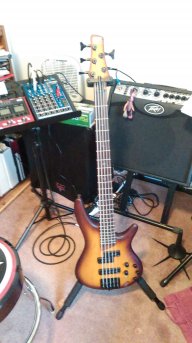

When I switched, I didn't stay with the 5 full time for a while. I switched back and forth and that made the transition longer. The suggestion above about putting the 4 away for a month and only play with the 5 is a good one.
I had a habit where if I panicked and didn't know where to go, I would fall back to the 3rd fret on E, "G". It was "home" to me. That really messed me up when I switched to 5, panic and the notes were wrong. When I went to the 5, I changed my "home" panic note to "E" at 7 on the "A" string. It is pretty much the dead center of the fretboard both on the strings and from the body to the nut. I started learning the fretboard from there out with the new notes available to me.
I have progressed since then quite a bit and no longer have a panic position because I have a very through knowledge of the fretboard.
Have fun.
I had a habit where if I panicked and didn't know where to go, I would fall back to the 3rd fret on E, "G". It was "home" to me. That really messed me up when I switched to 5, panic and the notes were wrong. When I went to the 5, I changed my "home" panic note to "E" at 7 on the "A" string. It is pretty much the dead center of the fretboard both on the strings and from the body to the nut. I started learning the fretboard from there out with the new notes available to me.
I have progressed since then quite a bit and no longer have a panic position because I have a very through knowledge of the fretboard.
Have fun.
Only do that if you hear the new notes and you see that sometimes it may improve your bass playing by allowing new positions.
I moved to the 5 very early one because the 4 didn't make sense to me ... i also liked a lot of music that used the extra range, I got in some situation that having the 5th string would help me with the fingering ... samething happenned when I moved to 6 strings, I saw it, I saw how it could help me and how the extra would be interesting.
My technic was already fit for those extra range bass. Muting seem to be the problem for most people and also for those chocking the neck with their fretting hand seem to not like extra range bass.
I moved to the 5 very early one because the 4 didn't make sense to me ... i also liked a lot of music that used the extra range, I got in some situation that having the 5th string would help me with the fingering ... samething happenned when I moved to 6 strings, I saw it, I saw how it could help me and how the extra would be interesting.
My technic was already fit for those extra range bass. Muting seem to be the problem for most people and also for those chocking the neck with their fretting hand seem to not like extra range bass.
Latest posts
-

-

-

-
 I asked for feedback here a little while ago, and this is what it turned into
- Latest: MultiScaleMale