• TalkBass has been independent since 1998. Add your voice.
    Create a free account to reply to discussions, view embedded media, and browse with fewer display ads.
    Join freeLog in
    Want zero display ads or expanded classifieds tools? Compare plans.

Talk me into tuning in fiths

Jun 4, 2001
4,415
4,944
39
Holland, MI
I've been considering this move for a while, and after reading all that the search feature here could yield me, I thought I'd let some folks here talk me into it.

This is the bass:
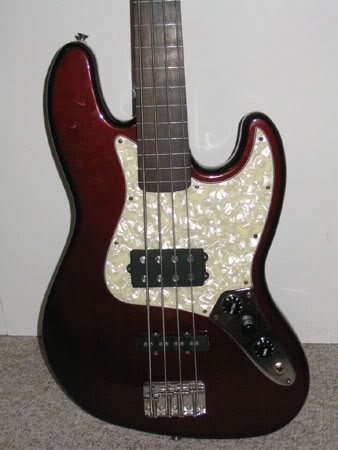
Plowbody2.jpg


A fretless MIM Fender Jazz with a MM Humbucker at the neck and a Quarter Pound jazz pickup at the bridge. This is my main bass. This tuning would be an experiment, but it would be a serious experiment - I don't play my fretted bass much, and I'd really like to have the extended range with this bass. Obviously there has been a lot of work put into it, so it isn't as simple as going out and buying a 5 string for the extra range. I used to play 7 string and miss the bottom end especially. I played in BEAD for a while, but missed being able to play middle-register notes on a reasonable part of the neck.

That combined with the desire to do something new now, because I'm not in any long-term projects and have the time (and will) to learn some stuff on my own.

The tuning would probably be CGDA. I like manly low strings (.105 E at the minimum, and I prefer a .110), and am more flexible on the higher strings. I was thinking: C .130, G .95, D .65, A .40. Is this reasonable?
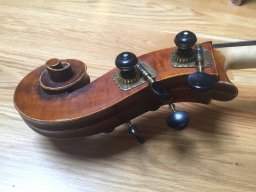
 
I've been thinking about too especially for bach cello suites.
It would be easy for reading like guitar pro tabs, but for reading sheet music it would be like reading cello. But you're talking about composing I'm sure. You'd have to relearn scales arpeggio patterns and everything. You would have to relearn everything besides your technique. But things like Minor arpeggios will be a lot easier. I do think it's reasonable, if you will stick it out, you could become popular for it, plus you will be able to play things most bassists will have trouble. And you will rethink your instrument.. Let us know how it goes!
 
There's quite a few guys on the double bass side who tune C-G-D-A, and there are some good threads about it. I've got a set of 5ths tuning strings (Spiro Red Mitchell weichs) and the Dennis Masuzzo 5ths book coming from Lemur music as my holiday project.

It's generally accepted that the 5ths tuning 'opens up' the instrument and makes it louder, dunno if it will do that on a slab though.

Major/ minor thirds seem to be the 'hardest', at least in double-bass land, unless you invert them.

Also check out the Red Mitchell threads (he played cgda from the 1960s).

Joel Quarrington and Silvio dalatorre (spelling?) tune in 5ths too.
 
I tuned one of my basses to 5ths. A few years ago I picked up a cheap mandolin and was blown away, since up until that time I had only played guitar and bass in standard tuning. Well, that's not completely true - I would play in drop D sometimes, so I was familiar with how it felt between two strings, but playing with all the strings tuned to 5ths was a revelation. I think it actually improved my playing, because all of a sudden I wasn't stuck in the same old patterns.

As Peck_Time pointed out, there are some intervals that may be a bit uncomfortable - it's definitely different playing mandolin vs. electric bass. It might not make sense if you are just playing covers, but if you want to experiment and/or expand your playing, then I say go for it! And if you do the tuning you mentioned, then you can get cello books for practice and to learn the notes on the neck - I tried it, but I'm not disciplined enough...
 
There's quite a few guys on the double bass side who tune C-G-D-A, and there are some good threads about it. ...
Joel Quarrington and Silvio dalatorre (spelling?) tune in 5ths too.

Right, Quarrington's interview in Bass Player several years ago is what planted the seed in my mind. When I was playing in an orchestra, my section-mate and I would sometimes tune DADG for stuff like Enigma Variations and Carmina Burana. That was about as far as it went, but he and I talked a lot about the benefits of tuning in fifths. Of course there is the problem of some intervals being tougher now, but others are much more accessible in fifths, so in the end, it probably balances out.

I did read through most of the threads on that side of TB, which were helpful too. I guess I'm pretty much convinced I should do it, and now it's just down to sorting out string sizes.
 
The impetus for 5ths tuning for me was playing a friends cello. It just made playing really cool! Having that range from low C to an A a tone above the normal G string is mindblowing. Certain keys sit really well in 5ths tuning too.

If i'm allowed to use a woodwind analogy it's like the difference in range between saxophones and clarinets. Saxes overblow at the octave, giving them a keyed range of 2 octaves and a fifth (adding in extra keys for the fifth). Clarinets overblow at the octave + a 5th giving them a range of well over 3 octaves. The downside for clarinet is that the fingering changes between registers (a c down the octave becomes a g with the register key pressed).
 
I've kept a bass (4 string fretted) tuned in 5ths since the late 70's. However, of late I've been playing in bar (cover) bands and have no use for it live. It really sounds cool though. Mine was tuned F-C-G-D which gives you just a slightly smaller range than a 6 string bass on a 4 string. E.g., if you started from the same low B you would have B-F#-C#-G#, which if you have the same # frets/positions, would be 4 half steps less (major 3rd). This tuning drives one towards chordal work in the bass range (at least it does for me) as you can get widely spaced chord tones easily. But I find it difficult to switch back and forth.