

Enjoy the benefits of a premium membership!
Upgrade Account
-
TalkBass has been independent since 1998. Add your voice.
Create a free account to reply to discussions, view embedded media, and browse with fewer display ads.
Join free Log in
Want zero display ads or expanded classifieds tools? Compare plans.
You are using an out of date browser. It may not display this or other websites correctly.
You should upgrade or use an alternative browser.
You should upgrade or use an alternative browser.
Tech21 VT-Bass - where's the magic ?
- Thread starter OldogNewTrick
- Start date
More options
Who Replied?
I know it's a bass pedal and all, but is there a digestable layman's explanation for why 500 Hz is a relevant test frequency, and shows the behavior of the processing throughout the frequency range? I would have guessed...hell, I dunno...pink noise or some such thing would be needed...?
The behavior of the Character and Drive controls is exactly the same at 50Hz, 250Hz, 500Hz and at any other frequency.
2 Reasons for choosing 500 Hz. Starting at about 500Hz is a critical frequency range defining the sound of the tone and its nicely in the center of the plot...
The frequency plots could also be done with pink noise with exactly the same results. TrueRTA however has a very convenient build-in feature, the "quick sweep"
Quote:
TrueRTA uses a digitally synthesized sweep signal of short duration (sometimes called a chirp) to automatically measure the frequency response of a system under test. When you click Quick Sweep the system takes over the generator and analyzer to first generate a sweep output signal and then capture the input and display the frequency response of the unit under test. You can use Quick Sweep for both electronic and acoustic measurements.
The digitally generated signal sweeps logarithmic frequency intervals in equal time. That is, as much time is spent sweeping the interval from 20 to 40 Hz as from 10 k to 20 kHz. This assures a high signal to noise ratio in the low frequency region. Unlike the pink noise source discussed above the digital [sweep does not have any noise in the amplitude response and does not need to be averaged in order to give precise results. A single sweep is all that is needed in order to measure the frequency response of any unit under test with great precision. The signal level of the sweep is determined by the Generators amplitude setting.
Rather than pink noise, which would be a huge mess with the harmonics, why not 250Hz and 125Hz?
That is precisely why I chose a single sine wave instead of pink noise, where any generated harmonics would be lost.
I always thought it was centered much higher, like in the 800 hz range. But it just seems to have a longer and more shelved Q.
The EQing part of the Character control AND of the Mid control are both centered exactly at 1.000 Hz. In fact they behave absolutely identical (in this respect).

Thanks for the great thread but shouldn't it be in Effects?
It should be in both. Not only clears up a lot about the pedal but gives you an idea about the tones of Ampeg tube amps and how they behave as well.
You are quite right, I did consider both, but...
It's now partnering my Carl Martin para EQ (clean channel) as tube preamp channel, feeding directly into a poweramp.
I am not using it as effects pedal, but as a preamp.
I'm guessing the difference between Character and the mid are that one is pre and one is post some gain stage (and possibly other stuff).
The Mid behaves just as an EQ, The Character control adds harmonics above the fundamental at different rates and different emphasis depending on setting, it really changes the character of the tone... very cool

There's probably more to it than is shown on these graphs.
Of course there is, how can you capture Magic in a graph?

As everybody using the VT Bass knows, what makes this thing happen is the interplay between the Character and the Drive control... just have a look again at these
All controls set as per manual
Plots with frequency sweep and 500Hz sine wave and generated harmonics
Fat Tube
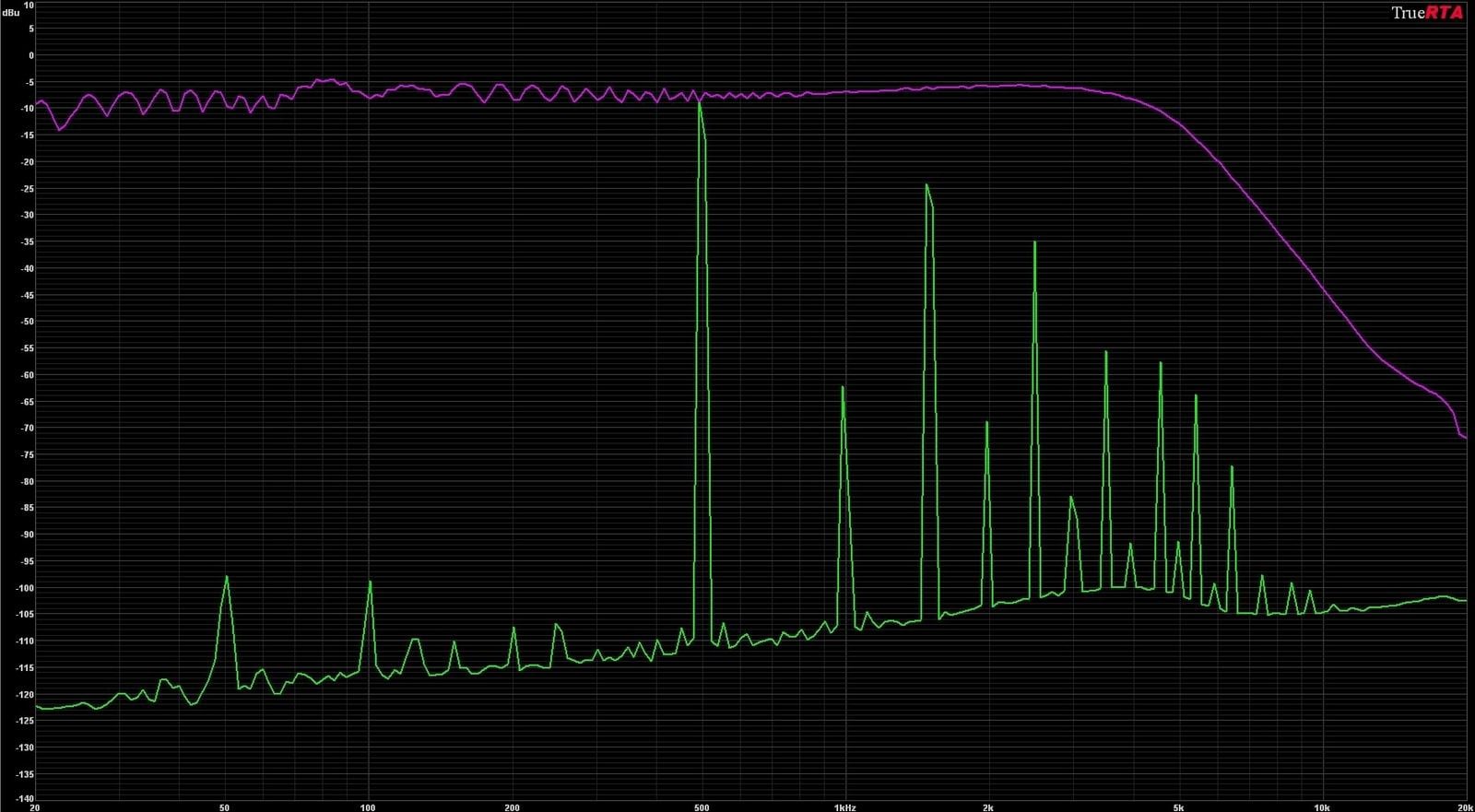
T9-M12-B12_Ch10-Dr9
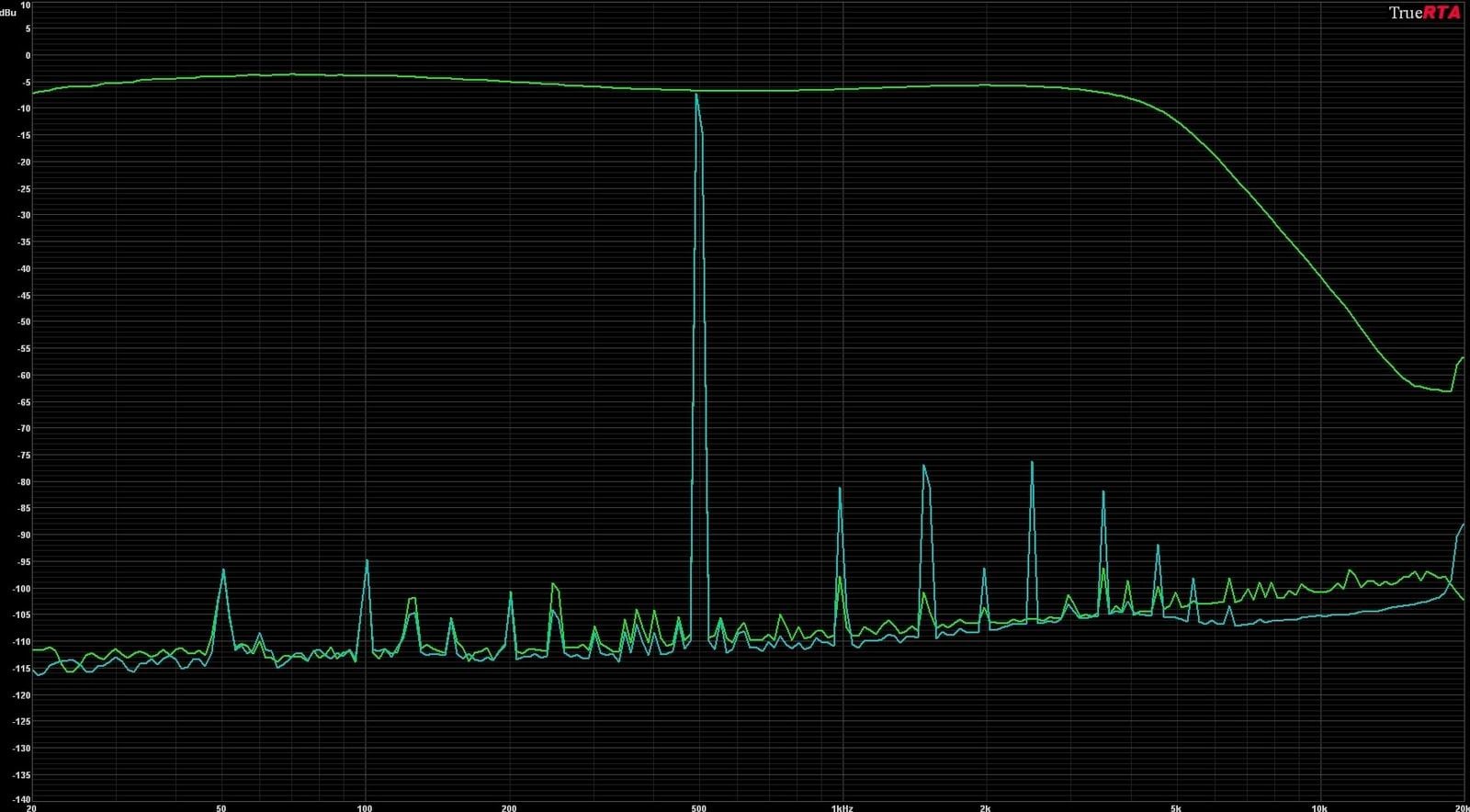

Ya, the way the drive pedal acts on the character as you crank it is very important. But even if you have the drive completely off, it still behaves and sounds like a clean running Ampeg. People seem amazed when I tell them the SVT is the cleanest amp I've ever used, but it's true. And I've never heard that sound in any other amp (Markbass LMII comes close), but Tech 21 nailed it.

If other Ampegs are much like the SVP-Pro, then, according some some testing using RMAA, there is a significant amount of harmonic distortion produced even at clean settings. So, while I'd say my SVP sounds good, it isn't low in distortion.
Great thread! I've got a VT Bass on the way. Plan to put it in front of my modded Eden for those times when a more driven sound is desirable.
Great thread! I've got a VT Bass on the way. Plan to put it in front of my modded Eden for those times when a more driven sound is desirable.

Great Job OldDogNewTricks
One thing I note is the Generated harmonic emphasis.
In general, both even and odd harmonics are generated, but the Odd harmonics are emphasized a little more. Kind of dispels the the old myth about tube amps generate even and solid state odd. If you did the same with a real tube amp I'm sure you'd see the same. I'm sure Tech21 A/B blind tested this pre-amp with the real thing while doing the design.
This little pre-amp fools a lot of people into thinking of tube amps. It does one of the best jobs out there. But it's not the only game in town.
One thing I note is the Generated harmonic emphasis.
In general, both even and odd harmonics are generated, but the Odd harmonics are emphasized a little more. Kind of dispels the the old myth about tube amps generate even and solid state odd. If you did the same with a real tube amp I'm sure you'd see the same. I'm sure Tech21 A/B blind tested this pre-amp with the real thing while doing the design.
This little pre-amp fools a lot of people into thinking of tube amps. It does one of the best jobs out there. But it's not the only game in town.
Well, that explains the distortion and compression effects
noobish question: I've read the description of the pedal and its a little unclear to this non-pedal person...this is not a full-blown compressor effect per se, but it does have a bit of compression effect, is that right?
Red

- Dec 18, 2000
- 13,201
- 340
- Disclosures
- greenboy designs: fEARful, bassic, dually, crazy88 etc
oldog,
Nice to see TrueRTA being used in this manner. Enlightening on the specific piece and educational at a broader level. I'd love to run a bunch of my V-Bass amp/cab and bass modeling through the package, but right now I'm kinda lookin' at some expensive speaker/enclosure/crossover measurement/design stuff.
Nice to see TrueRTA being used in this manner. Enlightening on the specific piece and educational at a broader level. I'd love to run a bunch of my V-Bass amp/cab and bass modeling through the package, but right now I'm kinda lookin' at some expensive speaker/enclosure/crossover measurement/design stuff.


Rick Auricchio
Registered Bass Offender
...this is not a full-blown compressor effect per se, but it does have a bit of compression effect, is that right?
Red
I wouldn't really say there's conventional compression going on. Usually, compression acts solely on the signal level. Basically, a compressor lowers gain as you push the input harder. The result is a more consistent output level.
There is some squashing of the waveform done by the Drive control, but that isn't necessarily going to be noticed like conventional level-control compression. It will sound more like a change in the tone/distortion/character of the signal, not so much as a leveling.
A beautiful measurement job for a rather special pedal.

Does anyone have any links to good articles, threads, books, etc. that explain what all of this means?
I understand the basics of frequencies and such, but am having trouble relating that to what I see on the graphs.
Thanks!
I understand the basics of frequencies and such, but am having trouble relating that to what I see on the graphs.
Thanks!

Thanks for the great thread but shouldn't it be in Effects?
Legit question enough, but this pedal is more of a preamp than standard effects pedal to most folks. Hence it's really not out of place to talk about it here imho, but the mods I guess will have to decide that. I love this thread by the way. Great work.

Anyone tried one in front of a Carvin B1500?
The B1500 has the famous Carvin "Drive" control. You should run some measurements to see if you already similar response to the graphs posted in the thread.

OK - I realize these measurements are beyond the common player, but the point is - the Carvin already does a very good job of emulating "tube sound" - IMHO, and many others.
Yup - that's why I wondered. Thanks.The B1500 has the famous Carvin "Drive" control. You should run some measurements to see if you already similar response to the graphs posted in the thread.
OK - I realize these measurements are beyond the common player, but the point is - the Carvin already does a very good job of emulating "tube sound" - IMHO, and many others.


