• TalkBass has been independent since 1998. Add your voice.
    Create a free account to reply to discussions, view embedded media, and browse with fewer display ads.
    Join freeLog in
    Want zero display ads or expanded classifieds tools? Compare plans.

Technical vintage tube amp question (Philips 2848/04)

Greetings guys

Long story short, I locally ran up to a 20 watt 1951 Philips 2848/04 tube amp (same model but not the one shown) which had been expertly doctored to be used as a guitar amp. The 20 watts should be enough for relaxing home plucking.

Anyway, to get to the moral of the story: I have no clue of the inner workings of tech and really would prefer not fry neither the amp nor my cab (I´m getting the amp for a trial soon). So the question is this:

My cab is 4 ohm and the amp has a switchable voltage selector (see pic), which selects the right ohm setting for output. Which should I choose for 4 ohm cab??!??!? :wideyed:
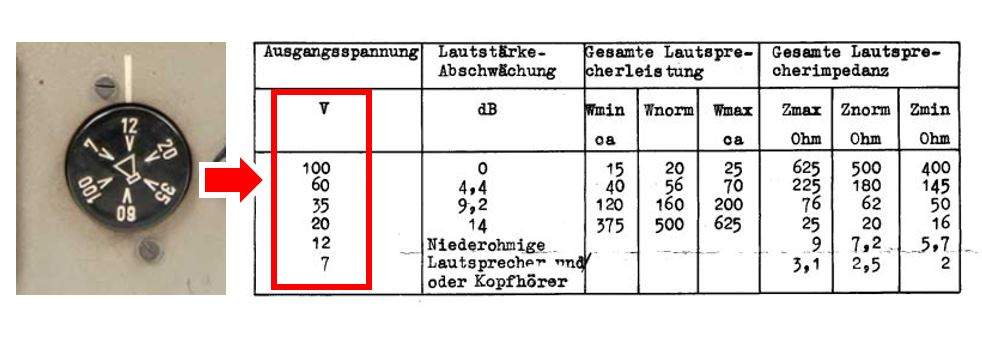
tb philips ask.JPG
 
And more from here...

"Country: Germany
Manufacturer / Brand: Philips Radios - Deutschland
Brand
EF40 ECC40 EL34 EL34 AZ50
Main principle Audio-Amplification
Wave bands - without
Details
Power type and voltage
Alternating Current supply (AC) / 110; 125; 145; 200; 220; 245 Volt
Loudspeaker - This model requires external speaker(s).
Power out 20 W (unknown quality)
from Radiomuseum.org Model: 20-Watt-Mischpultverstärker 2848 /01 /04 /06 - Philips Radios - Deutschland
Material Metal case
Shape Tablemodel, with any shape - general.
Dimensions (WHD) 340 x 210 x 197 mm / 13.4 x 8.3 x 7.8 inch
Notes
3 Eingänge; 5 Ausgänge; Frequenzgang: 40···10000 Hz.

3 Ausführungen:
2848 /01 = ?
2848 /04 = ?
2848 /06 = Ausführung für die Sicherheitsbestimmungen in Schweden.

Net weight (2.2 lb = 1 kg) 8.9 kg / 19 lb 9.7 oz (19.604 lb)
Price in first year of sale 660.00 DM
Collectors' prices
External source of data Erb
Source of data Kat.d.Rundf.GrossH.1951/52
Literature/Schematics (1) -- Original-techn. papers."
 
Normally you would need what is called a line matching transformer. Below is an example of what they do. Audio quality may not be the best, you'd have to see.

One option is to have to the amp modified, install a proper musical instrument output transformer. But you said that it has been worked on, maybe this has been done. You would have to have the amp inspected to see if the output transformer is original and if the selector switch is connected.


line matching transformer.JPG
 
Last edited:
Gesamtelautsprecherimpedanz: Total loudspeaker impedance (Max, Norm and Min)
So on 12V you should connect a 7,2 ohm LS (8 Ohms).

For the 12V and 7V positions it says ´Niederohmige Lautsprecher und/oder Kopfhörer' = Low ohms LS or headphones.

Try a 8Ohms LS (One that you do not care much about preferably) on the 12V and it should be OK. That being said, if you want the full power, you'll need the 100V transfo mentioned above.

Manual and schemo are here: Invalid Link Removed
 
Last edited:
Basically the amplifier belongs to the "class" of
Constant-voltage speaker system - Wikipedia

These amplifiers are primarily meant for fixed installations. The highish speaker "line" levels help to reduce thermal losses if there is need to transfer the "power" signal over long distance.
Almost always the speaker cabs of these PA-systems provide a step-down transformer just to "step-down" the power signal down to "practical" voltage numbers.

upload_2017-11-21_0-16-25.png


Ausgangsspannung: Ouput Voltage
Lautstärkeabschwächung: Volume damping (dB)
Gesamte Lautsprecherleistung: total loudspeaker power
Gesamte Lautsprecherimpedanz: total loudspeaker Impedance
Niederohmige Lautsprecher und/oder Kopfhörer: low Impedance loudspeaker and/or Headphones

I'm confused with the rated numbers for "total loudspeaker power"
To me that makes no sense. Very likely I'm missing the point of rating.

Further considerations.
The amplifier is meant to amplify mic and phone levels and AM (RF) line levels of the very oldish days.
I'm not sure you will get good results with a bass guitar that hits way more level to the table than the inputs likely expect.

I'd expect f3 response about 150Hz at best. Pretty good number in the oldish days just to reinforce some speach or have some AM RF audio material amplified in the audience
 
Last edited:
> I'm confused with the rated numbers for "total loudspeaker power"
Me too.
But I think the key is in the plural 'Werden Lautsprecher....': the total wattage is relative to speakers in paralell, which would explain why they mention that the Output impedance drops when using speakers which have, as a group in parallel, a total receivable power bigger than 20W (which with their speakers and 100V tranny should give 500 Ohm to the output tranny of the amp).
15W LS 8 Ohms on 12V is my best guess.

EDIT: I see you have a 4 Ohms cabs: Then I would try the 7V (3.1 Ohms max), if as has been mentioned above, the output stage has not been modified.
 
Last edited:
Seven but that's not that I speak German, I am wondering if this PA amp has a 100Volt line system where the signal is superimposed on a DC circuit so the PA speaker has a small transformer to erase the DC component.:)X
That's not how a 70V and 100V distribution system works.

It's simply a standard where the rated output is defined by power is delivered at say 100 VRMS. You then work backwards to rated load impedance, and connect loads via transformers so that each connected load represents a portion of the total rated load impedance.

Typically, it's easier and more conventional to rate in watts at the rated voltage, then connect transformer matched loads with the calculation already made to convert to watts so that all you have to do is add up the load power and as long as it's under the rated power you are ok.