• TalkBass has been independent since 1998. Add your voice.
    Create a free account to reply to discussions, view embedded media, and browse with fewer display ads.
    Join freeLog in
    Want zero display ads or expanded classifieds tools? Compare plans.

Techniques for damping strings

I'm looking for alternatives for damping my strings to reduce sustain. I'm in a jazz project where the object is to get a "upright-like" tone with a P/J electric bass played exclusively as a "P" with the "J" pup turned off. Not interested in palm muting; I want the damping effect to always be in place without having to manually do it each time. I'm particularly interested in your ideas that retain some of the fundamental harmonics without sounding like a dead thud with each pluck.

Here's what I've tried:

Foam mute. Stuck a piece of foam under the strings between the J pup and bridge. Result: dead thuds.

Rubber mute. Wove a piece of thin rubber about one inch wide (and very thin) through/around the strings. Result: almost dead thuds.

Narrow rubber mute. Cut the same piece of thin rubberized material to about 1/8 of an inch wide, also weaving it around/through the strings. Result: better, but still too dead and thuddy.

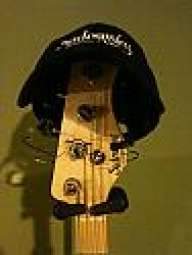
Piece of cloth. Cut to about 1/8 of an inch wide, woven around/through strings (see photo). Result: best of all. No more dead thuds. But the decay still isn't quite as pronounced as I'd like. Virtually no harmonics can be heard. Works OK in a mix, but I'm hoping for better.

Can you share alternative ideas to achieve this goal? BTW, I'm fine using a fretless Rob Allen Deep 4, but for this project it's important to use the fretted Fender bass. Thanks.

P.S. I'm using Status Graphite half-wound strings. I like the feel of those better than flats.
 

Attachments

  • Cloth Mute.png
    Cloth Mute.png
    623.6 KB · Views: 1,036
  • Like
Reactions: peter-j
Wow, that's interesting there with the little bow-tie.

I don't use mutes but I do use right-hand technique to achieve the sound I need for the situation. I would try experimenting with your right hand positioning, how the string is struck, etc.
 
What kind of cloth are you using? If that was the option that gave you the best results at this point, I would look at using a piece of flannel or fleece (something that is much thicker) in order to get you closer.
 
What kind of cloth are you using? If that was the option that gave you the best results at this point, I would look at using a piece of flannel or fleece (something that is much thicker) in order to get you closer.

Lightweight cloth swatch for suit pants. I'll look around for alternative materials. Thanks. But I would presume thicker material would damp the signal even more, putting the tone back closer to thud?
 
I've noticed that you lose less harmonic content the closer you get to the saddles with your muting material. I stuffed facial tissue right under the string where it meets the saddle, very pronounced decay with good harmonics. As always YMMV.
 
I've noticed that you lose less harmonic content the closer you get to the saddles with your muting material. I stuffed facial tissue right under the string where it meets the saddle, very pronounced decay with good harmonics. As always YMMV.

This hits my tonal and performance goal right on the nail. Thank you! The decay sounds very natural. And the harmonics are good.

The only negative is the tissue tends to fake off and get into the bridge. Might be worth experimenting with fine lightweight cloth....
 

Attachments

  • Tissue mute.JPG
    Tissue mute.JPG
    30.3 KB · Views: 798
  • Like
Reactions: Al Kraft
From Carol Kaye's website:
tip 34

Yes, Fender had that in their tailpieces but it wasn't adequate. The mute thing is so tricky, too much and you have that "plunk" sound that you don't want, you want the strings to ring. And they couldn't ever get it so that every string was muted about the same -- just wasn't that useful. I loved that tailpiece tho', it held the piece of doubled-up felt just great if you stuck a pick or two in between the tailpiece and the body, using them as shims to it kept the tailpiece up to let the strings ring but the felt sat on top of the strings just right. I just use some masking tape and tape the felt on top of the strings right next to the bridges, and that works just fine (altho' it might not look that great, sure gets a lot of questions and others have followed suit who use a pick). It has to be *on top* of the strings when using a pick. For finger players, it has to be *underneath* the strings and NOT felt, has to be foam rubber. The foam doesn't work that well for the pick sounds, just a nice piece of doubled-up felt (buy it cheap at any sewing center, even at Target, etc.). This is so critical to get a good clarified sound that will project through from either a combo or a big band. Works every time, and is a critical necessity also for recording. I believe that bassists have over-bought all kinds of gear trying to define their sounds when all it takes is a mute (the accessory gear manufacturers will hate me).
Carol Kaye
 
From Carol Kaye's website:
tip 34

Yes, Fender had that in their tailpieces but it wasn't adequate. The mute thing is so tricky, too much and you have that "plunk" sound that you don't want, you want the strings to ring. And they couldn't ever get it so that every string was muted about the same -- just wasn't that useful. I loved that tailpiece tho', it held the piece of doubled-up felt just great if you stuck a pick or two in between the tailpiece and the body, using them as shims to it kept the tailpiece up to let the strings ring but the felt sat on top of the strings just right. I just use some masking tape and tape the felt on top of the strings right next to the bridges, and that works just fine (altho' it might not look that great, sure gets a lot of questions and others have followed suit who use a pick). It has to be *on top* of the strings when using a pick. For finger players, it has to be *underneath* the strings and NOT felt, has to be foam rubber. The foam doesn't work that well for the pick sounds, just a nice piece of doubled-up felt (buy it cheap at any sewing center, even at Target, etc.). This is so critical to get a good clarified sound that will project through from either a combo or a big band. Works every time, and is a critical necessity also for recording. I believe that bassists have over-bought all kinds of gear trying to define their sounds when all it takes is a mute (the accessory gear manufacturers will hate me).
Carol Kaye

Well thank you for that. I have learned so much from CK.
 
  • Like
Reactions: PeteCarlton
Lightweight cloth swatch for suit pants. I'll look around for alternative materials. Thanks. But I would presume thicker material would damp the signal even more, putting the tone back closer to thud?

I would think a lot of that would depend on how tightly the cloth is tied around the strings. If there's some slack in it, I would think it would dampen the sound enough for your particular needs.
 
Last night I took a sheet of the thin rubbery material and placed a roll of it underneath the strings next to the bridge. The material bulged slightly upward between each string so it was pressing lightly against the bottoms. Decay was ok but not great - and nowhere near as musical as when using tissue paper. Harmonics were ok but worse than using the tissue mute. Tissues are ugly but way more effective.

Maybe the rubbery stuff was pressing too tight. Maybe not. I think it's time to pause and consult with experts in this technology. Time for a visit to the local fabric shop.