• TalkBass has been independent since 1998. Add your voice.
    Create a free account to reply to discussions, view embedded media, and browse with fewer display ads.
    Join freeLog in
    Want zero display ads or expanded classifieds tools? Compare plans.

Tell me I'm wrong!

I'm thinking I should take my bass to a Pro, please tell me I'm a dumb teenager who doesn't know everything!

I have an Ibby GSR 200 with lame stock pick ups, when ever I would play plugged in I don't really bother with the bass' knobs and just do use the settings on my combo amp. The other day I decided to finally figure out what each knob on the bass does.

I turned the volume all the way up and the sound totally died while the knob kept turning very loosely. I took off the knobs/(knob caps?) and found the nuts (I want to call it something else because it seems like a half nut or something) was coming loose when I turned the knob too far. I tried tightening them up by hand but I couldn't get the sound back.

I put in a new battery hoping that was the issue, but alas that did nothing. I took off the back and pulled up a wiring diagram but I apparently have a model with an odd number of pots.

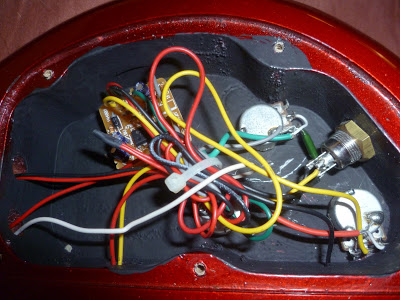
P1010950.jpg


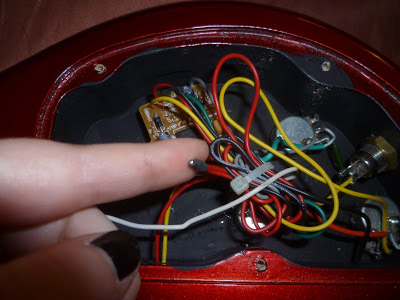
All the connections seemed good but I found one taped together wire that didn't match up with the diagram:

P1010952.jpg


Anyone have insight? Could this be the problem? How much am I out?
 
Yes, look at the top photo, the pot on the far right. It looks like the far right tang with the white wire on it and the top pot the tab on the top. They look like they are touching the black grounding paint. If a pot loosens up and turns one of the terminals can touch something and ground out.
 
I'm thinking I should take my bass to a Pro, please tell me I'm a dumb teenager who doesn't know everything!

I have an Ibby GSR 200 with lame stock pick ups, when ever I would play plugged in I don't really bother with the bass' knobs and just do use the settings on my combo amp. The other day I decided to finally figure out what each knob on the bass does.

I turned the volume all the way up and the sound totally died while the knob kept turning very loosely. I took off the knobs/(knob caps?) and found the nuts (I want to call it something else because it seems like a half nut or something) was coming loose when I turned the knob too far. I tried tightening them up by hand but I couldn't get the sound back.

I put in a new battery hoping that was the issue, but alas that did nothing. I took off the back and pulled up a wiring diagram but I apparently have a model with an odd number of pots.

Anyone have insight? Could this be the problem? How much am I out?

Since you ask me to, yes, you are a dumb teenage girl who certainly does not know it all. In fact knows very little! But your enthusiasm to dig into things is a good sign! No shame. Everybody starts out dumb! The shame is in making an effort to stay that way.

1. I have an Ibby GSR 206 and that is one kick butt bass! Those pickups are NOT "lame". Mine are more lame than yours because on a 6 string they don't quite cover the strings evenly but I can live with it with a bit of EQ. I like those pickups better than the ones on my SR506. OK?
(Teens! <sigh> never know when they have something great)

2. You want to play bass but don't bother to figure out what the knobs do?

True Story: Old black guitar player at music shop: "There was this kid! Man could he play! He could play anything! But he didn't know how to tune his guitar! He had to have someone else tune it for him, And then man could he play! <old man shakes head>. Store owner: "Why you here today". Old guitar dude: "Well I bought this amp from you a couple weeks ago and I bumped the knobs and I was wondering if you could put them back where they were when I bought it!

Get the picture? If you are going to play the instrument rather than it play you, you had better learn what EVEYTHING does on it! Especially the knobs! Even if you just have to learn how to set them so they do nothing!

3. "knob" episode. The knobs on your bass work controls on the other side of the wood. Turning the knob varies the electrical properties (resistance) of them to control things like volume and tone. They have a threaded part that goes through the hole in the wood with a nut on the outer side under the knob to tighten the whole thing down.

The whole business coming loose is a common guitar fail. When this happens if you twist the knob too far the whole thing twists and may short the terminals (those projecting metal pieces where the wires attach) to the shielding (black conductive paint) in the cavity. Also may make bunch of noise ("static") or bass may quit. (others have pointed this out to you in your photos)

The answer is to rotate the control (part in the cavity) so terminals are touching nothing and tighten the nut that holds it in place. No, you can't use your fingers to do this except to get it all started. You'll actually have to use a <shudder> tool! Why women hate tools I don't know. But your choice here is to either find a wrench (spanner) of the proper size or a thing that looks like a screw driver called a "hex nut driver" also of the proper size. The nut driver is THE proper tool for this. A wrench may slip and scratch the bass. We guys would typically just grab pliars to tighten it up and that is guaranteed to slip and make a big scratch!

Or you could continue owning no tools and pay someone with tools to do it for you.

True Musician story: Jamming with Guitard. His guitar jack is loose and making all kinds of noise. I mention it. He: "Well the nut came loose so I put some duct tape on it but it still makes "static", but I found that if I stand like this (strikes pose) and stand real still it sort of works!"

4. Battery issue. I just had to replace mine. I was playing my GSR206 and it was starting to hiss like mad. And very unusual was the hiss level seemed controled by the bass knob not the treble knob (you will know what I'm talking about once you learn what your knobs do) I thought I don't remember this thing hissing like this. It used to sound absolutely Killer! So eventually I get around to checking the battery. And it's one I put in a couple of months ago as I recognize the brand. And then I see the "use by" date on the side. 2010! Oops. Popped in a new (really new this time) battery and bingo that bass is rocking the house again!

As for pots these come in two models. Mine (older) with just bass and treble controls and newer ones with bass, treble and mid controls (you really need to learn what the knobs do!) Both work well.

Good luck and remember that in music one never stops learning and even more important it's the always the bass player who has to know how to fix things to save the band!
 
The pot cases are all grounded anyway, so it's not a problem if they touch the shielding. It is a problem if the tabs on the pots touch the shielding. The red wires with the shrink tubing on them are probably a graft and are intended to be that way. Borrow an adjustable wrench from your dad and tighten the nuts on all the pots, making sure that the pots are situated such that none of the tabs are touching the cavity walls.

Look at the green wire near the top pot. In the picture, it looks like there might be a bare spot where it's touching the pot case. Is that happening?
 
I turned the volume all the way up and the sound totally died while the knob kept turning very loosely.
kept turning like it still turned all the way around, it didn't "stop" at all? and it wasn't just the knob spinning on the shaft part, or the entire pot moving because it was loose, but the shaft part itself that still kept turning?

if so, your volume pot is itself broken, and needs to be replaced. that's not such a big deal, a $5 part and maybe $20 to get a pro to wire it in for you.
 
Short answer: It shouldn't be expensive at all to repair.

Start asking around about trusted repair persons in your area. Find someone with a good rep for delivering what you want (not telling you what you should want).

In the meantime, start to read up on how to repair and maintain your instrument. In addition to electronics, learn how to adjust truss rid, set intonation, and adjust action. Look through Talkbass, watch YouTube videos, and ask plenty of questions. Starting to learn from now will save you a frantic headache if/when something needs to be done.
 
Short answer: It shouldn't be expensive at all to repair.

Start asking around about trusted repair persons in your area. Find someone with a good rep for delivering what you want (not telling you what you should want).

In the meantime, start to read up on how to repair and maintain your instrument. In addition to electronics, learn how to adjust truss rid, set intonation, and adjust action. Look through Talkbass, watch YouTube videos, and ask plenty of questions. Starting to learn from now will save you a frantic headache if/when something needs to be done.

Can I replace pots at home?!?! I've done all the other stuff you've mentioned without an issue, but I didn't think pots would be so cheap.
 
Congrats for being brave enough to dig in and see what is happening. It's the only way to learn, and this is a good instrument to learn on. It is effectively wired like a P-J bass with V-V-T and then into the Phat II (same as EMG's EXB) to get some contouring for contemporary or pop-and-slap tones. I really like the Phat II on my SRA305.

Yes, since the cavity is painted with a grounding paint that is electrically conductive, it looks like a potentiometer came loose, rotated, and the lugs came in contact with the grounding paint, shorting it to ground. Rotate the control so the lugs are away from touching the cavity and tighten the shaft nut with a proper small wrench or socket. This should bring the bass back to life.

I would suggest you start learning how to fix it yourself by reviewing Joey's Bass Notes, or joeysbassnotes.com , and you can get wiring diagrams from a variety of sources, including the Seymour Duncan and DiMarzio websites.

I think when you get everything sorted out and set up properly, the pickups won't sound so lame. But if you do change pickups, since it is a standard P/J setup, the world is your oyster as to what you would like to upgrade to. But give it a year after you've sorted out the wiring to be sure.

Yes, pots can be replaced at home, just like any other component. You will need a basic assortment of tools and a soldering iron and accessories, which the stickies can help you with.

You are exactly where I was 38 years ago when my folks bought me my first mail-order electric guitar, and after learning a few chords, I took it apart to see how it worked! Yes, I got it back together, and I still have and play occasionally that same guitar. Then I started changing and modding the wiring in my guitars and basses I subsequently acquired, and now my friends all have me rewire and set up their instruments for them.

Here's the converse to the loose jack story above, and how it should be done. I also have a guitar that when I first got it the jack was constantly working loose. I took the nut off, measured it, found a proper thin washer to fit between the jack plate and the nut to help the nut seat properly, put the jack, washer, and nut back together properly on the jack plate, and now 32 years later that nut is still as secure as when I first tightened it back up with the added washer in place.

Welcome to bass guitar! Good luck getting everything sorted out.
 
Can I replace pots at home?!?! I've done all the other stuff you've mentioned without an issue, but I didn't think pots would be so cheap.

Yes. Pots aren't expensive. As long as you are handy with a soldering iron, it shouldn't be too difficult. Do some searches for how-to videos. Be sure to use eye protection when desoldering.
 
Where your thumb is on the wire, strip about half that amount of the insulation off the wire, make sure the strands of the wire are wrapped together well, tin the wire well with just the slightest bit of solder with rosin core flux, and resolder the wire to the lug it came off of.
 
Alright!!! Everybody!!! Let's all sing it together!!!
(to the tune of William Tell)
"To the tech, to the tech, to the tech, tech, tech!"

(I'm really not trying to be a smartass -- I've had instruments in to my techs as well, including tubas that I thought I could fix, but didn't have the right tools, and, well, let's just say I'm thankful it didn't cost me more to save my screwups. This repair needed in this thread is probably not too serious, but may need the man this time.)
 
A good way to learn is to take it to a tech and when you pick it up, spend a few minutes talking about the repair, what the tech did and why, and maybe you can get the tech to show you what he did and make some other suggestions about best practices etc.

You learn a lot talking to pros.