• TalkBass has been independent since 1998. Add your voice.
    Create a free account to reply to discussions, view embedded media, and browse with fewer display ads.
    Join freeLog in
    Want zero display ads or expanded classifieds tools? Compare plans.

The Aleph - A Call for Opinions

michaelwayneharwood

Builder of the Wastelands
In Memoriam
Commercial User
May 1, 2014
2,494
2,341
56
Colorado
michaelwayneharwood.blogspot.com
Disclosures
Owner Melodious Resonance Constructs
After receiving several very helpful suggestions on my current build in regards to the aesthetics of the body design, I have decided to throw out one of my other designs for public comment to see if similar improvements that I am missing might be realized. This is the bass I will be building after I finish my current project. It has been dubbed "The Aleph" as a William Gibson reference as the design encompasses elements from the Lady 5Jane.

The design specs are as follows:
  • Headless design using piano tuners (of course).
  • Fretless design without lines. Side dots will incorporated, and very small top dots on the treble side is a possibility.
  • 34" scale, though 32" is being seriously considered.
  • Zero fret instead of a nut
  • Heavily chambered design.
  • The body will be thick - 2" is the minimum, and I am thinking 2.75" might be the sweet spot as I will be using 4/4 wood for the main body "middle" with a 1/2" back, and a 1/4" top.
  • An internal "sound board" will in the middle of the chambers with two piezo pickups attached - one each for the bass and treble side.
  • Hickory fingerboard that is flush with the body. The fingerboard material was chosen primarily to utilize a domestic hardwood variety, and secondarily for aesthetic purposes. I want to use domestic wood that has a striking grain pattern. Mesquite is also on the table.
  • Main body wood to be determined, though I have narrowed the choices down to Walnut, Texas Walnut, or Pecan.
  • The top wood will be most likely be Mesquite, but if Mesquite were chosen for the fingerboard then another wood would be used for the top. Walnut, pecan, or another domestic wood are all options here.
  • The bridge will be a removable Hickory piece with fret wire on top that should line up and not interrupt the flow of the Hickory fingerboard.
  • A piezo pickup will be mounted at the top of the neck in the space between the zero fret and the headpiece.
  • A pair of current sensing pickups that have been dubbed by a friend as "Alumiclones" will be mounted from the back to avoid any break in the flow of the center wood aesthetic.
  • The fingerboard will "flow" as uninterrupted as possible across the top of the body
  • The tuning will be what I am calling "reflected tuning" - D A E A D G C F#. The D and A on either side of the E will be the same pitch. In other words you will have the same A on either side of the E, and the D is the same on either side of that. It has somewhat of a bastardized Chapman stick feel to it...sorta.
  • There will be eight sound holes, with sizes that reflect the sizes of the strings. One for the E, two for the A, two for the D, one for the G, etc.
  • Pickup controls will be slide pots mounted either on the single cut horn in the same position usually found on acoustic/electric guitars, or on the back.
What I am hoping for is honest feedback on the aesthetic aspects of the design. Lines that look awkward, suggestions on creative ways to line up the sound holes, suggestions for domestic wood choices, etc. I am also completely open to discussing other aspects of the build, but I am adamant about certain things such as the piano pins.

Please feel VERY free to let me know your honest opinions - I have my flame proof suit on, and I know better than to feed the trolls. ;)
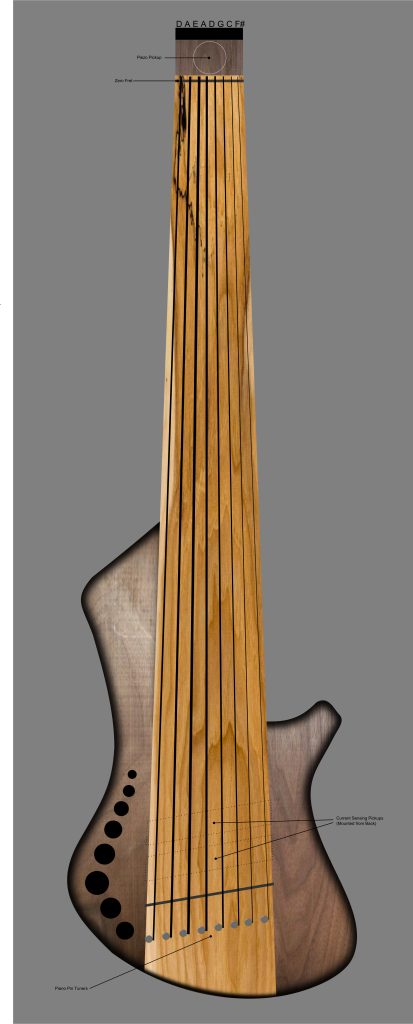
the-aleph_zpsd57922c3.png
 
Last edited:
Throwing my opinionated hat in the ring! Wheee! :laugh:

I, too, like the holes all in the upper bout on the bass side. Aesthetically, I actually like them on the lower bass side better, but that seems a little impractical and uncomfortable, being in the same area as the player's forearm. Either way, that's a very cool-looking way to do a sound hole.

If it were mine, I might smallify the string spacing a little bit - it seems like it'd be somewhat interesting to try and wrap your hands around as it stands. But the string spacing might be best determined with experimentation, and I could be totally wrong (which isn't entirely unheard of... :smug:).

Lastly... Have you considered American persimmon as a domestic fingerboard wood? It's actually a light-colored species of ebony, with the hardness and density to match. Used for the faces of wooden golf clubs because of its durability, abrasion resistance and elasticity. I haven't seen it used much in lutherie, but it might be worth looking into.

Otherwise... I think this is a really good-looking design. I love the rear-mounted pickups that maintain the clean aesthetic - always wondered why nobody did that. I feel like the piano pins could be a little closer to the butt end, but that's just personal preference. Looking great!
 
Last edited:
I like the look and most of the design. However I don't understand the purpose of all of the piezo pickups, particularly the one between the nut and zero fret. This will only provide unintended noise I would think. The internal soundboards might provide some useable signal, but unless they're sandwiched between something (think piezo bridge saddle between metal and string or an undersaddle transducer that is between a bone saddle and some hardwood), they will not provide much, if any signal. Compound this with this being a solid body instrument with some empty air space inside and I really don't see the use of this. I think an undersaddle transducer would be much more useful for your instrument.
 
Lastly... Have you considered American persimmon as a domestic fingerboard wood? It's actually a light-colored species of ebony, with the hardness and density to match. Used for the faces of wooden golf clubs because of its durability, abrasion resistance and elasticity. I haven't seen it used much in lutherie, but it might be worth looking into.

I have looked into American Persimmon, but finding available lumber has been a challenge. Mesquite and Hickory seem to be much easier options from an availability perspective. I also looked into Texas Ebony, but similar challenges seem to be present there. I may just need to do some extra leg work. :)

If it were mine, I might smallify the string spacing a little bit - it seems like it'd be somewhat interesting to try and wrap your hands around as it stands. But the string spacing might be best determined with experimentation, and I could be totally wrong (which isn't entirely unheard of... :smug:).

The string spacing represented is .669", but I could go down to a .656" spacing to see how she looks. I chose .669" because the HipShot 8 string bridge did not have a .656" spacing option and I went with the "safe" route on string spacing. I don't believe that just because HipShot does not have the option it's not a good idea, but I had to start somewhere. ;)


I agree that the holes look better lower down, but would seem to be more effective higher up. For me, perhaps #3 is the best compromise.

Love the design overall, and the piano pins are killer.

Thanks! Do you mean #3 as the one with sound holes in each horn?


I like the look and most of the design. However I don't understand the purpose of all of the piezo pickups, particularly the one between the nut and zero fret. This will only provide unintended noise I would think. The internal soundboards might provide some useable signal, but unless they're sandwiched between something (think piezo bridge saddle between metal and string or an undersaddle transducer that is between a bone saddle and some hardwood), they will not provide much, if any signal. Compound this with this being a solid body instrument with some empty air space inside and I really don't see the use of this. I think an undersaddle transducer would be much more useful for your instrument.

Some recent experiments by @Duplo42 have produced some interesting results that I find compelling. The best way to answer this is to direct you to check out post #101 from @Duplo42 in this thread. His experiments had excellent (and surprising) results with a piezo placed on the headstock. The sound samples he captured were unprocessed without even a pre-amps in the signal path. I am interested in seeing what, if any, results will be garnered by introducing a sound board in the middle of the bass. It may not work, in fact I have some serious doubts about it myself, but the only way to know for sure is to try.

How are you going to get enough break over the saddle?

Excellent point! I did a fingerboard flush with the body on this prototype, and the break angle could easily be achieved by removing some material at the bottom of the body where the pins reside. I need to think about the aesthetic of that, and it may be that a raised fingerboard would better suit the design overall.
 
I did I quick check on the string spacing and I can confirm that the drawing represents a 17mm (i.e. .669") string spacing. Once upon a time I had a Conklin Groove Tools 7 string and some quick research shows that it had this same spacing. I know that it's a spacing I am comfortable with for a 7 string, and I assume it will work for an 8 string equally as well.

I like the sound holes in both the upper and lower horn. Gives a sense of symmetry.
Thanks for the feedback!
 
Since you asked....

How the hell do you play something like that?? I understand that the Chapman Stick is a touch instrument, but doesn't that require a fretted board? Can you actually wrap your hand around a neck that large? I'm really glad the industry progressed from four strings to five, and I can see the stretch from five to six, but I just don't see the purpose for anything beyond that...

I'm really not a fan of single-cuts (unless you count the Les Paul design, which in bass form causes extreme polarization of opinions around here....), but that one looks nice enough. I mean "nice enough" as in "benignly pleasant, but not particularly exciting". It doesn't look very amenable to playing while seated, though. Especially not with that monster of a neck!

And I'm with Geoff on the electronics. I don't see how all that stuff is going to work. However, I also very much appreciate and approve of your approach too - you never know 'til you try!

So good on ya for the experimental aspects of this build, but aesthetically and ergonomically, meh...

Hey, you asked!! :)
 
I will take these one at a time... ;)

How the hell do you play something like that?? I understand that the Chapman Stick is a touch instrument, but doesn't that require a fretted board? Can you actually wrap your hand around a neck that large? I'm really glad the industry progressed from four strings to five, and I can see the stretch from five to six, but I just don't see the purpose for anything beyond that...

I have played fretted 7, 8. and 9 string extended range basses and quite enjoyed them. For me this is about providing extra pitch and tonal options. Perhaps this is less a bass, and more an extended range stringed instrument with some bass aspects. ;)

I'm really not a fan of single-cuts (unless you count the Les Paul design, which in bass form causes extreme polarization of opinions around here....), but that one looks nice enough. I mean "nice enough" as in "benignly pleasant, but not particularly exciting". It doesn't look very amenable to playing while seated, though. Especially not with that monster of a neck!

In general I am not either, but there are a few single cut designs I have seen that I really like. I tried a ton of different ideas for this instrument, and this is where I settled after a lot of revision. I certainly don't expect this to appeal to others necessarily, and I appreciate your candor.

And I'm with Geoff on the electronics. I don't see how all that stuff is going to work. However, I also very much appreciate and approve of your approach too - you never know 'til you try!

Agreed, and thanks!

Hey, you asked!! :)

Indeed I did. ;)
 
Here's a quick update that incorporates a 16mm string spacing, and slight modification of the locations of the tuning pins:

the-aleph_zps450b1f4d.png

This one is the trick....

I won't argue about pickups or whatever, you can sort that out. I'm just thinking aesthetically. Can make those circle soundholes ovals? Coz nothing else on that design is circular, the radii on the curves are constantly changing. I'd also work at creating some sort of headstock. For two reasons; 1. it rounds out the instrument aesthetically instead of ending in sharp cutoff; 2. then you can hang it on a wall hanger. No.2 is very important in a practical sense. It's a lesson I learnt the wrong/hard way. ;)

The only other comment I'd make is... (coz I'm about to encounter the same thing) think about how the strap will effective connect to the angle on that upper bout. You'll need strap locks for sure and even then it will effect the balance some.

BTW, I like the tuning on the bottom 2 strings. :)
 
Kerplunk: 2¢

I like BOTH sets of holes on the bass side, ie those close to the neck and those close to the bridge. If they are finished properly, they won't be "in the way" nor "bothersome" to the forearm. You'd have holes (ovoid perhaps, as the Rev suggested) flowing all along the bass bout.

Sorry, I don't have Photoshop to merge the two images...

http%3A%2F%2Fi1027.photobucket.com%2Falbums%2Fy331%2Fmichaelwayneharwood%2Fthe-aleph_zpsd57922c3.png
http%3A%2F%2Fi1027.photobucket.com%2Falbums%2Fy331%2Fmichaelwayneharwood%2Fthe-aleph_zps450b1f4d.png


The treble bout would be left untouched.

+1 for a modicum of a "headstock".
 
Here are a pair of quick updates to further the conversation. The sound holes were modified to ovals, and a headstock was added. Sound holes in both upper and lower sections were added to take a peek at what @Feral Feline's idea would look like. No offense to the Untamed Felinae, but I prefer the sound holes in the upper horn over the combination he suggested.

The headstock is basically the shape of the lower half of the body, and in my opinion is looks like a warped muffin top, but it's a place to start. A "string through" design similar to the three wood challenge bass or @reverendrally's three wood challenge bass would remove the necessity of fabricating a headpiece. I am not sure that I like the idea of a headstock for the bass in general, but that may be because I have not stumbled upon a shape that really resonates with me yet.


the-aleph_zpsc68417a5.png
the-aleph-2_zps64044b79.png
 
I understand a desire for symmetry, but the four CW and four CCW tuner pins personally would drive me insane. I'd either make them all go the same way for logic and muscle memory's sake, or maybe better yet do three CW tightening on the bass three strings and five CCW tightening on the treble five strings since it follows the other logical grouping. Plus, the asymmetrical aesthetic is nicer to me as it counters and balances the (standard) asymmetrical bass and treble wings.

For the headstock, I'd try replacing the curve at the bass side with something more closely resembling the shape of the body's bass-side non-horn (upper bout).