• TalkBass has been independent since 1998. Add your voice.
    Create a free account to reply to discussions, view embedded media, and browse with fewer display ads.
    Join freeLog in
    Want zero display ads or expanded classifieds tools? Compare plans.

The CGDA "Cello" Tuning, Tell Me About It....

In my very brief forays into the world of cello music I have to say that using the cello tuning does make things fall into place very naturally. I don't think that DB players use the tuning primarily for that reason though. Red Mitchell is often described as a jazz bassist though he played almost anything for Hollywood studio projects. I think it does have advantages for the DB that do not translate to the BG. In spite of all the tonewood talk here our instruments do not really resonate to any significant extent so when DB players talk about how the fifths tuning "opens up" the sound of their instruments by changing the string resonances we can't expect the same result. Likewise though we may play cello music and may do so more than DB players do in fact, few of us play with string sections so we won't really be "in sync" with them the way DB players suddenly feel they are (even when playing DB parts) for the first time when they play in fifths. Of course some of us may play with strings with some frequency so that may not be an effect that is totally without benefit for some BG players. You still won't be bowing like they are though! :D

Evidently a lot of "classical" music was written as if the DB was tuned like a cello. For years DB players have had to play notes between the low C and E an octave up. They actually began using five strings to get those notes before we did. Most popular music was written as if a BG were tuned EADG, or more recently BEADG. So the CGDA tuning giveth and it taketh away. Cello (and at least some DB) music becomes less awkward, BG music becomes more awkward. As Dennis Masuzzo advised me in a private email you have to be prepared to play the tuning, not transpose what you have been doing to the new tuning. In theory if you do it right you won't end up sounding like all the other BG players. Maybe you consider that a good thing, maybe you don't. As for me I am resigned to the fact that I will sound like all the other hack BG players no matter what tuning I use. ;)

Ken

I agree with you, I did some research on different tuning for DB through the ages. One DB playing that I find very interesting is Rinat Ibragimov of the London Symphonic Orchestra.
 
I've been playing my four string with the CGDA tuning for a while now. My only "gig" is playing bass for the worship band at church occasionally, it seems to be settling into about once a month. I'd been sitting in with the band practices for a couple of months to get used to it and the very night I showed up with the retuned bass for the first time after a whole ten days of practice with it was, of course, the night the worship leader comes up to me with a big grin on his face and tells me "Ken, I've got no one else available for Sunday so your it buddy". I'd already learned that week's songs on the new tuning and there was no time left to relearn them on my traditionally tuned fiver so I was in for a penny, in for a pound at that point. And it worked well. When I try to play the fourths tuned bass lines I know fairly well I typically find they are a little harder to play with CGDA because there is more jumping up and down the neck and the fingerings rarely flow as well on the new tuning since they were worked out for the traditional tuning. In a few cases though the new tuning makes them easier because awkward string to string jumps are replaced with back and forth jumps that flow better. On the other hand when I learn new songs I just play the tuning and it works fine. Of course cello music makes a great deal more sense when your instrument is tuned like a cello. At this point I think I am committed to it for the long haul. The debate I currently have with myself is over the fate of my fiver which is now collecting dust for the most part. Do I keep it for when I feel the urge to play in fourths? Do I retune it to make it a five string "sixer"? Or do I trade it in on another four string to tune CGDA, a fretless perhaps?

Ken
 
The debate I currently have with myself is over the fate of my fiver which is now collecting dust for the most part. Do I keep it for when I feel the urge to play in fourths? Do I retune it to make it a five string "sixer"? Or do I trade it in on another four string to tune CGDA, a fretless perhaps?

Ken

CGDAE tuning on the fiver would give you cello tuning at pitch (from the fifth fret on the GDAE strings). Plus, as you know, you would have the range of a "standard" six-stringer (minus the B0 pitch) and then some.

The fretless tuned CGDA is also an interesting tonal possibility if you are committed to learning proper intonation.

With either choice, It seems like you have some good options.
 
CGDAE tuning on the fiver would give you cello tuning at pitch (from the fifth fret on the GDAE strings). Plus, as you know, you would have the range of a "standard" six-stringer (minus the B0 pitch) and then some.

I'm not sure how important the B0 really is to anyone. So far it has not been an issue for me but the mere fact that I don't have it does nag at my subconscious anyway! With a fifths tuned four string you could drop down a half step or two or more to pick it up but you then end up with a lot of flats (B-Gb-Db-Ab) or odd combinations of strings (Bb-F-C-G, A-E-B-Gb). One tempting choice because it is all very familiar strings is to turn the standard tuning on its head: GDAE. The problem with that is that you now give up some of the top end in favor of notes that are so low that they are useless for most of us.

That approach is more feasible on a five string. It gives you BEADG turned on its head: GDAEB. Now you have all the low notes you would ever use and even if you have a few you will rarely use the top end still comes only half a step shy of a standard tuned six string's. Anything other than CGDA loses your connection to the cello somewhat but as you note any fifths tuning will give you the cello tuning somewhere further up the neck where the effective scale length is more cello-like too.

It is a tempting way to use my fiver but anything other than CGDAE (or the B and maybe Bb starting note options) would require serious nut slot filing and I am not keen to do that on a bass I may sell soon. I'm leaning more towards getting a MIM Reggie Hamilton to replace the Ibanez and converting my Active Jazz to a fretless. The RH has a drop "D" tuner which would allow me to pick up that B0 when I really need it. Doing that seems like a better choice for a 60 year old brain than dealing with several different tunings. If I am going to use two tunings then I suppose BEADG would be the best choice on the five string since it is already mostly ingrained.

Ken
 
Sorry to revive an old thread, but I'm interested in doing this on my wishbass to get more range and have something new to play around with. I'm probably going to use it more for a DFA1979 and Om blend of sound. Someone mentioned CGDA being much for suitable for melodic lines instead of your standard pop/rock basslines. Obviously, it's personal preference, but how do you think it would work in my situation?
 
Chapman stick.

I completely agree!

When I went to a Suzuki Bass workshop, for the little bass players, we used cellos tuned as basses. The tone wasn't too great and it was a little floppy. But they don't make basses that small so we had to improvise.

Sure "they" do. They are 1/10 scale - same nut-to-bridge string length (28"), as a full size 'cello.

I still have a 1/10 scale DB. It's NOT a 'cello. It's a bass body, sloping shoulders. My son began playing on it at age 7. I couldn't fool him with a 'cello body.

Strings are made for these size basses, as well.

bo_prod_H610_1-10M_main_1.jpg
 
Sorry to revive an old thread, but I'm interested in doing this on my wishbass to get more range and have something new to play around with. I'm probably going to use it more for a DFA1979 and Om blend of sound. Someone mentioned CGDA being much for suitable for melodic lines instead of your standard pop/rock basslines. Obviously, it's personal preference, but how do you think it would work in my situation?
Well, CGDA is kinda inconvenient for basslines which include a lot of quick leaps between thirds. I have no idea if DFA1979 or Om do that a lot, all I know is somebody once took an Om album cover and Photoshopped it to say OM NOM NOM. That's not very helpful, is it?
 
I don't know how you get the string tensions right for this on a BG, even a fiver. So your B becomes a C, that's easy. Your E becomes a G ... do-able, I suppose. But your A becomes a D? What kind of string do you use to do that? Same with D to A.

Whenever I've experimented with alternate tunings -- which, btw, I do on a Steinberger L-2, so it's sort of cheating :) -- I don't think about tuning, say, and A string up to a D; rather, I think about finding the closest stock string/guage to the pitch I'm aiming for.
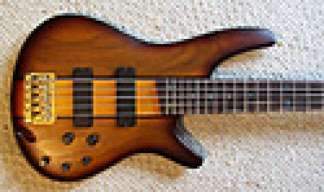
So, in the example above ('cello tuning, CGDA) I don't tune an A string up to D, I just use a D string!
 
I've since sold my five string, picked up a Reggie Hamilton, and then picked up a cheap used fretless Jazz. So I now have the RH and the fretless tuned CGDA and the original Jazz tune GDAE as an experiment. I really like the fifths tuning and I use it for everthing. The leaps to some intervals are a bit long but you get used to that and you sometimes just play things differently than you used to. The drop tuner on my RH will give me a low A if I need it, but I have never used it. Really the only way to tell if it works for you or a specific kind of music that you play is to try it. Some like it, some do not, and most have never tried it.

You can tune a cello any way you like but if you are picking up the cello to play cello music I doubt that you will be happy with EADG. Cello music often makes use of the range you get from the fifths tuning so the fourths tuning will put you at a disadvantage. Cello music flows very nicely on a bass tuned in fifths, as you would expect, but not as nicely on a bass tuned in fourths. Now if you are using the cello as an acoustic bass you might be happy with EADG and it looks like there are even strings made for that purpose that should fit a cello, if you don't find them too floppy when tuned to that octave on a 27 inch scale instrument.

Ken
 
I'm a bit late finding this thread since you've sold your fiver, but if you have thoughts of further experimentation I have an idea for you. I've been playing EADGC on a five and it's opened up a whole other world. I'm basically a four string EB player and I found the adjustment to be pretty easy to get used to. I got an Ibanez bass because it has a narrow neck and that helps a lot. You have the familar bottom four but then can also play chords and chord fragments on the upper strings while still hitting the root on the lower strings.

It's useful in small groups when the guitarist takes a solo and you can fill the hole in the rhythm section with chords. You can also work up songs where you can carry the majority of the rhythm track - great for fill in work at live gigs.
The first gig I took it on was a house party and after awhile the guitarist called it a night but the rest of us kept going. I was able to carry the load on a number of songs in a way that couldn't have happened on a four string (not by me, anyway).

The best thing is, that it's completely different from what most people are used to, so it gives me something relatively unique to be known for. So I'd encourage you to go with anything that sets you apart from the masses (as long as you can still do the basics on four when needed.)
 
I'm a bit late finding this thread since you've sold your fiver, but if you have thoughts of further experimentation I have an idea for you. I've been playing EADGC on a five and it's opened up a whole other world. I'm basically a four string EB player and I found the adjustment to be pretty easy to get used to. I got an Ibanez bass because it has a narrow neck and that helps a lot. You have the familar bottom four but then can also play chords and chord fragments on the upper strings while still hitting the root on the lower strings.

It's useful in small groups when the guitarist takes a solo and you can fill the hole in the rhythm section with chords. You can also work up songs where you can carry the majority of the rhythm track - great for fill in work at live gigs.
The first gig I took it on was a house party and after awhile the guitarist called it a night but the rest of us kept going. I was able to carry the load on a number of songs in a way that couldn't have happened on a four string (not by me, anyway).

The best thing is, that it's completely different from what most people are used to, so it gives me something relatively unique to be known for. So I'd encourage you to go with anything that sets you apart from the masses (as long as you can still do the basics on four when needed.)

A 4-string tuned E1 B1 F#2 C#3 would give one the same range as a 5-string tuned E1 A1 D2 G2 C3. If I were to tune in fourths, I would definitely go with EADGC on a 5-string, but fifths tuning is just too appealing to me now. Plus, I find it a "bonus" to have only 4 strings to mute rather than 5...that could change in the future.
 
I think my biggest problem with the Ibanez fiver I bought was that even though extensive in store trials had convinced me that I wanted its narrow string spacing, once I had it at home that started to seem unnatural and kept getting worse. If I were ever to try a fiver again I would go with a wide one, and probably tune it CGDAE! I am not sure how well I can learn to chord but I do find that the higher voice of the GDAE bass works better for that, IMO.

I am giving some consideration to a six string in fact because my church is currently hurting for guitarists more than bassists. As a result I am thinking about trying a bass VI or baritone guitar. I'd play either one with a pick and I think that would solve the string spacing problem my right hand had with my SR505 (which is a splendid bass if you like the string spacing, BTW). If I do give either one a try I would keep it tuned in fourths plus one third like a normal guitar because having the ability to use standard guitar chords is the whole point of the thing. I'd want to be able to switch from playing the bass part to the guitar part on the fly as mentioned above. Of course I have never been able to learn to chord well on a standard guitar in the past so there is no reason to believe I could do it this time either unless the longer scale length suits me better....

Ken
 
Well, CGDA is kinda inconvenient for basslines which include a lot of quick leaps between thirds. I have no idea if DFA1979 or Om do that a lot, all I know is somebody once took an Om album cover and Photoshopped it to say OM NOM NOM. That's not very helpful, is it?

Not very helpful to the situation at hand, but definitely something I will google and laugh maniacally at, so there's that.
 
I use 'cello tuning and have absolutely no problems, but it's more than likely b/c I've been playing the 'cello for years.

Because my church needed a bass player, I went from playing 'cello on one Sunday, to playing bass the next Sunday with absolutely rehearsals or time to get used to "standard" bass tuning. I tried it, but it was actually harder for me to play bass tuned EADG b/c I'm so acclimated to CGDA's placement of notes and patterns.

As for relying a lot on open strings with 'cello tuning - I don't. Don't know why, but on the 'cello I avoid open strings and I still do with the bass. I spend a lot of my time more in 2nd and 3rd positions and tend to only drop to 1st when I'm going to play anything F# and lower.

Is it difficult for me playing different genres? Not at all. Within Christian music I've played traditional, gospel, latino, rock, and country to name a few, but haven't experienced any particular difficulties within them. But again, I attribute it to the fact that I've played 'cello for so long that I instinctively know where notes are and can quite easily mimic what I hear.

To account for down-tuned E string floppiness, I use Ernie Ball slinkies, where the E is .110, and had my truss adjusted accordingly - so everything is peachy for ME.

So, I don't know if this post is of any help to you, but I just wanted to chime in to tell of my experience with my 'cello tuning.
 
  • Like
Reactions: Rayjay