Just for the sake of it...can anyone list some of the major tonewoods and the general sound they produce. Just something simple light "bright" or "dark but sometimes muddy" etc.

Enjoy the benefits of a premium membership!
Upgrade Account
-
TalkBass has been independent since 1998. Add your voice.
Create a free account to reply to discussions, view embedded media, and browse with fewer display ads.
Join free Log in
Want zero display ads or expanded classifieds tools? Compare plans.
You are using an out of date browser. It may not display this or other websites correctly.
You should upgrade or use an alternative browser.
You should upgrade or use an alternative browser.
The different tonewoods and their sounds
- Thread starter LotusCarsLtd52
- Start date
More options
Who Replied?(sits back and waits for the scientific, engineer types to chime in with "wood doesn't make any difference. If you can't measure the difference on a meter or see it on a scope, then there is no difference between plastic, particle board, plywood, recycled pallets and Ash) 


(sits back and waits for the scientific, engineer types to chime in with "wood doesn't make any difference. If you can't measure the difference on a meter or see it on a scope, then there is no difference between plastic, particle board, plywood, recycled pallets and Ash)
 The anti-wood police.
Speaking as an engineer, I am quite sure that you CAN measure the differences between woods, IF you know what to measure. I am confident that 3D waterfall displays of sound from sample basses made from different woods under controlled conditions would clearly show the variations caused by the woods.

Balsa wood is a lighter wood & makes better model planes than Bubinga- or so I've heard! ;-) Sorry - couldn't resist!

Hit the Luthiers Corner section and search "Tone Wars". See how much of it you can stomach. 
FWIW I do believe wood species plays a definite role in the tone of an instrument, and my ears prefer alder or mahogany as a body wood, and a maple neck with a maple fingerboard.
Oh, yeah: IMHO & IME
FWIW I do believe wood species plays a definite role in the tone of an instrument, and my ears prefer alder or mahogany as a body wood, and a maple neck with a maple fingerboard.
Oh, yeah: IMHO & IME

Contrary to many players, I choose woods based on their aroma. There's just something about the smell of afzelia burl in the morning that puts a smile on my face. Some might wonder if I can identify the smell of different woods during double-blind testing. To be honest, I'm not sure. Shall we try?
M. M.
M. M.
Contrary to many players, I choose woods based on their aroma. There's just something about the smell of afzelia burl in the morning that puts a smile on my face. Some might wonder if I can identify the smell of different woods during double-blind testing. To be honest, I'm not sure. Shall we try?
M. M.
Can you post some sniff samples so we can all try it?

i think the neck joint and quality of the pickups are what defines the tone of a solidbody. to a lesser degree i think wood density matters, though i cured the wussy sound of my p lyte (basswood body) with some overwound pickups. i've had a lot of conceptions about wood totally shaken when i recorded every bass i owned. got a couple basses made by the same place with different body shapes, different fb woods, different string count, different bridges, and same pickups. completely different sounds when unplugged, but they sound identical on tape.
i think wood is way important in hollowbodies, but maybe doesn't carry quite as much importance in solidbodies.
i think wood is way important in hollowbodies, but maybe doesn't carry quite as much importance in solidbodies.

I've always thought the wood that matters the most is the neck wood. When I pluck a note and then put my ear on the neck and then pluck another and hold my ear on the bass's body, the neck always seems to resonate louder and more clearly. So let's get this tread rolling, I guess.

Opinions and debating aside. This is a list of wood and tone descriptions from the Warwick manual:
Afzelia (Afzelia pachyloba, bipindensis, or africana):
Afzelia is a non-endangered African hardwood that is incredibly dense. Although it is a bit heavier than other woods, it makes for a very punchy low end and very transient highs.
Models: Steamer Stage II, Dolphin SN™ TCS™
Bubinga (Guibourtia demeusei, pellegriniana, or tessmannii):
Bubinga is found in Equatorial Africa from southeast Nigeria, through Cameroon and Gabon, to the Congo region. It is a hardwood that is very lustrous and can be highly figured. Acoustically, bubinga is a very resonant wood that offers very clear lows and well-defined upper mids and highs.
Models: Corvette Standard, Thumb Neck-Through
Ovangkol (Guiboourtia ehie):
Found in most of the same regions of Africa as bubinga, ovangkol is slightly heavier than bubinga yet still offers the same excellent acoustic properties. Its color is dark brown with deep yellow and black stripes. The grain is sometimes very nicely figured with 3D, wavy effects. It also makes a wonderful neck wood.
Models: Thumb Bolt-on, Dolphin Pro I, Infinity
Maple/Flamed Maple (Acer, various):
Maple has been used as a body wood for electric basses for many years. It can be found in several regions of the world, with each region producing a different quality of wood. Warwick takes great care in selecting only the finest maple, to ensure the great resonance and clarity that people demand from our basses.
Models: Corvette ProLine, Fortress One, Fortress Masterman, Streamer LX, Streamer Pro M, Streamer Stage I
Ash/Swamp Ash (Fraxinus, various):
Like maple, ash is a tried-and-true body wood, found in several areas of the world. Ash is the lightest body wood that Warwick currently uses beside Carolena. Acoustically, it has wonderful mid-frequency response and a very warm low end.
Models: Fortress Flashback, Corvette Std., FNA, FNA Jazzman, Streamer Jazzman
Wenge (Millettia Laurentii):
Warwick pioneered the use of wenge as a neck and fingerboard wood. It is very strong, stable and dense. A wenge or ovangkol neck with a wenge fingerboard is a prime ingredient in the “Warwick sound”. Wenge is a dark brown wood with blackish streaks. It sometimes has a bleached appearance. It is open to medium grained, hard, dense, and heavy.
Mahogani (Meliaceae):
Mahogani is a red and brown hard wood, it has been used for a long time in the guitar manufacturing as a body wood. It can be found in West Africa. Mahogani is acoustically a deep, warm sounding wood with harmonical high frequencies.
Zebrano
Zebrano is found in wide areas of Africa and is non endangered hardwood. Its color is dark with yellowish, light stripes. Its sound is very powerful with a full low end, while the highs are clear and bright.
Model: Buzzard Ltd, Infinity SN™ TCS™
Afzelia (Afzelia pachyloba, bipindensis, or africana):
Afzelia is a non-endangered African hardwood that is incredibly dense. Although it is a bit heavier than other woods, it makes for a very punchy low end and very transient highs.
Models: Steamer Stage II, Dolphin SN™ TCS™
Bubinga (Guibourtia demeusei, pellegriniana, or tessmannii):
Bubinga is found in Equatorial Africa from southeast Nigeria, through Cameroon and Gabon, to the Congo region. It is a hardwood that is very lustrous and can be highly figured. Acoustically, bubinga is a very resonant wood that offers very clear lows and well-defined upper mids and highs.
Models: Corvette Standard, Thumb Neck-Through
Ovangkol (Guiboourtia ehie):
Found in most of the same regions of Africa as bubinga, ovangkol is slightly heavier than bubinga yet still offers the same excellent acoustic properties. Its color is dark brown with deep yellow and black stripes. The grain is sometimes very nicely figured with 3D, wavy effects. It also makes a wonderful neck wood.
Models: Thumb Bolt-on, Dolphin Pro I, Infinity
Maple/Flamed Maple (Acer, various):
Maple has been used as a body wood for electric basses for many years. It can be found in several regions of the world, with each region producing a different quality of wood. Warwick takes great care in selecting only the finest maple, to ensure the great resonance and clarity that people demand from our basses.
Models: Corvette ProLine, Fortress One, Fortress Masterman, Streamer LX, Streamer Pro M, Streamer Stage I
Ash/Swamp Ash (Fraxinus, various):
Like maple, ash is a tried-and-true body wood, found in several areas of the world. Ash is the lightest body wood that Warwick currently uses beside Carolena. Acoustically, it has wonderful mid-frequency response and a very warm low end.
Models: Fortress Flashback, Corvette Std., FNA, FNA Jazzman, Streamer Jazzman
Wenge (Millettia Laurentii):
Warwick pioneered the use of wenge as a neck and fingerboard wood. It is very strong, stable and dense. A wenge or ovangkol neck with a wenge fingerboard is a prime ingredient in the “Warwick sound”. Wenge is a dark brown wood with blackish streaks. It sometimes has a bleached appearance. It is open to medium grained, hard, dense, and heavy.
Mahogani (Meliaceae):
Mahogani is a red and brown hard wood, it has been used for a long time in the guitar manufacturing as a body wood. It can be found in West Africa. Mahogani is acoustically a deep, warm sounding wood with harmonical high frequencies.
Zebrano
Zebrano is found in wide areas of Africa and is non endangered hardwood. Its color is dark with yellowish, light stripes. Its sound is very powerful with a full low end, while the highs are clear and bright.
Model: Buzzard Ltd, Infinity SN™ TCS™
Over in Bicycle World, the framebuilders have a mantra: It ain't the material, it's the execution. Contrary to public opinion, a skilled frambuilder can build a bicycle frame out of carbon fiber that will ride indistinguishably from steel or titanium...they just have to want to make that their goal. And since no smart skilled rational framebuilder in their right mind would want to build a titanium bike that rode like carbon fiber if it was easier, cheaper, and more efficient to simply build it out of carbon fiber, it's sort of a moot point.
And so I suspect it is with tonewoods. I would bet if you asked a skilled luthier like Mike Tobias or Vinnie Fodera to make a bass that sounded "bright, snappy, punchy" (whatever) he could make it out of mahogany or maple or alder or ash or burled sasafras and you'd always get a bright snappy punchy bass...that killed.
And so I suspect it is with tonewoods. I would bet if you asked a skilled luthier like Mike Tobias or Vinnie Fodera to make a bass that sounded "bright, snappy, punchy" (whatever) he could make it out of mahogany or maple or alder or ash or burled sasafras and you'd always get a bright snappy punchy bass...that killed.
Over in Bicycle World, the framebuilders have a mantra: It ain't the material, it's the execution. Contrary to public opinion, a skilled frambuilder can build a bicycle frame out of carbon fiber that will ride indistinguishably from steel or titanium...they just have to want to make that their goal. And since no smart skilled rational framebuilder in their right mind would want to build a titanium bike that rode like carbon fiber if it was easier, cheaper, and more efficient to simply build it out of carbon fiber, it's sort of a moot point.
And so I suspect it is with tonewoods. I would bet if you asked a skilled luthier like Mike Tobias or Vinnie Fodera to make a bass that sounded "bright, snappy, punchy" (whatever) he could make it out of mahogany or maple or alder or ash or burled sasafras and you'd always get a bright snappy punchy bass...that killed.
I think part of that is because they know how to pick a good piece of wood. The quality of the wood (also how well it was aged) has as much to do with it as the type. Some wood is just dead, no matter what you do with it, and then other good quality wood will be very resonant. Try taking a standard MIM body off of a Fender and replacing it with a Warmoth. There is an obvious difference.

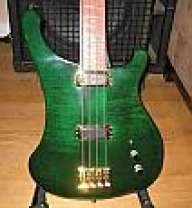
Wood does effect your tone. The proof is the fact that two of the same model of guitar can sound very different. However, that same example is a perfect reason not to shop for an instrument based on body wood-- but to use it as a guideline. Woods have a general tonal range, not a defined tone.
However, hardware plays a huge role as well. I noticed on my Squier one of the tuners would rattle. If I held the tuner, it would stop. That rattle was soaking up the higher frequencies and, thus, robbing some life out of the tone. Solid hardware goes a long way.
However, hardware plays a huge role as well. I noticed on my Squier one of the tuners would rattle. If I held the tuner, it would stop. That rattle was soaking up the higher frequencies and, thus, robbing some life out of the tone. Solid hardware goes a long way.
Carl Thompson's opinion may be relevant here (he is a jazz bassist as well as luthier):
Invalid Link Removed
Money quote: . I can tell what is going to change the sound of a bass real quick though.
Aaron: Practice?
Carl: "Player will change the sound more than [...] finishes and wood. Change the scale length and you'll really know the difference. If a guy comes in with a piece, a bass like this and it's made out of Mahogany or it's made out of Walnut or Cherry or Swamp Ash or any of those things that they talk about all the time. And somebody comes in with the same bass made out of a totally different wood. I'll bet if people couldn't see it they wouldn't know."
Also: "I like playing the Danelectro basses. I think they are great. I get a good sound out of a Dano-I really do."
Invalid Link Removed
Money quote: . I can tell what is going to change the sound of a bass real quick though.
Aaron: Practice?
Carl: "Player will change the sound more than [...] finishes and wood. Change the scale length and you'll really know the difference. If a guy comes in with a piece, a bass like this and it's made out of Mahogany or it's made out of Walnut or Cherry or Swamp Ash or any of those things that they talk about all the time. And somebody comes in with the same bass made out of a totally different wood. I'll bet if people couldn't see it they wouldn't know."
Also: "I like playing the Danelectro basses. I think they are great. I get a good sound out of a Dano-I really do."
Over in Bicycle World, the framebuilders have a mantra: It ain't the material, it's the execution. Contrary to public opinion, a skilled frambuilder can build a bicycle frame out of carbon fiber that will ride indistinguishably from steel or titanium...they just have to want to make that their goal. And since no smart skilled rational framebuilder in their right mind would want to build a titanium bike that rode like carbon fiber if it was easier, cheaper, and more efficient to simply build it out of carbon fiber, it's sort of a moot point.
Hmm, and there was me thinking carbon was lighter than steel frames

Talking of which, weight and balance is a worthy consideration when it come to choosing woods. When I was buying my Thumb BO I tried out other Warwick to check various options. The shop didn't have a 5 string Thumb in stock only a 4, so knowing their necks were all the same at the time, I tried a 5 string Streamer LX (which would have been my other choice if I didn't like the Thumb). Anyway I digress. The body material of the Streamer was so light, it just didn't balance with the neck at all. If you think a Thumb is bad for neck dive, the Streamer was awful. Headstock nearly hit the floor when on a strap!
So many different ways to go with this... but this is a family style forum, so I refrain

