• TalkBass has been independent since 1998. Add your voice.
    Create a free account to reply to discussions, view embedded media, and browse with fewer display ads.
    Join freeLog in
    Want zero display ads or expanded classifieds tools? Compare plans.

Double Bass The effect of Bridge height

I've done a search and still have the following question:

What is the effect if a taller bridge on DB? I am assuming that the string height, neck angle, standover, string angle, etc. are all dialed in correctly for the specific bridge and bass.

I have a bridge that comes in at 5 3/4" between the A and D strings and the string height seems about right for my bass. I have heard of work being done to reset neck angle and heighten the bridge to get it closer to 6 1/2 to 7" tall, but I don't know what the specific result is from having this work done.

My particular bass probably isn't worth this level of work, but I'm still curious. Thanks in advance for any insight.
 
Raising the bridge is one way of changing the angle at which the strings bend over the bridge (I've heard this called the breakover angle). The more acute that angle, the greater downward pressure the strings exert on the top of the bass (assuming equal tension on the strings).

You can visualize this by considering the two extremes - first, where the strings make a 180 degree bend over the bridge and pull it directly into the top; and second, where the strings are parallel to the top and touch the bridge but exert no downward pressure.

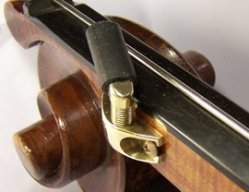
My bass has a raised saddle to reduce the breakover angle; it has a very thin top and the pressure was causing the top to sink and choking off the sound a bit. For basses with thicker or stiffer top plates, having an increased breakover angle (or using heavier strings) helps get the top plate moving. So it's not that one is better or worse, it's a complex optimization problem involving lots of factors.
 
Last edited:
  • Like
Reactions: Steven Ayres
So, as I understand it, the idea is to maximize the vibration of the top, and that might require an increase or decrease in string pressure depending on the strength, responsiveness, etc. of the top plate. Got it (I think). Thanks.

Below is an example of a raised saddle:

raised saddle.jpg
 
  • Like
Reactions: jleguy
Today, I heard an interesting tidbit in a short interview between Jason Heath and Steve Swan (paraphrased):

With the advent of steel strings in the mid-20th century, German makers became worried about the potential damage to fragile top plates on their shop basses. Their response was to increase top thickness and decrease bridge height on shop basses to accommodate the higher downward pressure exerted by the steel strings; however, at the expense of tone and volume....at least that’s how I understood the conversation. It all makes perfect sense really.