• TalkBass has been independent since 1998. Add your voice.
    Create a free account to reply to discussions, view embedded media, and browse with fewer display ads.
    Join freeLog in
    Want zero display ads or expanded classifieds tools? Compare plans.

The Fretless Club (Part IV)

Would love to see more photos of the custom fretless. Nice.
...

Well it has changed body and strings in the mean time and I'm currently waiting for a new pickguard.
It's been an ongoing project for the last three years, evolving with every change. It used to be a 32" scale, then it went to 33" and now ended up being 34". When it's finished which will be in 2-3 weeks I'll post some photos.

The idea behing this bass started 3 years ago. At that time I already had a Peavey T-20FL but didn't have a T-40 and wanted to have a fretless bass with some of the more "weird" electronics of the T-40.

So I finished earlier than expected my work on the Orion FL project.
Here's a short history of the project.

I started off with a body and a fretted neck. At that time I didn't have the knowledge I now have and just bought a fretless neck which later on I found out was 20 fret long while the original fretted neck was a 24 one.

I also bought a complete set of three Warman pickup's, a J-pup which went to the bridge position, a P-pup in the middle and a Jazzbar humbucker that went to the neck posisition. The electronics were the biggest problem because I needed to combine these pups into some weird standard with T-40 mixture. This took a long time to figure out and in the mean time I got more experienced in customizing and found out I had made a 32 scale bass.
I decided to move the neck upward but couldn't get to a 34" scale and had to leave it at 33" which also wasn't to my liking. This was when the body was still a sunburst one with a self-made red tort pickguard. All hardware was gold and so should be the strings.

A few month ago I finally bought a new body with a 20 fret sized fretted neck. The neck went to another bass project (all black hardware P-style bass) but the new body would do as a base for the project.
Today I finished the hand-made yellow-gold pickguard. I also updated the electronics to a different scheme and only used the Warman jazzbar together with a DiMarzio P-pup getting a far better result.
More about that later on.
Here are some photos:

Body view
2020-03-08 15.19.19.jpg


Headstock view
2020-03-08 15.21.16.jpg

Yes this bass is called "Peavey Orion FL", in honor of my very first Peavey 20-FL bought back in 1985 and still with me. This headstock is made from a half paddle headstock so I needed to cut the peavey shape and do all the lining and lettering myself.

Here are the spec's:
Ash body
Mapple neck with rosewood fretboard and double trussrod, J-style 38 mm at the nut, super slim and super fast, 20 frets long.
Gold tuners and brass nut.
Gold high mass bridge with string through the body.
34" scale
Warman jazzbar humbucker at the neck
DiMarzio DP127BK dual rail P-pup
Dual stacked V/T controls, Serial/Parallel switch for the Warman, Phase switch for the DiMarzio, passive electronics, all gold controls and switches.
Optima 24k gold strings gauge .060-.080-.100-.125 due to the D-standard tuning I use.

All in all it has become a very unique bass, plays super fast with a great tonal range.
:)
 
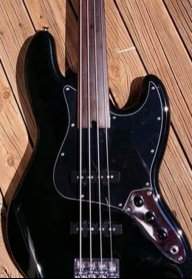
I picked this amazing fretless 1969 PBass at a local shop for a killer deal a few years back. Someone ground the frets off, leaving the fret tangs in place. It's the most resonant and musical bass I've ever heard. It's usually what I play on if I'm going to just grab a bass, but it really never leaves the house...

Oh and can I get a number please!

EEBDD2B8-36AC-4C1D-AF02-9A2336BCE138.jpeg
6079D0CB-27A4-49FC-91B1-82381ED434E9.jpeg
F4E2FD0F-2FF1-4758-AFEE-9170C3C14B97.jpeg
FF8313ED-4234-47AA-AD1A-8C62B6F0C7F8.jpeg
 

Attachments

  • D2A453C1-DE2B-419B-AD3F-0839CC73F7C2.jpeg
    D2A453C1-DE2B-419B-AD3F-0839CC73F7C2.jpeg
    261.3 KB · Views: 23
  • 6E50CEB6-741B-4D25-B0B3-517DB28759C2.jpeg
    6E50CEB6-741B-4D25-B0B3-517DB28759C2.jpeg
    343.1 KB · Views: 26
Last edited:
Hi MirandM,

Is there any reason for you not putting the ends of your strings into the hole in the machine head? I don't think it affects stability at all but it looks neater and avoids pricking your finger on the string ends.
Yes there is, I just cut them :smug:
I normally leave new strings on without cutting them for a few weeks, just in case I don't like them and need to change again. Right before I took the photo I cut the leftovers and left a small amount of string to be able to bend them into the post later on. I just didn't want to lose my tuning at that point, I know... lazy :D
On some tuning posts that don't have center holes I cut the string flush to the windings.
 
  • Like
Reactions: JRA and BAG
I normally leave new strings on without cutting them for a few weeks, just in case I don't like them and need to change again. Right before I took the photo I cut the leftovers and left a small amount of string to be able to bend them into the post later on. I

I thought there hard to be a decent reason. I can be a bit of a slob but uncut strings on a headstock just does something to me. :laugh:
 
  • Like
Reactions: MirandM
Thanks to a suggestion by michael_t over at the D Standard club, I'm trying GHS pressurewounds on my fretless MTD Kingston now. Bartolini singles and an Audere preamp too. Will report after the strings settle in.

My only immediate impression is that whereas I had to fight the Dunlop Super Bright nickels I had on to keep them from mwah, these are a bit more responsive on that score. They're not all mwah all the time.

That's one reason I use Pressurewound on my Zon fretless. Plenty of mwah when I want it, but not when I don't.
 
  • Like
Reactions: 4StringTheorist
Sounds great!

But, but, but..... it can't be any good without the right tonewoods!

Looked up the "hardness" on Aluminum. Hard to compare to wood because there is no "Janka" scale on Aluminum, but someone has done the comparison on the Brinell Hardness chart. Australian Buloke is the one of the hardest woods around and has a Janka of score of 3,760 lb, its BHN score is 11.48. Pure aluminum is 15 BHN and hardened AW-6060 aluminum is 75 BHN, Even mild aluminum would make a far harder fretless neck than most woods. I have a bass with a Panga Panga neck which is only 1,640 Janka. For reference, a favorite for fretless necks is Gaboon Ebony at 3,080.

I wonder if you had a AW-6060 Aluminum neck with round wounds could you get a good Mmmwah, or would it just zing like it was on frets?

Copper is 35 BHN and would make an awesome looking fretless neck and probably 4 times harder than Ebony.

Intersting
 
I can't help but think those screw heads will be even worse than fretlines the sprout. :oops:

And with aluminum and copper fingerboards, now you have to worry about oxidation. Three-D printed ceramics — that's where it's at. :D

I could live with the oxidation. Don't like the screws through the top of the fretboard. I think cutting on a CNC, it would be easy to cut a dovetail lengthwise and opposite on the neck. Slide on from the headstock side. One screw behind the nut keeps the neck in position.

3-d printed ceramics sounds durable and probably more organic sounding than metal.
 
Last edited:
  • Like
Reactions: Abner
What he said ^

I could live with the oxidation. Don't like the screws through the top of the fretboard. I think cutting on a CNBC, it would be easy to cut a dovetail lengthwise and opposite on the neck. Slide on from the headstock side. One screw behind the nut keeps the neck in position.

3-d printed ceramics sounds durable and probably more organic sounding than metal.

Nice ideas about mounting the fingerboard. But about the oxidation... have you seen an old copper roof? :o
 
  • Like
Reactions: ExaltBass
What he said ^


Nice ideas about mounting the fingerboard. But about the oxidation... have you seen an old copper roof? :oops:

I actually like the green oxidation. With the string wear under the strings and the green oxidation between, it would look incredible on a relic-ed bass. Think P bass with a grey primer, black undercoat and a seafoam top coat then relic-ed so that you could see through in wear spots and the oxidated neck. Yummy! (of course it would have to be 5 string for me. :)

The high temper aluminum is harder and probably easier to machine. A machinist friend tells me that copper is not the easiest to machine. The aluminum is probably cheaper and for sure lighter than copper. Aluminum neck with black body would look pretty stunning too.
 
...Aluminum neck with black body would look pretty stunning too.
I have seen fretless basses with stainless-steel fingerboards - probably you have too.
I think they're interesting but I don't see it in my future.
What I would like to see - especially considering the scarcity of DiamondWood - is a carbon-fiber / epoxy fingerboard...
 
  • Like
Reactions: kirkdickinson

Latest posts