

Enjoy the benefits of a premium membership!
Upgrade Account
-
TalkBass has been independent since 1998. Add your voice.
Create a free account to reply to discussions, view embedded media, and browse with fewer display ads.
Join free Log in
Want zero display ads or expanded classifieds tools? Compare plans.
You are using an out of date browser. It may not display this or other websites correctly.
You should upgrade or use an alternative browser.
You should upgrade or use an alternative browser.
The future of Fretted Instruments?
- Thread starter Nasty Nate
- Start date
More options
Who Replied?
Interesting. Two interesting developments I've seen are fanned frets, made famous by Dingwall, and the Little Torzal Natural Twist. Some very cool technology out there.
Interesting. Two interesting developments I've seen are fanned frets, made famous by Dingwall, and the Little Torzal Natural Twist. Some very cool technology out there.
The natural twist still baffles me on how it works with strings that go in a straight line.
Also, Dingwall only licenses the Fanned Fret system.


....will we all be playing instrume... years i doubt we'll *all* be playing this.;)
So Leo, instead of calling his first instrument a "Precision Bass" should have called it a "Stringed Fretted Stick That May Be Somewhat in Tune For Limited Intrervals Along its Scale and Only For a Select Number of Popular Keys and For Certain Specific Sring Sets"? If nothing else - it would make for a wicked-tough decal change to turn a Squier into a Fender!
I cant believe I am the first to say this.
This is a good reason to go fretless.
I feel deprived when playing electric guitar or electric bass, because I can't adjust the thirds like I can on my E-cello. Yeah, even when you play with fretted guitarists and keyboardists, you can utilize a sharpening of leading tones, a flattening of major thirds, and a sharpening of minor thirds, to enhance the motion of a bass line. Even when it doesn't _match_ the equal tempered instruments, the ear can account for the difference.

can't slap a fretless
I know many have negated this already, but I am reminded of Esperanza Spalding's last BP mag spot, where she said she had been told this. Then she said Prince took her fretless and, "slapped the sh!t out of it!".

I just want to point out that the people saying it only works for one key didn't read the FAQ. It's not designed to be a Just intonation system, it's designed to more accurately represent the Equal temperament that straight frets cause problems with. They go over the physical and mechanical reasons that straight, logarithmically spaced frets don't accurately divide the board into equal temperament semitones. This is a system designed to better do the job that straight frets don't fully accomplish.
I'm not sure you read it correctly or completely. They make several different necks and you can easily see from the pictures that if one of them corrects the errors that straight fretted basses have with respect to the even tempered scale they cannot all do so. Their frets are too different. As they say in their FAQ or elsewhere ONE of their neck designs corrects your guitar to the even tempered scale. It is the one with the mildest looking fret bends as one might expect since straight frets do pretty well. The OTHERS go beyond that to favor some keys over others and they list the keys so I am not making this up or misreading anything. They claim it is a mild change that does not create wolf keys but that is in the ear of the listener. None of them go as far as just intonation in any key because that most definitely will create wolf keys.
Ken

This looks like a solution in search of a problem.
Astute observation.

I tried an acoustic guitar with these bent frets...interesting indeed! I much prefer the Novax fan-fret system...!
If everypone elses basses and guitars arent capable of true tuning upa dn down the neck, then we've all been listening to music done that way since the begining of fretted instruments way back when. Another of those "solutions" for nonexistent problem imo.l
If everypone elses basses and guitars arent capable of true tuning upa dn down the neck, then we've all been listening to music done that way since the begining of fretted instruments way back when. Another of those "solutions" for nonexistent problem imo.l
Well, true temperament is a problem in itself. Our brains have just become so acustomed to hearing the problems that they seem natural. Kind of like how picking up a Dingwall or Zonn just sounds wrong at first. The notes are just that hair off of what we expect to hear.
The only true way to get what we need would be to use a metal fretboard on a fretless bass & then learn how to play perfect tones.
Well, true temperament is a problem in itself. Our brains have just become so acustomed to hearing the problems that they seem natural. Kind of like how picking up a Dingwall or Zonn just sounds wrong at first. The notes are just that hair off of what we expect to hear.
The only true way to get what we need would be to use a metal fretboard on a fretless bass & then learn how to play perfect tones.
Theres also that phenomenon of how sometimes it sounds better when not absolutely in tune with another instrument. Back in old days we tuned by ear by referance pitch of tuning fork or pitch pipe. With each other via ref note supplied by keyboard player if had one or the bass or guitar player. Untill mfairly recent in human history. Tuning has ben by ear and as a result isnt quite the same as by electro tuner. Sometimes today when I compare tuning completely by electro tuner, to little shift at times from by ear from that. I'll find I like the by ear tweak better. When layeing oscillators for a voice on synth. Detuning one or more in ref to another by a few cents can fatten up sound or otherwise make it thicker or more organic.
In the end, this new fangled fretting design just means a user is gonna have tuning problems with others in band who dont have the same fretting system on their bass or guitar methinks. Is silly invention imo. Maybe ok for use in some sci fi movie dipicting an alien bands guitars and basses though. Lol.
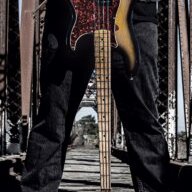
Well, true temperament is a problem in itself. Our brains have just become so acustomed to hearing the problems that they seem natural. Kind of like how picking up a Dingwall or Zonn just sounds wrong at first. The notes are just that hair off of what we expect to hear.
The only true way to get what we need would be to use a metal fretboard on a fretless bass & then learn how to play perfect tones.
There's no "wrong" sounding notes on any Dingwall or Zon I've ever played. The frets may be "angled" on a Dingwall, but they're still "straight".
So Leo, instead of calling his first instrument a "Precision Bass" should have called it a "Stringed Fretted Stick That May Be Somewhat in Tune For Limited Intrervals Along its Scale and Only For a Select Number of Popular Keys and For Certain Specific Sring Sets"?
I like it! Nail on the head.


