• TalkBass has been independent since 1998. Add your voice.
    Create a free account to reply to discussions, view embedded media, and browse with fewer display ads.
    Join freeLog in
    Want zero display ads or expanded classifieds tools? Compare plans.

Double Bass The last word on Blisters?

I realize that this method is contrary to what has been mentioned -
I recently had a blister develop (due to action-raising and/or possible laziness!) and here is my method:
ASAP - puncture the blister with a (sterilized) pin; completely drain the fluid; then wrap with medical tape/bandaids to force the blistered skin back on to the underlying skin. This must be done ASAP! This should be wrapped tight enough to encourage the 2 layers to re-bond.
The thought here is to NOT remove or lose that outer layer of skin, which has been toughened-up, and should not be removed, as the underlying skin is "virgin" skin, and is not as tough as the outer layer.
If you can get the 2 layers to re-bond, you have a better chance of re-building strength in that outer layer (callous?) that should eventually be impervious (mostly!) to re-blistering, under normal conditions.
ALSO - I would not recommend "resting up" or not touching the bass for a 2 week period, but rather, keep playing/practicing (daily?) to maintain whatever callous is there already.
My $0.03.
Good Luck to you.
Thanks.
 
Last edited:
"Resting up" was a poorly used phrase. I wasn't taking a break; life just grabbed all my time for a brief period. I don't know what's happening here. This has happened before when I was playing regularly both at home and on gigs. I'm certain that I'm not overdoing the physical effort, and the sound is plenty loud, according to others on stage and in the audience. I'm just at a loss as to why this continues to happen when I'm using a low-ish height to begin with.
 
  • Like
Reactions: Don Kasper
In my experience, the best practice is to play at least a little every day to keep calluses viable. My LH ones last longer than the right hand ones when I lay off, but after a certain point, blisters are sure to form if I haven't been playing regularly and keeping the calluses thick enough. EEMMV, of course.
 
My personal take is that blisters are a direct result of pulling too hard because you're compensating for volume. I used to get blisters even with calluses until I spent quality time working on my technique (both hands) to pull a bigger sound. I play mostly without an amp and I haven't had a meaningful blister in a few years now. You can pull that big sound without over playing the strings but you have to learn the specific dynamics of your own style and technique and adjust to your strings and your bass. You also have to have faith in your bass's ability to fill a room, even if it doesn't sound that loud to you. I've had the good fortune of having people record me playing (acoustically) in a room full of people and at the time, to me, the bass seemed like it was swallowed up by the crowd and other instruments but the recordings confirmed it was quite loud, more than holding it's own. YMMV, FWIW, etc.
 
  • Like
Reactions: lurk and AGCurry
I realize that this method is contrary to what has been mentioned -
I recently had a blister develop (due to action-raising and/or possible laziness!) and here is my method:
ASAP - puncture the blister with a (sterilized) pin; completely drain the fluid; then wrap with medical tape/bandaids to force the blistered skin back on to the underlying skin. This must be done ASAP!

This should be wrapped tight enough to encourage the 2 layers to re-bond. The thought here is to NOT remove or lose that outer layer of skin, which has been toughened-up, and should not be removed, as the underlying skin is "virgin" skin, and is not as tough as the outer layer.

If you can get the 2 layers to re-bond, you have a better chance of re-building strength in that outer layer (callous?) that should eventually be impervious (mostly!) to re-blistering, under normal conditions.

ALSO - I would not recommend "resting up" or not touching the bass for a 2 week period, but rather, keep playing/practicing (daily?) to maintain whatever callous is there already.
My $0.03.
Good Luck to you.
Thanks.
The method described is simply what your Doctor would do for you. It is sound. It is what you'd do on a hiking trip to get you by and make it to the end.

As far as making the two layer re-bond hypothesis, results can vary wildly from person-to-person or even repeated episodes on the same person.

Learn what you need to do to prevent them. Be very patient during active recovery.
 
Last edited:
  • Like
Reactions: Don Kasper
Was talking about playing the doghouse at a party a while back and there happened to be a dermatologist who was listening. I asked him what's the proper way to care for a blister since he's a pro.

Bottom line: Do not pop it!
I was simply adding my recent experience to balance the OP's original remarks.
Thank You.
 
  • Like
Reactions: Groove Doctor
To maintain the callouses in condition when being away from the instrument for too long it could be helpful to rub those against a hard surface (e.g. the edge of a wooden table) with light pressure a couple times every day (preferably being unseen while doing so ...). I did this the last time over a 2 weeks period and while they deformed a little bit otherwise were good enough to continue.
 
Hi, as i read i understand tha is a very personal individual matter, every body is different and every hand is different also the skin and the environnament and strings. About me i play gut strings and i try to play far from the tip of the finger, to have a good and poweful sound and this is my finger, i play with only one finger at 99% except superfast song. I never had troubles or pain and i play mostly acoustic (with drummers sax and so on). Years ago i remember when i was playng with the tip of the two fingers i had lot of troubles and weak sound. My suggestion is 'no pain more gain' if you overplay and you are using the tip of the fingers and you have steel strings and no amp... be careful all night long...
 

Attachments

  • image.jpeg
    image.jpeg
    62.7 KB · Views: 117
  • image.jpeg
    image.jpeg
    67.4 KB · Views: 120
You also have to have faith in your bass's ability to fill a room, even if it doesn't sound that loud to you. I've had the good fortune of having people record me playing (acoustically) in a room full of people and at the time, to me, the bass seemed like it was swallowed up by the crowd and other instruments but the recordings confirmed it was quite loud, more than holding it's own. YMMV, FWIW, etc.

I'm beginning to think that this may be part of my problem. I've been getting feedback about my sound from others on the stage/stand that suggests I'm much louder than I think I am from the playing position. IOW, I can dial it back some and be fine. I've been listening for the same things I heard when there was an amp behind me and that isn't possible, or at least not in the same way. I also spoke with a couple of local bassists (one of whom served as my teacher for some time) who looked and listened while I played. Bottom line from both of them is the volume out front isn't an issue, but I have to get used to hearing myself differently. That'll come with more time sans amp.

I was pretty angry when I posted a few days ago, and I exaggerated the situation. Yeah, I get some pain from time to time and I have blown my callouses out before, but not every gig. That was just me venting.
 
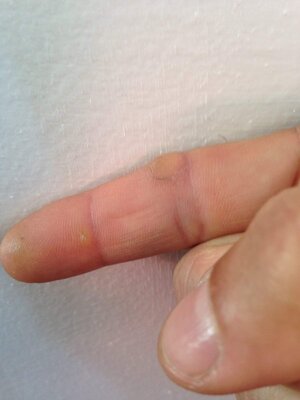
Update: Callouses have relocated themselves a bit due to me paying more attention to how I'm playing, and one has developed in a weird place, at the first joint wrinkle. See below:

20191113_045434.jpg


That started out as a bump, which was pretty painful for the first few days with Mitts and then it didn't hurt anymore, just got tough. Anybody else got a callous in a weird place?
 
  • Like
Reactions: Chris Fitzgerald
That started out as a bump, which was pretty painful for the first few days with Mitts and then it didn't hurt anymore, just got tough. Anybody else got a callous in a weird place?

I get calluses all along my index finger, including the places you have circled and the side of the middle joint. Assuming they are dry, I sand them lightly with a pedicure block to smooth them out from time to time so they don't try to rip off when really digging in (this actually happened once... :vomit:). I think it's a healthy way to keep useful calluses once you realize where your normal playing style puts them.
 
I get calluses all along my index finger, including the places you have circled and the side of the middle joint. Assuming they are dry, I sand them lightly with a pedicure block to smooth them out from time to time so they don't try to rip off when really digging in (this actually happened once... :vomit:). I think it's a healthy way to keep useful calluses once you realize where your normal playing style puts them.

I do all of the above, but I've had to sand the small one only once because that one came after a string change. That photo doesn't really do them justice- they're pretty thick.
 
  • Like
Reactions: Chris Fitzgerald