• TalkBass has been independent since 1998. Add your voice.
    Create a free account to reply to discussions, view embedded media, and browse with fewer display ads.
    Join freeLog in
    Want zero display ads or expanded classifieds tools? Compare plans.

The Most Versatile Bass? You'd Be Surprised

*snip*
For the working bassist in a contemporary setting, a "Fender" will work pretty much every time.*snip*

Versatile bass, what is that? Is versatile bass a bass that has a inherent sound that can fit in many situations? If this is the case, a P might be it, even though after criteria 1, it can't measure up to many/most competitiors.

I think there is a difference between sonically and musically versatile.

Musically, for me, it'll always be a P-bass. I've used for for everything. Its hard to get a bad sound of it.
*snip*

+1.

I personally prefer a passive P-Bass to a passive Jazz for the gigs that I play. IMO a passive P-Bass is a very versatile instrument, YMMV.

**snip**
If I were to make this statement based on hit songs recorded, then the P bass blows the J away, even considering all of Joe Osborne's stuff.

My $.01 (as it's surely been said before):

The Fender Precision. Its versatility lies in its ability to fit in with different styles and instrumentations without changing its own sound.

I love my current Jazz, it is the most comfortable bass I've personally owned - but my beat to **** old P is still the reliable go-to bass when I just need the sound to fit in without tweaking.

A J is a classic nice instrument with a couple good sounds. I'm more of a P bass guy myself.
I think at versatility more in terms of player's goal rather than instrument features. This doesn't mean that I'm unable to understand how a two humbucker equipped bass with many switches works but I think that, on an instrument, the step from versatility to useless is a small one.
Have you heard the kind of sounds that Chris Wood produces with his upright? Or with his P bass?
Creative mind making wonders on supposed one-trick pony... my kind of guy.

I find this bass to be the most versatile I have seen.
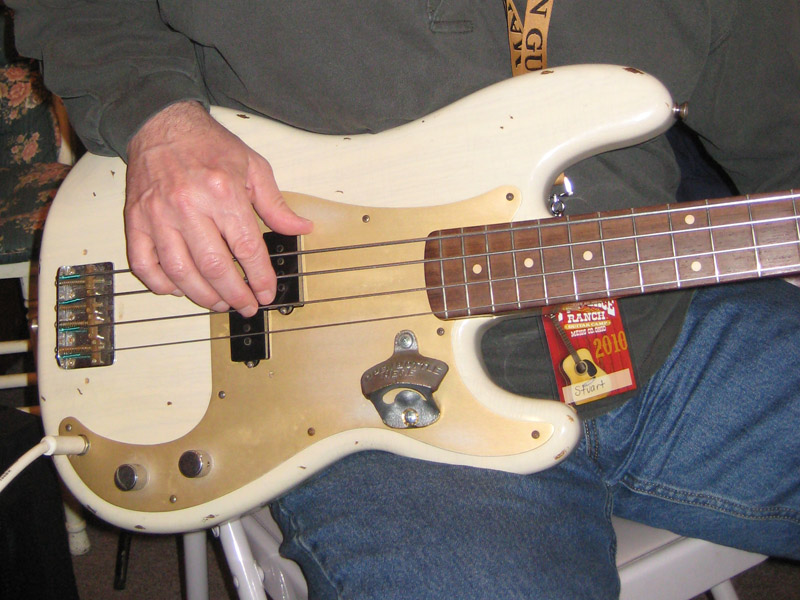
IMG_9048-2.jpg

I find a P bass can handle almost anything. **snip**


Are you sure?


yeah pretty sure from the looks of it....:)
 
G&L's huh? In the context of a band situation, can the audience really hear (or care) the difference between series or parallel or humbucking or single coil? I mean really?

I can hear the difference in my L-2000 Tribute. So to me that's all that matters.

I can also definitely hear the difference in recording situations. I'm fairly confident that in a live situation, though it might not be overtly and obviously evident, the subtle changes between series or parallel or (my favorite) single coil can be felt, perhaps more than noticed.

neck pup vs bridge pup is definitely a noticeable sound and passive/active/active with treble boost are also definitely noticeable.

+1 for G&L L-2000. Most versatile bass I've ever seen (not to say that it's the best...)
 
Bromosapian said:
Id argue it as being a wal, given the leagues between someone like justin chancellor or geddy lee and the sound that mcartney got out of it. Though I guess that can be chalked up to a difference in amps.

The same can be said about a Rick 4001, there is many tones in between Mcartney and Squire. And the 4003 have even more with the modern/ vintage push- pull.
There are many basses which can cover lots of ground., even a p- bass with it's single passive pup.
 
DV016_Jpg_Large_513471.010_natural.jpg


Hmm...3-way coil tap switches (humbucker, single coil, and series/parallel mode) along with tone and volume knobs. Well, looks like the ol' jazz has been bested :D


I kid, but "the most versatile"? I think part of that is up to the bassist himself. Understanding your instrument's guts and all the variables that go into your final sound (setup, strings, right-hand technique, pedals, amp, speakers). But if we're going for something passive-style simple, all the $$ has is the ability to switch how the pickups act, which gives you 3x the options that the regular jazz bass has....

plus the $$ looks cooler :hiding:
 
Probably already been covered but IMO after 30 years playing a buncha different genres, to me (and I acknowledge that other people's needs/wants will be different to mine) it's more having a sound that can fit many different situations rather than having a buttload of sounds available.

You just know I'm gonna say "Precision", dontcha?

The only thing it doesn't do for me is the slap thing; yeah I know that a bunch of different guys slap on their P's. It just never seems to work for me.
 
It's a good thing you said jazz, otherwise I would've had to disagree with the self-proclaimed arbiter of versatility. In more general terms, it's bound to be a 2-pickup bass.
I agree and then I don't. Yeah, you can get more choices with a 2 pickup bass, and I'd be lying if I said I didn't add J pickups to my P's just for that purpose, but nowadays I find myself leaving just the P pickup on 90% of the time and it works just as well for everything I do or want to do.

BTW, I find versatility in a bass' pickup config highly overrated. I've experimented with all that stuff. Ended up putting everything all in the normal position, so I got rid of all the switches and stuff I don't need. YMMV, but I can do without it.
 
Sonically Basses with filter based preamps such Alembic, Wal and ACG will offer the most potential variation in tone but it doen't mean that they're all musically useable.
As for more traditional active basses, G&L L2000's and Lakland 44-94's are brilliant in their flexibility.

Since every genre of music has been recorded and shaped by the sound of the trusty P and J bass, they intrinsically will fit into any style regardless of their technical limitations.
 
G&L's huh? In the context of a band situation, can the audience really hear (or care) the difference between series or parallel or humbucking or single coil? I mean really?

I primarily used a G&L Tribute L-2500 for all but a handful of my bass gigs (prior to trading it; moving down to 4 strings) and can honestly say that the series/parallel and passive/active/treble boost switches were godsends. The difference in tone may have been negligible in clean fingerstyle situations, but the effect of the settings on my distortion and envelope filters is extremely noticeable. For someone who needs a bunch of textures, the onboard electronics are often the difference between being heard properly and not at all.

FWIW, I'm using an OLP MM clone with a Basslines humbucker and have been doing fine. Its natural EQ jives very well with the rest of my rig, my technique, and my desired tone. I could use a series/parallel switch to tweak my filter response, but it's not terribly essential.
 

Latest posts