• TalkBass has been independent since 1998. Add your voice.
    Create a free account to reply to discussions, view embedded media, and browse with fewer display ads.
    Join freeLog in
    Want zero display ads or expanded classifieds tools? Compare plans.

The Most Versatile Bass? You'd Be Surprised

G&L's huh? In the context of a band situation, can the audience really hear (or care) the difference between series or parallel or humbucking or single coil? I mean really?

I catch your meaning. Will it make the audience enjoy the set any more or less if the bass has just the sonic difference you get from switching from parallel to series? No, probably not.

But something is to be said about the bassist's enjoyment of the set and the sound he's got. I played in two bands with my G&Ls, and for band A's gig, the sound was series and all bridge pickup and for band B it was parallel with some bridge and some neck. It made a huge difference to me and the sound/dynamics coming from my Ampegs behind me, and I think that was pretty important in how I played. In the end .. the audience probably didn't care about that either, but I digress.
 
. I just prefer the tone and truthfully, how often do you want the bridge-solo tone on a gig?

I understand what you're saying Harry, but I use the bridge P/up soloed (tone rolled all the way off) all the time on small-combo jazz gigs. It's a great sound for playing straight-up jazz and bebop in that setting: I agree with you though and find that it's just not sonically appropriate for most other styles...(well in a live setting).

I think the jazz is unbeatable with both pickups on full for certain styles such as soul and R&B. That sound has so much 'authority'. You get that big round sound with a hint of growl on top.

...great discussion
 
I find this bass to be the most versatile I have seen.

IMG_9048-2.jpg
 
Funk 'N' Stein said:
I understand what you're saying Harry, but I use the bridge P/up soloed (tone rolled all the way off) all the time on small-combo jazz gigs. It's a great sound for playing straight-up jazz and bebop in that setting: I agree with you though and find that it's just not sonically appropriate for most other styles...(well in a live setting).

I think the jazz is unbeatable with both pickups on full for certain styles such as soul and R&B. That sound has so much 'authority'. You get that big round sound with a hint of growl on top.

...great discussion

I agree with many here. No bass does everything well. I took my old Ibanez musician to rehearsal and played the whole time with a pick, which is unusual for me as I grow older. I had a blast and other band members were suprised but really liked it Yesterday I took my 83 Jazz and Fretless and didn't use a pick but worked better for some new original material. After my experience with the Ibanez two weeks ago I'm thinking of just taking my 77 Ric 4001 just to see if it's fun and can cover enough ground. They'll all be different, but each bring s it's own qualities and challenges to playing, but isn't that why we own more than one?
 
"I think the jazz is unbeatable with both pickups on full for certain styles such as soul and R&B. That sound has so much 'authority'. You get that big round sound with a hint of growl on top."

'I agree with you on this, a good J neck pickup can pull off a P bass close enough, add some EQ in the right frequency and you are good to go."

"Agreed. A good Jazz bass is all you need. Or a P with a J bridge pickup."

"SHHHH! don't spoil the dirty little secret us Jazz owners already know."

"Have you heard the kind of sounds that Chris Wood produces with his upright? Or with his P bass?"
Creative mind making wonders on supposed one-trick pony... my kind of guy.

__________________

"at the end of a day of playing one id rather have a jazz or a p-bass."

Just opinions , I know....

But it makes me feel good about having a Precision and a Jazz bass.
It's GOOD to play bass, whatever you like :D :bassist: :cool:
 
Well, if you do solo instrumental bass work, then a Jazz may sit in your closet for years and not be used.
Who cares.
For the working bassist in a contemporary setting, a "Fender" will work pretty much every time.

Agreed. Well, I'm not sure if they're versatile or not. But, a good P or a good J, work most of the time for me.

For me, if I want to change my sound, I change the strings.
 
For me, if I want to change my sound, I change the strings.
Strings are everything with bass.

It amazes me people aren't more aware of this.

That said, the passive J is a more electronically flawed design than the simpler P and doesn't do anything additionally that I think is particularly desirable, much less necessary.

"Versatility" is not a significant goal for traditional groove bass. Strings, technique, minimal effects and a good recording engineer supply all the variety you can possibly use before losing the the script entirely.

"Versatility" is a goal for "modern bass guitar."

I consider the latter a major wrong turn in music.

Most people on TB disagree.
 
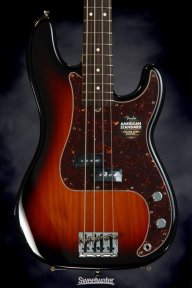
I find a P bass can handle almost anything.

But for versatility, I prefer an ATK750.

I have tried to like jazz basses, but I just don't. It seems you have to live with the hum in order to get the true jazz sound, and the hum makes me nuts. Shield it, and the tone seems to lose something. So you can have them all. I'm fine with P's, PJ's, and ATK's.
 
It can be argued why one bass would be more versatile than another and cite many valid reasons why... as the many threads like this illustrate.

So I would have to draw my conclusion from observation and it looks like the very basic P bass is the one most used in most genres of recorded music... sounds like it fits the requirements of a versatile bass to me.

You're surprised... aren't you?:p
 
"Versatility" is a goal for "modern bass guitar."

I consider the latter a major wrong turn in music.

Most people on TB disagree.

Well, it's always been a bass guitar, whether people called it that or not.

And I'm sure there's a lot of folks a generation or two before you that thought using an electric bass and things like multitrack recording were major wrong turns in music that were a minority compared to how your generation felt.
 
I think there is a difference between sonically and musically versatile.

Musically, for me, it'll always be a P-bass. I've used for for everything. Its hard to get a bad sound of it.

In terms of the most usable tones you can get out of something? My first thought, in terms of common place things, is a good active jazz bass. The realistic part of me who has played and owned far too many basses says an L2000. It does the Stingray, P-bass, and Jazz thing and so much more. Its just a little aggressive for my tastes where I currently don't own one.

As for not having a bass with a lot of knobs to that one poster, I know how to use those knobs. I personally prefer two or 3 knobs so I can dial in something quickly and then dial it back mid song. I also find the more knobs I have on a bass the more I tend to tweak the **** out of them.

+ many to all of this....

as for Knobphobia - 100% personal taste in my mind. Some people prefer to have the ability to tweak at will to alter tone to meet this situation. I prefer fewer 'on the fly' options as I prefer to maximize the tonal options within a set tonal framework. Like here is my 'base' tone - through the use of the vol and tone knobs and hand placement I find enough differences to be authentic enough. Another player might prefer 3 or 4 distintly switchable tones and use a more consistent attack and hand position.

I have certainly heard a pile of examples from each camp that worked great.

I can't think of a time I saw a 'pro' band and was struck with an example of the bassist hurting a song by failing to cop an appropriate tone. However I am sure we have all seen a band murder Diamonds on the Soles of Her Shoes because the bassist couldn't cop the feel and notes of the bassline.
 
It can be argued why one bass would be more versatile than another and cite many valid reasons why... as the many threads like this illustrate.

So I would have to draw my conclusion from observation and it looks like the very basic P bass is the one most used in most genres of recorded music... sounds like it fits the requirements of a versatile bass to me.

You're surprised... aren't you?:p

well no...that point about a P has been made 7 or 8 times prior to your post in this thread....

now if you had suggested that a keyboard bass is in fact the most versatile bass.....