• TalkBass has been independent since 1998. Add your voice.
    Create a free account to reply to discussions, view embedded media, and browse with fewer display ads.
    Join freeLog in
    Want zero display ads or expanded classifieds tools? Compare plans.

Double Bass The Radio Shack mic rebooted

Jay Corwin

Supporting Member
Jan 29, 2008
4,672
5,816
Sanborn, NY
www.facebook.com
I was a user of the famous "radio-shack" mic years ago when I played mostly low volume gigs. It worked great on my old Shen. A new bass, and mostly loud gigs for a handful of years forced me back into piezos only. These days I seem to be playing every kind of gig under the sun, so I decided to revisit the setup.

My old "radio-shack" mic had bitten the dust, so I took to ebay to find a replacement. I found one for 12 bucks and ordered it. What's to lose on 12 bucks and free shipping? I have a drawer full of much more expensive mics!

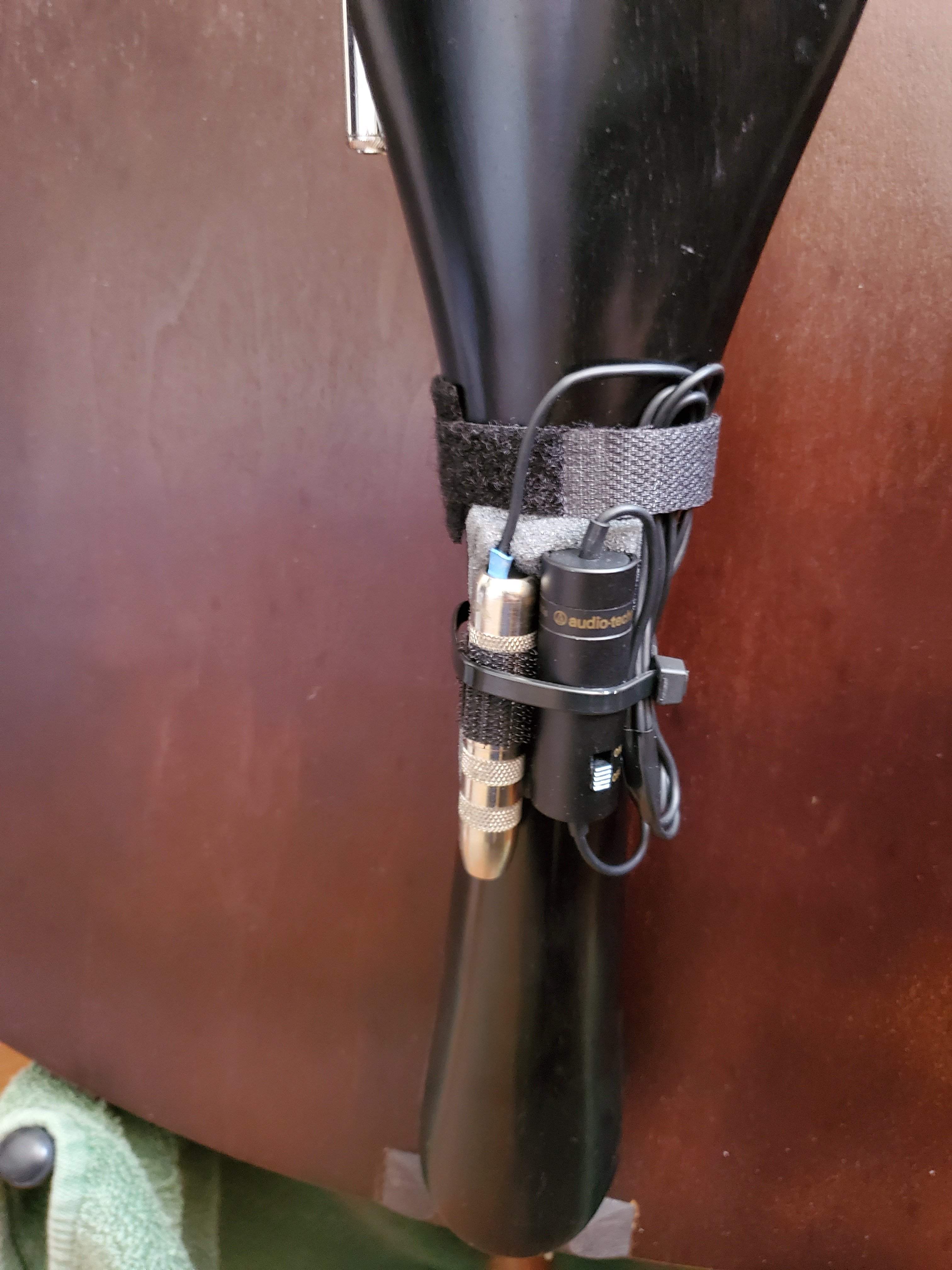
At some point Audio Technica must have started making these things for Radio Shack, because what I received was an ATR3350 in a RS box. Modified the 1/8" male (with super long chord) to a 1/4" female jack, mounted it all up, and tested it out.

It works fine straight into the amp. Nothing earth shattering, but better than a piezo with outstanding feedback rejection. Just like all of the old reviews of the RS mic. I'll be using this for my lower volume gigs. I'm sure it wont work well for my rock club or festival gigs.

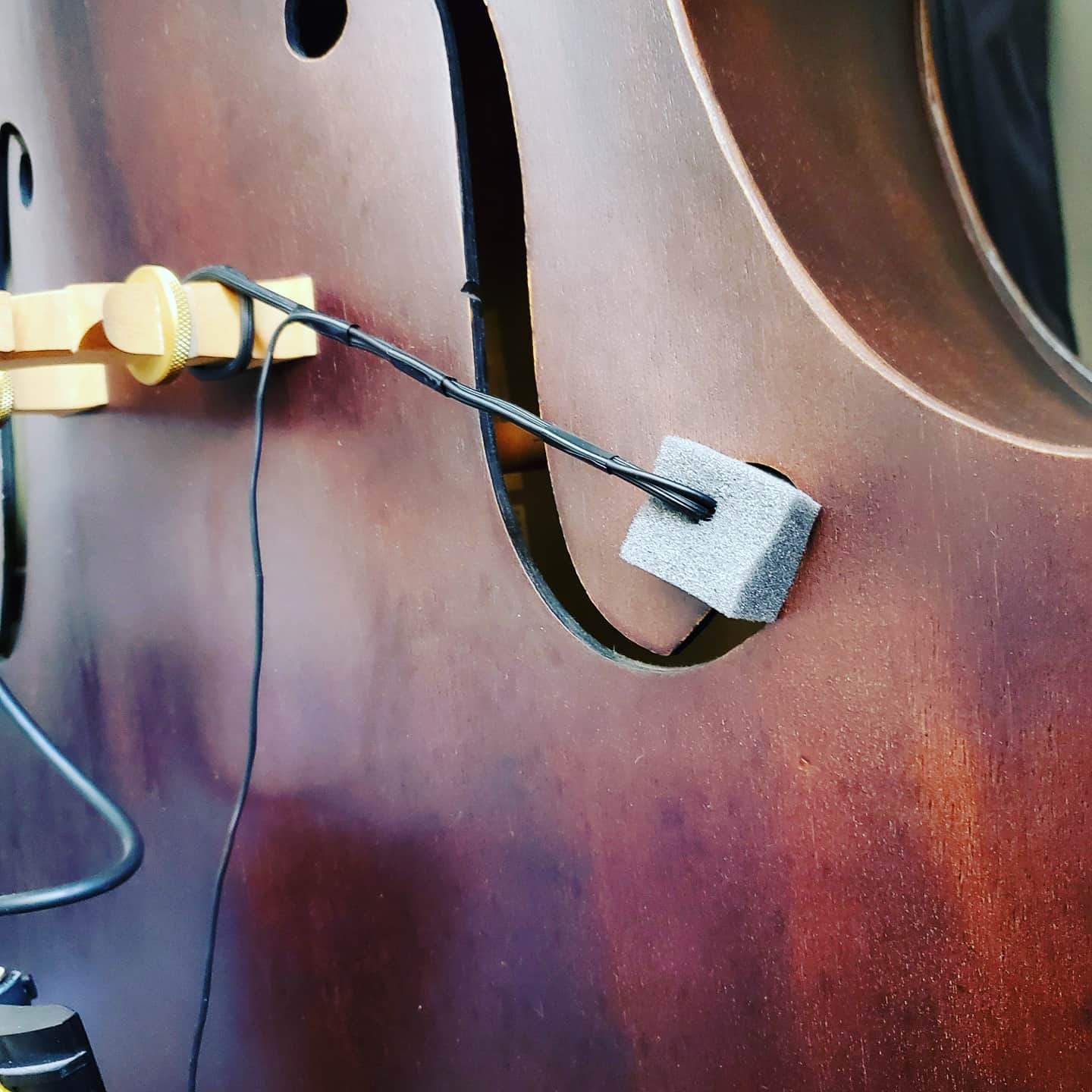
Here are a few pictures. Ask me anything!

Oh BTW, I still have my piezo mounted and ready to for action.
IMG_20200214_125337_919.jpg
IMG_20200214_125337_907.jpg
20200214_123228.jpg
IMG_20200214_125337_905.jpg
 
I used the Radio Shack mic for about 7 years. Never disappointed with it. No feedback and it always sounded like my bass. A few months ago mine bit the dust as well. I had a back up that I bought at the time I bought the first one. Somehow I managed to mess that one up when I was installing it. I decided to look for another option. After much research, I bought this Movo lavalier condenser mic from Amazon for about $30. It uses phantom power but I like that I don’t have to mess with batteries. It sounds awesome. More full and powerful than the RS. It seems a bit more sensitive to feedback than the RS but I was still able to play with the amp right behind me with no problems. I’ve only played one gig with it so far, so time will tell. I have a gig this coming a Tuesday. I’ll let you know how it goes.

093A5488-B214-469F-A3AB-D846553D629A.jpeg
1EBD223A-3228-4FBD-AD4D-E0E7F2DE028E.jpeg
 
I've got one of the old Radio Shack Realistic lapel mics sitting around somewhere, I've bumped into it occasionally and resisted tossing it out by "just in case". I guess these were one of the early micro condenser mics. Never thought of using it on my DB.

How do they sound? Do they need a pre or impedance transformation?
 
No preamp needed. They work fine straight in to a head. EQ to taste.

Now they sound good, not as good as ribbons or anything else you might use in recording. The advantage is feedback rejection, and ditching the horribleness of piezo. Certainly not a magic bullet, but a nice option for little money.

A lot of people are resistant to putting a mic in the f hole, but with this a Radio Shack mic, it’s really necessary to get good sound. It’s just not sensitive enough to pick up the bass sound anywhere else. However, the lack of sensitivity is also what makes the feedback rejection so good.
 
Last edited:
A lot of people are resistant to putting a mic in the f hole, but with this a Radio Shack mic, it’s really necessary to get good sound. It’s just not sensitive enough to pick up the bass sound anywhere else. However, the lack of sensitivity is also what makes the feedback rejection so good.
Agree on all points.
 
  • Like
Reactions: Don Hergert
On a whim, after reading the recommendation by Mandobass, I decided to try this cheap "Movo" lavalier mic on amazon. I mounted it up inside my bass' body last night and gave it a try. I still might do some more experimenting to do with placement of this thing, but I must say that I am blown away with how well this performs. In fact, I'll go so far as to say that this is the best mic system I've tried yet for doublebass. And I've owned about every mic system ever made for bass (including expensive ones like the Remic, Axlsson Chuck Israels, Ischell, DPA 4099, Ehrlund, and more that I can't remember). I mounted this inside the bass body with some extra tacky putty that came with my Ischell mic system, close to the soundpost, with the mic facing inside. It's amazing that I have no feedback, and it really does sound fantastic, v ery similar to my condenser mics. Since I had my luthier put a 45 degree endpin on my bass (ala Rabbath), I still have the original endpin hole, and I just routed the cable from the mic inside the bass body, secured to the bottom of the bass, so you can't even see the thing. It's pretty cool. I had it cranked loud in my practice room, but the real test is to see how it does on a gig. I'll report back after I gig with it.

I'd say that anyone looking for a mic system for their bass should check out one of these. For this to outperform the expensive mics that I've had, is pretty incredible. it does require 48 volts phantom power, so I just dug out my old Zoom A3 box to power it, and ran the signal into my Clarus, and Audiokinesis TC112. Sounds killer.
 
So I clipped my Audio Technica AT803 condenser lapel mic to the treble side F-hole, suspending the omni capsule inside and underneath the bass top side. Plugged straight into the Phil Jones FlightCase BG-150. Sounds really good! Then I routed the signal into a Noble dual-tube preamp and then into the PJB effects return. WOW! Sounds super nice!

The piece of cardboard protects the wood from the lapel mic's alligator clip. Hard to say if the clip will move from top side vibrations. The featherweight cable hangs down and loops around the tail piece.

Can't see a downside to this configuration. Yes, omni is prone to capture side bleed. But if the capsule is inside the bass, what's to bleed? The instrument is full of bass tone!

AT803 clipped inside bass - S.JPG
 
I've had some success using the Audio Technica ATR3350 on live gigs as well. It's the only microphone (and I've tried a few more expensive ones) that I can get any volume with through an amp. Curiously it doesn't seem to need an impedance matching adapter to get decent volume from it, and the adapter actually makes it more feedback prone and less natural sounding.

It really has to be right in the F hole surrounded with foam to work, just like the Radio Shack mic.

It is the best arco sound I've had on gigs through an amp, but like any microphone can be a bit boomy in some spaces, and may need some EQ or HPF. I will probably revisit blending it with the pickup again at some stage, but it also works pretty good on it's own.

The most annoying thing is the long cable, I'd be interested in any replacement or mounting solutions for it?
 

Attachments

  • IMG_3344.JPG
    IMG_3344.JPG
    648.8 KB · Views: 268
I've had some success using the Audio Technica ATR3350 on live gigs as well. It's the only microphone (and I've tried a few more expensive ones) that I can get any volume with through an amp. Curiously it doesn't seem to need an impedance matching adapter to get decent volume from it, and the adapter actually makes it more feedback prone and less natural sounding.

It really has to be right in the F hole surrounded with foam to work, just like the Radio Shack mic.

It is the best arco sound I've had on gigs through an amp, but like any microphone can be a bit boomy in some spaces, and may need some EQ or HPF. I will probably revisit blending it with the pickup again at some stage, but it also works pretty good on it's own.

The most annoying thing is the long cable, I'd be interested in any replacement or mounting solutions for it?

That was my only complaint about the microphone, when I owned one of the first ATM 35's. DPA had the same issue with the 4099B which they corrected with the 4099 Dvote by adding a detachable cable for the microphone. You could shorten the cable yourself it you're

handy with a soldering iron. Just a thought. I really think the boom is coming as a result of where you're placing the microphone. The foam surround is serving as a damper to prevent feedback, but it can also deaden the sound. Of course, in the end it's about what's best

for you. Just my take.
 
  • Like
Reactions: mittenwald
I recently got a new Rode Smartlav+. $74 on Amazon. It sounds great, with no feedback or bleed issues. It's a bit smoother and more hi-fi than the Movo. I mount it inside the bass, pretty close to the treble side F hole, using tacky putty. My bass has a Rabbath/Laborie style end pin, so it has two holes in the bottom. I just ran the little cable through the bottom hole, and you can't even see the mic or cable, and I plug my XLR cable into it at the bottom. Pretty elegant solution, I think. Haven't been able to gig with it, since there's no gigs available, but I'm really happy with my sound, running it into my Clarus, and either into an Ampeg SVT210AV, or my Audiokinesis TC112 cabinet. It's the best amplified tone I've been able to achieve yet.
 
Does the Rode Smartlav + needs phantom power or does it work alone (like the Radio Shack) ?

It's designed to be able to be plugged into iPad and iPhone so, probably not running +48v

My big question is what ARE y'all plugging your lapel mics into? They all seem to have mini aux connectors. So they are balanced outputs? Do you just just some kind of 1/16 - 1/4 adapter to go into a standard instrument input?

My Markbass head has an XLR input but that seems no use for a mic mounted inside your bass. Google doesn't seem to be able to reveal to me any lavaliers with XLR output except those that require phantom.

E: Invalid Link Removed
 
Last edited:
These small capsules (up to 1 cm) are electret condenser capsules.
They need a supply voltage of 1,5 to 10 volts for the FET that is (usually) built-in. There are two variations one with two wires, one with three, but both incompatible with phantom power. And both need a voltage source for powering the built-in FET.

On the two wire, the signal and supply voltage share the same wire, on the three wire they are separate.

You need an adaptor like an AKG B29L to make the mic compatible with phantom power. A simpler solution is possible too, but the capsule signal is unbalanced, so there needs to be a circuit to generate a balanced signal and a voltage regulator for the phantom power. Not too simple to build yourself.

BTW, larger electret capsules exist too and also electret capsules without a built-in FET (so the best one can be selected for higher quality sound). Dynamic capsules are generally larger than 1 cm diameter (typically 1.5 to 3 cm).
 
Yes, the Rode Smartlav+ does require what I believe to be 3-5 volts, which comes from the phantom power of my AI Clarus. Or if you want to go a cheaper route for phantom power, the Zoom A3 really works well. You do have to use the Rode VXLR+ to convert the voltage down to its correct power, as well as a TRRS to TRS adapter.

Here is a link to the Rode Smartlav+: RØDE Microphones - smartLav+ Lavalier microphone for smartphones

Here are the links to what I bought from Amazon for these two adapters:
https://www.amazon.com/gp/product/B071LNDKBJ/ref=ppx_yo_dt_b_asin_title_o00_s00?ie=UTF8&psc=1

https://www.amazon.com/gp/product/B07HF2WN8D/ref=ppx_yo_dt_b_asin_title_o01_s00?ie=UTF8&psc=1

All told, you can get all of this for around $100. It may seem like more pain than it's worth in getting adapters and phantom power all worked out, but to me it was definitely worth it, because I'm so happy with my tone. If you already have a mic pre (or amp) with phantom power, it's worth a try. Especially when you can return the mic and adapters if you don't like it.

Obviously, a lavalier mic was never designed to work as an instrument mic, but it really does work. I can get my tone, at a much higher volume than I need to for a gig, with no apparent bleed or feedback in the signal. I have tried about every mic there is for the upright bass (Remic, DPA4099, K+K, Ischell, Xlsson Chuck Israels, ATM350, Ehrlund, EV RE20, and more), and this is the first one that delivers the tone I want into my amp without feedback or bleed. The fact that it is getting all of this sound from within your instrument, and is shielded from other sound sources like drums and your bass speaker, just make it work.

Maybe some microphone maker will take this idea, and perfect it one of these days as a mic specially designed for double bass. For now, I'm a happy camper. Just getting impatient for the day that the gigs come back - LOL.
 
As an Amazon Associate, TalkBass may receive commissions from qualifying purchases made via links on this site.
Lavalier mics are designed to sit around the breast of a speaker. The low frequencies are much more prominent there than close to the mouth. So these mics are designed to reduce the bass frequency content and this works well for close micing a double bass because the bass frequencies close to the top of the bass are overrepresented as well.

At a distance if one to two meters to the bass top (or even more) they might sound a bit thin, but close to the instrument the bass weakness is what makes the instrument sound more natural (like to a listener at some distance).
 
Just for fun and because I am a bit bored here, I took my ATM 35, wrapped it in foam and put it in the top G side F hole. I put the bass rolloff on and wow - plenty of volume, no feedback and a great natural sound through the PJ Double Four (off the floor) and the Bose L1 Compact. Then I tried it in the E string side F hole, and while it had a little less output the tone was even more natural. My home experiments (especially with mics) never seem to work well on gigs though, but this might have some promise. It will probably be a long time before I can try it on a gig.
 
Can someone explain the exact connections you are using to connect both types?
1) battery powered type lav mic - is it just 1/4” adapter —-> amp?
2) phantom powered type - what exactly are the connections? Would a GB Shuttle 3.0 provide the power?
Thanks