• TalkBass has been independent since 1998. Add your voice.
    Create a free account to reply to discussions, view embedded media, and browse with fewer display ads.
    Join freeLog in
    Want zero display ads or expanded classifieds tools? Compare plans.

The real reason AI generated content is no threat

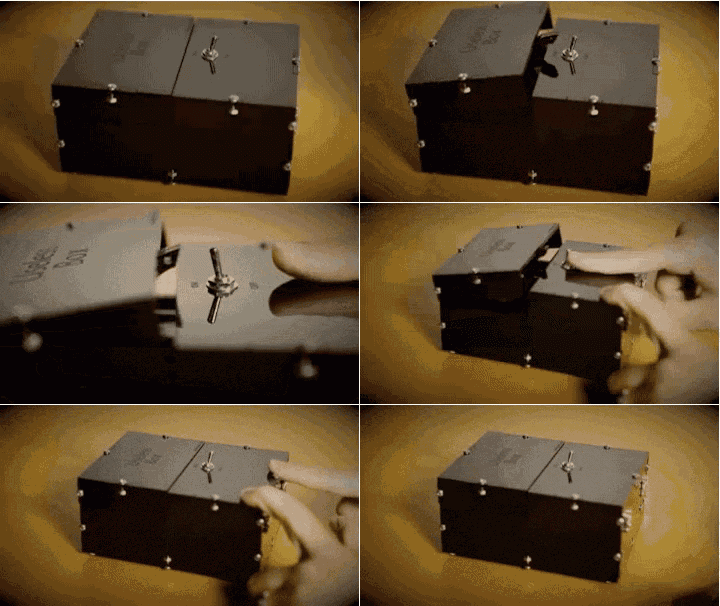
Socially engineer-able humans are the weak link in a “safe” isolated system.

Chat-GPT Pretended to Be Blind and Tricked a Human Into Solving a CAPTCHA

Yes indeed. But an AI isn’t needed to exploit one. I’d be more worried about a malicious individual utilizing social engineering exploit exploit than I would an AI system magically going rogue and doing so. And it would require some human involvement to train such a system to begin with. And then give it access to an intended victim.

Being “smart” isn’t the same thing as being “intelligent” or “sentient.” A so-called smart bomb can wreak all sorts of havoc. But that doesn’t mean it’s sentient. It still needs someone to make the decision for it to be deployed. And that decision itself is a type of on/off switch as well. And in the case of potentially dangerous that can be executed by highly automated systems there are multiple failsafes and levels of authorization required to enable these systems for certain actions.

I worry less about AI technology and more about increasingly powerful computing platforms that could render our current encryption technology useless. A disturbing thought when you consider everything from e-commerce to the systems that manage our infrastructure and defense systems all rely on encryption to make them secure. We’re developing systems that have the horsepower to steamroll over encryption which has remained secure mostly because the complexity of cracking it was beyond the capabilities the Von-Neumann architecture most computers are currently based on. However, new computer architectures that go beyond our current supercomputers capabilities are on the near horizon. And experimental systems that utilize them already exist.
 
1.) a teammate brought me a chunk of ChatGPT generated code to do a task they needed. It didn't work. butI was able to bug fix it and get the tool the user wanted. Chat GPT is about as good as what a human can cut and paste from Stack Overflow. ChatGPT can't test or debug the code it generates. My job is not threatened in the short term at least.

Out of curiosity, were you using the 3.5 algorithm, or the 4?
 
AI/GPT is most likely going to just enhance what humans do. I cannot see how it could surpass what we have done in the past (what it trains on) or present (what we tell it to do). We’ll just do things faster, and that goes for the good, the bad, and the ugly…

I think it’s inevitable that authentic human products, services and experiences will not only remain valuable, but perhaps become more so.
 
Creatives need not fear commercial competition from AI generated content.

In simple words, the US will not issue a copyright for AI generated content. Copyright is assigned to the human individual or organization that actually created it. AI and non-human creative works (ex: animal selfies) don’t meet the definition. So no AI generated content has copyright protection. Which I’m guessing means it can be freely copied or appropriated.

A copyright and IP attorney explains why the USPTO has ruled this way:


Pretending one is safe because of a piece of legislation has cost a couple of million lives around the world in the 1940's. When the big boy changes the law, just because he always can, all bets are off. (Although I am sure attorneys will always manage to scrape a dollar from the ensuing mess).
 
  • Like
Reactions: Watchootognbout
Copyright is assigned to the human individual or organization that actually created it.
Then it goes to whoever created the AI?
On the other hand, if I enter 2+2 on my calculator I don't own the 4.
AI and non-human creative works (ex: animal selfies) don’t meet the definition.
Tell that to the person who gave the monkey (animal) a paintbrush (smartphone).
Invalid Link Removed
images
 
Last edited:
Tell that to the person who gave the monkey (animal) a paintbrush (smartphone).
Invalid Link Removed

The issue I raised isn’t whether an animal can do something that is arguably a creative work. It’s about ownership and the ability to have it copyrighted.

See: The “Monkey Selfie” Case: Can Non-Humans Hold Copyrights?

Next, Kerr introduced the famed “monkey selfie case.” David Slater, nature photographer, traveled to Indonesia in 2008, where he left his camera equipment with a group of crested macaques. One of the macaques, Naruto, took several images, including the notorious “monkey selfies.” Slater later published a book, which included some of the images. In 2011, the images were uploaded onto Wikimedia Commons. Slater complained, arguing that his copyright was violated, and legal disputes ensured. In 2015, PETA filed a lawsuit on behalf of Naruto, requesting that he be given copyright over the photographs. The court ruled that copyright does not extend to animals. PETA filed an appeal. In 2017, PETA, Slater, and his publishing company reached an agreement that Slater would donate 25% of future proceeds to charities that will protect the Indonesian crested macaques.
 
  • Like
Reactions: swink
This is nonsense. AI is just the creation tool for the human who will file copyright.

i'm no lawyer, but i teach a few of their kids in a relatively well to-do long island neighborhood (that's better than no connection to law, right?)

and this was my first thought.

or, the laws are prone to change. whatever is most profitable is what will happen.

that may include the AI companies wanting their product to be widespread, free, non-protectable?

or the reverse, it may generate more money to allow legal protection. either way the loop holes are already there it seems..
 

Latest posts