
• TalkBass has been independent since 1998. Add your voice.
    Create a free account to reply to discussions, view embedded media, and browse with fewer display ads.
    Join freeLog in
    Want zero display ads or expanded classifieds tools? Compare plans.

The Steve Swallow Parker fly knock off

Syberslack said:
I would get rid of the lower horn you made on your revision. The original steve swallow looks awesome the way it is, with no bottom horn.

Steve's original lower horn is still in the bass. The bass you see in the picture on this thread is not steve's bass.

PS, the lower horn is one of the coolest features on the instrument, without it, it would suck. BTW, in case you didn't know, that bass was not built without the lower horn, it actually broke, maybe because someone dropped it or something.

Link Removed
 
Here's a little more information for the other Swallow fans out there - from Bass Player magazine, May/June 1992:

Although the strange, angular body is what you notice first, almost everything else about Swallow’s bass is as unique as its shape. It’s an incredibly thin, lightweight solidbody, yet it has the resonance of an acoustic instrument. The key is Parker’s use of softwoods – the neck is Douglas fir and the body is western cedar – reinforced by a high-tech composite. The neck is joined to the body by a glue joint consisting of interlocking 3” wood “fingers”, and the fingerboard is made from pernambuco (a hard, dense wood). A special “rod element” takes the place of a conventional truss rod and allows the neck relief to be adjusted precisely.

The fifth string is a high C, and the string spacing is very close. “The bass has a 36” scale but the neck is only slightly wider than a regular [4-string] Precision neck”, Steve notes. “This is an advantage to because I always play with a pick. A guy who plays with his fingers would find it really difficult, but I’m very comfortable with it.” Swallow’s Hot Licks picks are made of heavy-gauge (.010) copper – notice scratch marks they’ve left on the body near the neck joint. The bass is strung with custom-made extra-long Labella stainless-steel roundwound strings in Soft gauge (.027, .040, .058, .080, .102). While Ken parker was building Swallow’s bass, Larry Fishman of Fishman Transducers was at work on the electronics. The instrument has piezoelectronic transducers built into the bridge saddles, and their inputs are mixed and buffed by an onboard preamp. “Larry did all the work himself”, notes Steve. “When he was nearly done, we spent hours changing capacitors and evaluating the sound. It was a wonderfully intense period, and then I grabbed the instrument and hit the road.”

For concerts, Swallow relies on the simplest of setups to amplify the Parker bass: he plugs into a DI box that sends one line directly to the PA and another to a small rig consisting of a 15-year-old Walter Woods single-channel 300-watt head and whatever rental speakers are available. In the studio, Steve always goes direct, and he uses no effects either live or on record.
 
wilser said:
Steve's original lower horn is still in the bass. The bass you see in the picture on this thread is not steve's bass.

PS, the lower horn is one of the coolest features on the instrument, without it, it would suck. BTW, in case you didn't know, that bass was not built without the lower horn, it actually broke, maybe because someone dropped it or something.

Link Removed
i guess you are right, i have no taste in instruments anyway. This thread was the first i ever heard of steve swallow, I don't know my bass players i guess.
 
Hello all swallow fans or interested parties.

Carving this bass has proven more laborious than one would initially expect. Particularly because this is maple and it's got pretty figured grain. Here's what I've got so far ...what do YOU think?

I'm about to install the truss rod. It's a regular LMII dual action rod. Problem is I don't want to put an access hole at the body end, and doing it at the head (fender style) would weaken such a small headstock. What would YOU do?
 
First off, that is coming along great man. Can't wait to see it finished.

Now onto you're question. Is there any particular reason that you don't want to put the adjustment knob at the body? Because I would put it there for a bass like this. The neck has a small headstock and the fact that it's so small with no obstructions is what makes it so cool. I think a cover or whole would kind of kill that effect.

 
Worshiper said:
Is there any particular reason that you don't want to put the adjustment knob at the body?

No particular reason, I actually think that is the only option, because of the same reasons you explained. BUT, seeing the closeup of a guitar headstock I see a hole in the small cut out section on the treble side of the headstock that looks like a truss rod adjustment access hole. I don't want to do this with this bass, but I am just exploring my options. Maybe there is some idea that some of you might have that I might be overlooking that would be better. I don't think there are many choices given the design.

Thanks for your feedback!
 
wilser said:
No particular reason, I actually think that is the only option, because of the same reasons you explained. BUT, seeing the closeup of a guitar headstock I see a hole in the small cut out section on the treble side of the headstock that looks like a truss rod adjustment access hole. I don't want to do this with this bass, but I am just exploring my options. Maybe there is some idea that some of you might have that I might be overlooking that would be better. I don't think there are many choices given the design.

Thanks for your feedback!

This looks like a perfect application for my TR adjustment gearbox with the adjustment shaft coming out the back! :bassist:

But seriously - how about a small cavity in the back with the TR adjustment there? The neck doesn't know if the adjustment is from the front or the back. You could put a matching cover over it and keep it in place with a magnet. I've done something similar (from the front) on my latest and it looks neat.
 
DSB said:
Very interesting project. I'd like to see more pics of the carving if possible :)
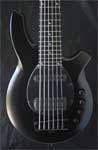
I'll try to post more pictures when a little more progress has been made ...it's kind of hard to photograph surface contours when the wood is unfinished.


Also, somehow, Larry was able to see the progress (I guess he lurks around here sometimes) and commented on how ugly the bass was. So it was officially baptized by him as "The Turkey Boy" because he says it looks like a dead turkey.

cheers for all parker prototype fans!
 
Well??? How far along is it?? Cant wait to see it finished. Parker should release the Steve Swallow model. It's miles ahead of the Fly or Mojo bass as far as looks go and I just cant fathom an electric solidbody made of all spruce, I dunno maybe they sound ok.
 
wilser said:
Also, somehow, Larry was able to see the progress (I guess he lurks around here sometimes)...

If by Larry, you mean Larry from Gallery HW, yes, he does do a bit of lurking. I had a thread on laminated neck woods with several different configurations, and I guess he saw it because I e-mailed him about quoting only one config and he sent back quotes on the 3 or 4 I mentioned in the thread. He is a sneaky devil, but you can't beat the quality and prices. :smug:

As for the bass, not too shabby. Kinda has a Salvador Dali vibe to it.
 
teacherguy said:
AWESOME! very swoopy and looks true to the original:hyper:

Two questions:
What pick-up is that and what is the weight so far? (looks hefty.)

Jon

thanks! I still have a lot of work ahead, though.

the pickup is a dimarzio model p that I took out of their covers and slapped into a wooden one, it looks pretty big, but it'll also serve as a 'ramp' style thing.

It feels rather light, considering it's maple neck and body, it's about 5lbs so far. The tuners are sperzel so they shouldn't add much weight, and electronics is passive vol + tone, so I don't think they'll add significant weight either. I'm estimating around 6 lb once everything is on.

I'll post more pics once I've finished it.