D
The "Transparency Myth" vs. Mix-Ready Tone
1. Transparency is for Mastering, Character is for Tracking
The quest for a "transparent" preamp or compressor (like the Empress) often ignores how records are actually made. Studio icons like the 1176 (Cali76), LA-2A, or Neve consoles are famous specifically because they color the sound. They add harmonic saturation and "weight" that give an instrument life. Total transparency is technically accurate but emotionally sterile.
2. The BDDI as "Mix-in-a-Box"
People criticize the SansAmp BDDI for its "scooped" mids (around 750-800Hz), but that's exactly where the magic happens. A "transparent" bass signal often fights for space with vocals and guitars. The BDDI performs "preventive surgery" by:
A transparent signal leaves all the hard work to the Mix Engineer. A "colored" tool like the BDDI or Cali76 imposes sonic discipline. It forces the bass into its proper frequency lane from the start. This is why the SansAmp is on more platinum records than all "boutique/transparent" preamps combined: it delivers a finished product, not just a raw signal.
If you want to hear your bass soloed in your bedroom, go transparent. If you want your bass to be heard on a professional record or through a massive PA system, you need the character and frequency carving that "purists" love to hate.
The Science of "Life" in Sound: Harmonic Saturation
1. Even vs. Odd Harmonics (The "Tube" vs. "Tape" feel)
The reason "transparent" gear often feels thin in a mix is the lack of harmonic reinforcement.
Transparency is a disadvantage on small speakers (phones, laptops). A perfectly clean bass has a massive fundamental frequency that these speakers can't reproduce.
Tools like the BDDI or Cali76 add saturation that creates "phantom" versions of your notes in the higher frequency range. Your brain hears these harmonics and "reconstructs" the low end, making the bass audible even when the actual sub-frequencies are missing.
3. Why "Linear" is boring
A "transparent" preamp is linear. But music is dynamic and non-linear. When you dig into a SansAmp or a Cali76, the gear "pushes back" with saturation. This compression and harmonic bloom create a texture that glues the bass to the drums. Without these distortions (even and odd), the sound has no "glue"—it just sits on top of the mix instead of being inside it, or in the dense mix simply disappear.
Transparency is technically correct but psychoacoustically weak. I’m not looking for a preamp that 'gets out of the way'; I’m looking for one that 'leads the way' by adding the harmonic complexity needed to survive a professional mix.
Cali76 vs. Empress: Character vs. Transparency
Critics often call the BDDI "dated" or "too colored." Here is why they are wrong, and why it has dominated platinum records for 30 years:
The BDDI isn't just a preamp; it's an insurance policy for your tone. It ensures that no matter how messy the room or the mix is, the bass has a clear, harmonic, and carved-out space to exist. Transparency is a luxury for solo players; character is a necessity for professional musicians.
I've tried a lot of configurations and a lot of preamps and I keep coming back to the BDDI v2. Yes, it has that scoop at 750/800hz, Treble is at 3.2khz (basically high mids), Presence is at 4.5/5khz, and it's boost only. The fact that I can switch the bass to 80hz (to make room for the kick drum) and the mids to 1khz (to accentuate that scoop at 800hz with another little scoop to make room for guitars and vocals or other instruments) is a deciding factor for me. Plus the harmonic saturation and that roll off at 35hz and 6khz are again crucial, because I can make the bass mix ready. With all these features it is present on more platinum recordings than all other bass preamps combined. From Pino Palladino, Tony Levin and Mike Porcaro, to Rex Brown, Sam Rivers and Fieldy, this SansAmp has been present on recordings and live, it has dominated the bass world for 3 decades.
Many people also talk about compressors or preamps that they want transparency, but I realized something, transparency is the enemy of music. Transparency does not put bass in the mix, transparency does not cut frequencies that clash with other instruments.
Initially I was a fan of Empress, for example, which is not exactly transparent (but quite transparent for a FET type circuit that partially succeeds in simulating the transparency of a VCA circuit), but I returned to Cali76 which makes a roll off in the lows and highs, pushes and harmonically saturates the mids and through that it sounds in the mix. Cali76 simply works magic in dense mixes, yes, I don't have the lows and highs of the Empress, Cali76 cuts, rounds, but gives density where it needs to, harmonically saturates, and psychoacoustics reconstructs it afterwards. And at the end, in the mix, the best part is, the sound seems bigger.
Many people associate transparency with studio tools and that's totally wrong, effects and studio tools are there for personality, not for transparency. Urei 1176, LA-2A, Distressor with Dist2 and Dist 3 (even and odd harmonics, i.e. tube and tape) are not transparent. Neither are Neve 5088 or 8068 consoles. Without even or odd harmonic distortions the sound has no life.
That's my opinion, that's why I'm not looking for transparency anymore, but for effects/pedals that put my bass in the mix without much effort on my part, in other words, effects that work for me in the mix, necessarily in the mix. What sounds great solo, usually doesn't work in the mix. The problem is people judge the BDDI (v1 and v2) as a preamp, when they should judge it as a 'mix-in-a-box'. There’s a reason this pedal is on more platinum records than all other bass preamps combined.
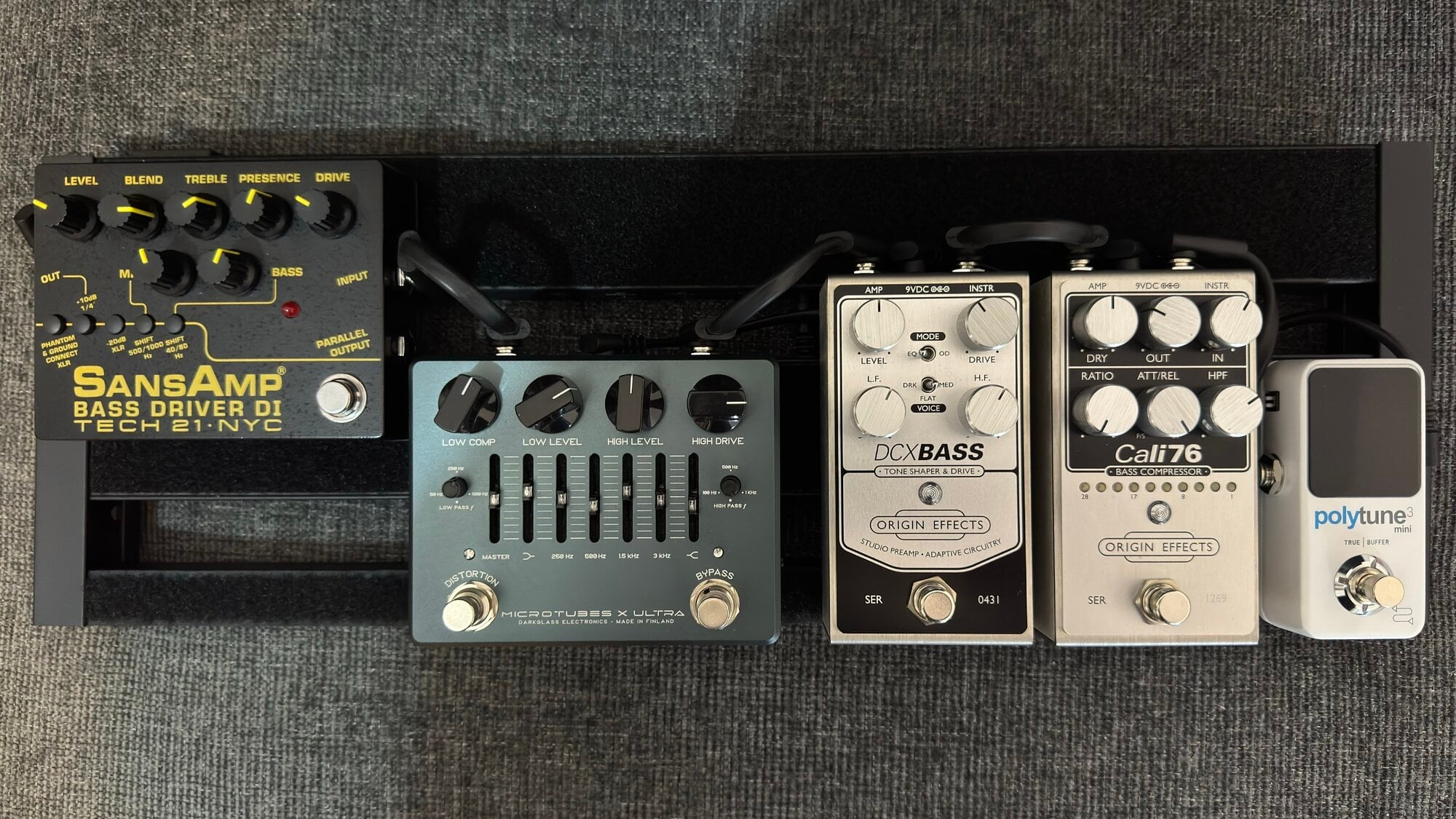
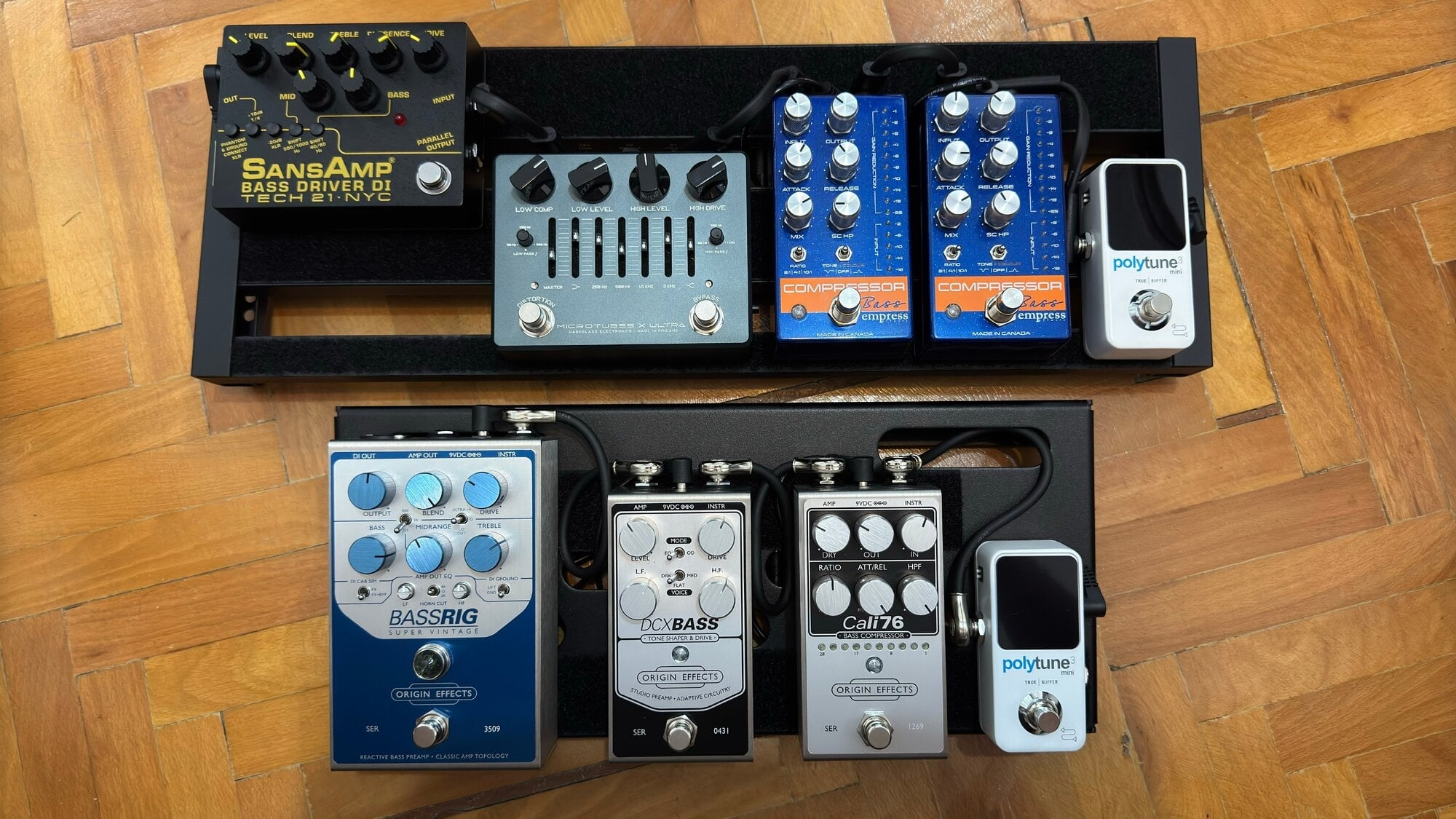
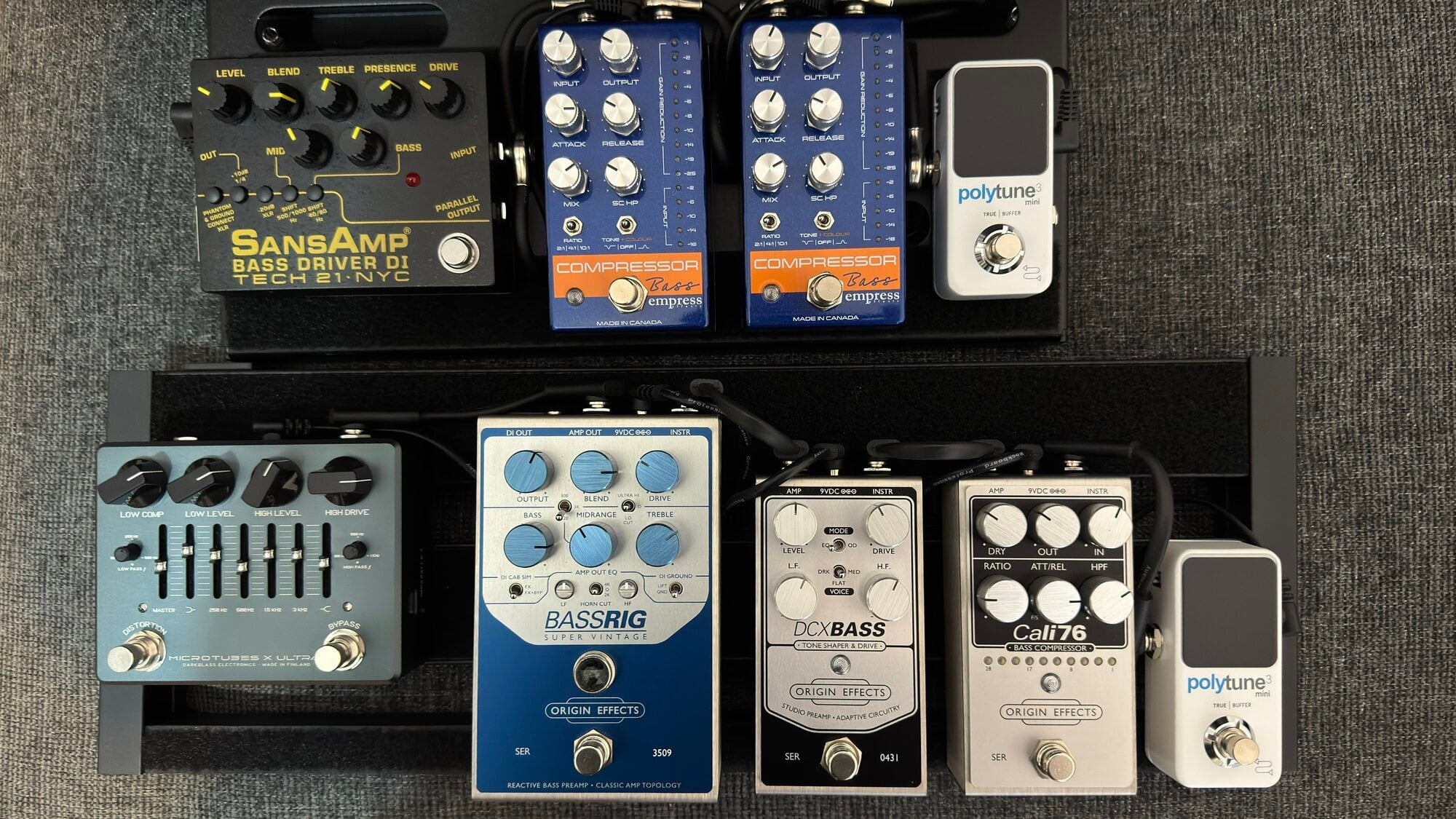
I went through many configurations (I fell into the myth of transparency too), I tried many variations, in the end I ended up configuring the pedalboard like this (but I'm also posting pictures with the variations):
1. Transparency is for Mastering, Character is for Tracking
The quest for a "transparent" preamp or compressor (like the Empress) often ignores how records are actually made. Studio icons like the 1176 (Cali76), LA-2A, or Neve consoles are famous specifically because they color the sound. They add harmonic saturation and "weight" that give an instrument life. Total transparency is technically accurate but emotionally sterile.
2. The BDDI as "Mix-in-a-Box"
People criticize the SansAmp BDDI for its "scooped" mids (around 750-800Hz), but that's exactly where the magic happens. A "transparent" bass signal often fights for space with vocals and guitars. The BDDI performs "preventive surgery" by:
- Rolling off the sub-lows (35Hz): Cleaning up the mud for the PA/Subwoofers.
- Cutting the low-mids: Opening up a pocket for the rest of the band.
- Rolling off the highs (6kHz): Removing the "clank" and simulating a real speaker cabinet.
A transparent signal leaves all the hard work to the Mix Engineer. A "colored" tool like the BDDI or Cali76 imposes sonic discipline. It forces the bass into its proper frequency lane from the start. This is why the SansAmp is on more platinum records than all "boutique/transparent" preamps combined: it delivers a finished product, not just a raw signal.
If you want to hear your bass soloed in your bedroom, go transparent. If you want your bass to be heard on a professional record or through a massive PA system, you need the character and frequency carving that "purists" love to hate.
The Science of "Life" in Sound: Harmonic Saturation
1. Even vs. Odd Harmonics (The "Tube" vs. "Tape" feel)
The reason "transparent" gear often feels thin in a mix is the lack of harmonic reinforcement.
- Even-Order Harmonics (2nd, 4th): These provide that "warmth" and "thickness" associated with Tube gear (LA-2A, SVT). They are mathematically related to the fundamental note (octaves), making the bass sound larger than life without being "distorted."
- Odd-Order Harmonics (3rd, 5th): These add "edge," "growl," and "definition," typical of Tape and Transformers (Neve, 1176). This is what helps a bass cut through dense guitars.
Transparency is a disadvantage on small speakers (phones, laptops). A perfectly clean bass has a massive fundamental frequency that these speakers can't reproduce.
Tools like the BDDI or Cali76 add saturation that creates "phantom" versions of your notes in the higher frequency range. Your brain hears these harmonics and "reconstructs" the low end, making the bass audible even when the actual sub-frequencies are missing.
3. Why "Linear" is boring
A "transparent" preamp is linear. But music is dynamic and non-linear. When you dig into a SansAmp or a Cali76, the gear "pushes back" with saturation. This compression and harmonic bloom create a texture that glues the bass to the drums. Without these distortions (even and odd), the sound has no "glue"—it just sits on top of the mix instead of being inside it, or in the dense mix simply disappear.
Transparency is technically correct but psychoacoustically weak. I’m not looking for a preamp that 'gets out of the way'; I’m looking for one that 'leads the way' by adding the harmonic complexity needed to survive a professional mix.
Cali76 vs. Empress: Character vs. Transparency
- The Empress Compressor: It’s a surgical tool. If you have a boutique bass and you want it to sound exactly the same, just with controlled dynamics, you pick the Empress. It is "invisible." The problem? In a dense rock or pop mix, an "invisible" bass often disappears. It adds no texture to help the notes "jump" out of the speakers.
- The Origin Effects Cali76: This is a sound-shaper, not just a compressor. Based on the 1176 FET circuit, it introduces those odd-order harmonics that provide bite, attack, and presence. The Cali76 subtly "pushes" the mids and tightens the extreme lows and highs, making the bass feel compact and "solid."
- The Verdict: The Empress leaves your tone alone; the Cali76 makes your tone better. In a mix, you want that Cali76 texture because it acts as a sonic "anchor." So the remark "I don't want the compressor to affect my tone" is puerile, since the most commonly used compressors on bass guitar in the studio (Urei 1176, LA-2A, Distressor) do exactly that, they affect your tone.
Critics often call the BDDI "dated" or "too colored." Here is why they are wrong, and why it has dominated platinum records for 30 years:
- Predictability: When a bassist shows up with a SansAmp, the Front of House (FOH) or studio engineer knows exactly what they’re getting: a signal that already has its "seat" reserved in the frequency spectrum. It is "sonically disciplined."
- The "Baked-In" Mix: The BDDI doesn't try to be a clean amp; it simulates an entire studio signal chain: Bass → Console Preamp → Compression → Mix EQ → Bass Cab → Mic. When you kick it on, you’ve skipped five stages of processing that the engineer would have had to do anyway.
- Small Speaker Survival: Through its specific harmonic saturation, the BDDI creates the high-mid information that allows the bass to be heard on car radios or phone speakers. A "transparent" preamp might sound glorious on $2,000 studio monitors, but it will be silent on a small consumer speaker.
- Workhorse vs. Diva: Boutique transparent preamps are like divas—they need perfect conditions to sound good. The SansAmp is a tank. It sounds right with a vintage P-bass, it sounds right with a modern active bass, and it sounds right whether you’re going direct to the PA or into a backline rental.
The BDDI isn't just a preamp; it's an insurance policy for your tone. It ensures that no matter how messy the room or the mix is, the bass has a clear, harmonic, and carved-out space to exist. Transparency is a luxury for solo players; character is a necessity for professional musicians.
I've tried a lot of configurations and a lot of preamps and I keep coming back to the BDDI v2. Yes, it has that scoop at 750/800hz, Treble is at 3.2khz (basically high mids), Presence is at 4.5/5khz, and it's boost only. The fact that I can switch the bass to 80hz (to make room for the kick drum) and the mids to 1khz (to accentuate that scoop at 800hz with another little scoop to make room for guitars and vocals or other instruments) is a deciding factor for me. Plus the harmonic saturation and that roll off at 35hz and 6khz are again crucial, because I can make the bass mix ready. With all these features it is present on more platinum recordings than all other bass preamps combined. From Pino Palladino, Tony Levin and Mike Porcaro, to Rex Brown, Sam Rivers and Fieldy, this SansAmp has been present on recordings and live, it has dominated the bass world for 3 decades.
Many people also talk about compressors or preamps that they want transparency, but I realized something, transparency is the enemy of music. Transparency does not put bass in the mix, transparency does not cut frequencies that clash with other instruments.
Initially I was a fan of Empress, for example, which is not exactly transparent (but quite transparent for a FET type circuit that partially succeeds in simulating the transparency of a VCA circuit), but I returned to Cali76 which makes a roll off in the lows and highs, pushes and harmonically saturates the mids and through that it sounds in the mix. Cali76 simply works magic in dense mixes, yes, I don't have the lows and highs of the Empress, Cali76 cuts, rounds, but gives density where it needs to, harmonically saturates, and psychoacoustics reconstructs it afterwards. And at the end, in the mix, the best part is, the sound seems bigger.
Many people associate transparency with studio tools and that's totally wrong, effects and studio tools are there for personality, not for transparency. Urei 1176, LA-2A, Distressor with Dist2 and Dist 3 (even and odd harmonics, i.e. tube and tape) are not transparent. Neither are Neve 5088 or 8068 consoles. Without even or odd harmonic distortions the sound has no life.
That's my opinion, that's why I'm not looking for transparency anymore, but for effects/pedals that put my bass in the mix without much effort on my part, in other words, effects that work for me in the mix, necessarily in the mix. What sounds great solo, usually doesn't work in the mix. The problem is people judge the BDDI (v1 and v2) as a preamp, when they should judge it as a 'mix-in-a-box'. There’s a reason this pedal is on more platinum records than all other bass preamps combined.
I went through many configurations (I fell into the myth of transparency too), I tried many variations, in the end I ended up configuring the pedalboard like this (but I'm also posting pictures with the variations):
- TC Electronic PolyTune 3 Mini
- Origin Effects Cali76 V2 Bass Compressor
- Origin Effects DCX Bass Overdrive
- Darkglass Microtubes X Ultra
- Tech 21 SansAmp Bass Driver DI V2