i'm surprised at how few take the time to learn about music.

Enjoy the benefits of a premium membership!
Upgrade Account
-
TalkBass has been independent since 1998. Add your voice.
Create a free account to reply to discussions, view embedded media, and browse with fewer display ads.
Join free Log in
Want zero display ads or expanded classifieds tools? Compare plans.
You are using an out of date browser. It may not display this or other websites correctly.
You should upgrade or use an alternative browser.
You should upgrade or use an alternative browser.
Things that surprise you about other musicians...
- Thread starter glocke1
- Start date
More options
Who Replied?

Stage volume issues continue to absolutely blow my mind.
Why a musician would turn up to the point he can hear himself and those around him, and then think, "Nah, I need to be the loudest thing up here, and I don't really need to hear the others, nor do they need to hear each other," is a mentality I will never understand.
I just had a keyboard player pretty much ruin my fun at last night's gig. But this is just an observation, not a criticism.
Why a musician would turn up to the point he can hear himself and those around him, and then think, "Nah, I need to be the loudest thing up here, and I don't really need to hear the others, nor do they need to hear each other," is a mentality I will never understand.
I just had a keyboard player pretty much ruin my fun at last night's gig. But this is just an observation, not a criticism.
Last edited:

Music teachers (mainly classical) who start all the students off with reading music when they are in elementary school, as if reading music, because it's so important, is developmentally appropriate for kids that young. Think about it: When did you first learn to read a graph? Because written music is a very difficult graph.
Sorry, but gotta totally disagree here. My first musical experience was learning to play a recorder in elementary school. We learned to read right along with learning fingerings. Made perfect sense. My kids all took piano starting in about 3rd grade and learned to read right along with learning the keyboard. It's not rocket surgery and it's a necessary part of learning theory. As many of the posts in this thread attest, a bigger problem is all the illiterate musicians who can't communicate with their bandmates.
Music teachers (mainly classical) who start all the students off with reading music when they are in elementary school, as if reading music, because it's so important, is developmentally appropriate for kids that young. Think about it: When did you first learn to read a graph? Because written music is a very difficult graph.
Actually, reading music isn't that difficult. I know because I teach young kids to read music everyday. In fact, reading music is easier for kids to learn to read than letters and words. It irritates me that there are musicians who can't read music because "it's too hard to learn". I can sort of understand if you just learned by ear or never took the time to learn or were never in a situation to learn. But, to use the excuse that it is too hard to read music is just wrong.
I learned to read a graph in elementary school; I learned to read music in 1st grade. Thanks Mrs. Royal (my elementary music teacher).
Music teachers (mainly classical) who start all the students off with reading music when they are in elementary school, as if reading music, because it's so important, is developmentally appropriate for kids that young. Think about it: When did you first learn to read a graph? Because written music is a very difficult graph.
You mean this difficult, indecipherable graph?
I can assure you, after 18 years as a private music teacher, I have yet to have a student age four or older stumped by this concept.
How few players know the Nashville Number System for chords.
I - iv - ii - V7 - etc.

Not long ago I told a guitarist I was playing the ♭7. His reaction? Oh - you mean a 6th chord?

i'm surprised at how few take the time to learn about music.
I get that sentiment.... While in the army I had guys that would come to Germany and speak fairly fluently in just a few months... Just came natural to them. For some, music theory comes natural. Not for me... I struggled like a kid in geometry trying. However you can play me a piece of music and I'll play it back for you note for note and hold a groove tighter than spandex doing it. Now forty odd years later I play hymns in my church. Would give my right little finger if some of that learning stuck in my brain pan. But written music is still just spots on a page to me. And it's not for lack of trying either!
Last edited:
Because written music is a very difficult graph.
I heard kids in China are all geniuses. Chinese is a hard language but they all know how to read and understand Chinese by the age of 5...

Sometimes what seems "good enough" to you is someone else's very best effort. All of us were pretty underwhelming at some point.
I'm not sure I've outgrown underwhelming myself, but that wasn't the intent of my post. I really meant people who are capable, but too lazy to put in the effort. My apologizes.
i'm surprised at how few take the time to learn about music.
That seems to apply in particular to guitarists. So many times I've played with good guitarists - guys who could play well - but as soon as I'd start discussing theory with respect to harmony or transposition for example, they went crosseyed. They only knew the chords of songs but not how and why they work together.
People who play keys generally seem to have a much better grasp of theory - maybe because they usually have some formal training, while guitarists will just learn some chords and start playing guitar hero. As a bass player, I made point of learning a decent amount of theory (and still learning) - IMO it comes with the territory. But every musician should know theory - it only helps you.
I would totally agree with you on this for classical, piano, school recorder/violin/etc (and jazz I suspect but have never played it).Sorry, but gotta totally disagree here. My first musical experience was learning to play a recorder in elementary school. We learned to read right along with learning fingerings. Made perfect sense. My kids all took piano starting in about 3rd grade and learned to read right along with learning the keyboard. It's not rocket surgery and it's a necessary part of learning theory. As many of the posts in this thread attest, a bigger problem is all the illiterate musicians who can't communicate with their bandmates.
But for what I have played for the last 48 years (blues, rock, pop, etc) I have yet to be presented with a score for anything I have been required to play. I am given the key and if lucky the basic chords and work the rest out for myself.
When we first started out we used to buy the sheet music for the songs we wanted to learn but soon discovered that it was often inaccurate, scored for piano, and never in the key of the record we were attempting to work from. That triggered a very steep learning curve in playing by ear, something that I still use to great advantage today.
Different strokes for different folks and I am not going to get into an argument about the pros and cons of reading*. You have your view and I have mine and neither of us are likely to change because of the other's experiences.
*I have a great respect for those that can read proficiently but have never had a use for it myself but when I need to read to get gigs I will brush up on my admittedly very rusty reading skills.

I heard kids in China are all geniuses. Chinese is a hard language but they all know how to read and understand Chinese by the age of 5...
Actually, no, they don't. Also, graphs are not ideograms.
You mean this difficult, indecipherable graph?
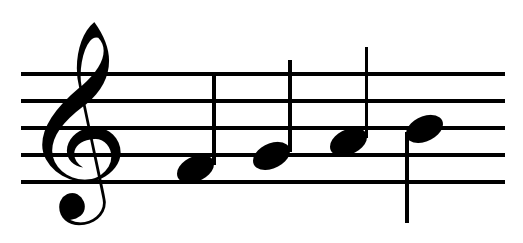
I can assure you, after 18 years as a private music teacher, I have yet to have a student age four or older stumped by this concept.
How many of them still read music?
How many of them still read music?
I am certain all of them still possess the ability to read music in standard notation. I am equally certain it was a valuable skill when they were active students and musicians.
Actually, reading music isn't that difficult. I know because I teach young kids to read music everyday. In fact, reading music is easier for kids to learn to read than letters and words. It irritates me that there are musicians who can't read music because "it's too hard to learn". I can sort of understand if you just learned by ear or never took the time to learn or were never in a situation to learn. But, to use the excuse that it is too hard to read music is just wrong.
I learned to read a graph in elementary school; I learned to read music in 1st grade. Thanks Mrs. Royal (my elementary music teacher).
I was taught to read music in 3rd grade on the flute, and in 5th grade my teacher tried to teach me to sight-sing, but she was not really able to.
My point is not that children can't learn to read music at an early age -- some can. Rather, it's clear that the process of teaching kids to read music emphasizes a skill that is highly specialized, and which many kids are not prepared to learn in the early grades.
In teaching music, what's the dropout rate? How many kids actually continue with using the skill? I'm all for teaching kids to read music, but it's NOT THE FIRST THING to learn about music. We all learn to speak and listen to language before we learn to read and write it, no?
I would totally agree with you on this for classical, piano, school recorder/violin/etc (and jazz I suspect but have never played it).
But for what I have played for the last 48 years (blues, rock, pop, etc) I have yet to be presented with a score for anything I have been required to play. I am given the key and if lucky the basic chords and work the rest out for myself.
When we first started out we used to buy the sheet music for the songs we wanted to learn but soon discovered that it was often inaccurate, scored for piano, and never in the key of the record we were attempting to work from. That triggered a very steep learning curve in playing by ear, something that I still use to great advantage today.
Different strokes for different folks and I am not going to get into an argument about the pros and cons of reading*. You have your view and I have mine and neither of us are likely to change because of the other's experiences.
*I have a great respect for those that can read proficiently but have never had a use for it myself but when I need to read to get gigs I will brush up on my admittedly very rusty reading skills.
I get where you're coming from. I play much the same music you do and get by with chord sheets and plying by ear. It's good to be able to read when I have to, even if I can't just take sheet of music and play it cold. My earlier post was mostly disagreeing with the idea that young kids aren't ready to learn to read or learn theory. That is baloney.
I am certain all of them still possess the ability to read music in standard notation. I am equally certain it was a valuable skill when they were active students and musicians.
When I was working on a paper for my grad degree, I did some research on a government program in Sweden, which subsidized private music lessons for children. The teachers loved it -- the government was subsidizing them. The students, OTOH, got very little out of the lessons and dropped out in droves. That said, it proved very helpful in creating the culture of excellence among some very able students.
Plenty of students can learn to read music at early ages, but I think that there are plenty of musical concepts that can be taught in advance of this, particularly with regard to LISTENING to music and understanding its expressive power.
Most people don't learn to read music. But all people are naturally musical. Most musical traditions don't emphasize reading music, and that's important to consider, as we try to engage young students with the power of music.

I and other band kids learned to read music just fine at a young age. Bass wasn't my first instrument, though. Trombone was.I was taught to read music in 3rd grade on the flute, and in 5th grade my teacher tried to teach me to sight-sing, but she was not really able to.
My point is not that children can't learn to read music at an early age -- some can. Rather, it's clear that the process of teaching kids to read music emphasizes a skill that is highly specialized, and which many kids are not prepared to learn in the early grades.
In teaching music, what's the dropout rate? How many kids actually continue with using the skill? I'm all for teaching kids to read music, but it's NOT THE FIRST THING to learn about music. We all learn to speak and listen to language before we learn to read and write it, no?
When I was working on a paper for my grad degree, I did some research on a government program in Sweden, which subsidized private music lessons for children. The teachers loved it -- the government was subsidizing them. The students, OTOH, got very little out of the lessons and dropped out in droves. That said, it proved very helpful in creating the culture of excellence among some very able students.
Plenty of students can learn to read music at early ages, but I think that there are plenty of musical concepts that can be taught in advance of this, particularly with regard to LISTENING to music and understanding its expressive power.
Most people don't learn to read music. But all people are naturally musical. Most musical traditions don't emphasize reading music, and that's important to consider, as we try to engage young students with the power of music.
That's all well and good, but you have hardly convinced me that the basics of standard notation are too difficult for most elementary school children, as you stated earlier.
I'm all for teaching kids to read music, but it's NOT THE FIRST THING to learn about music. We all learn to speak and listen to language before we learn to read and write it, no?
Good teachers don't stop at sight reading in standard notation. They incorporate it with more intuitive music skills. Standard notation is but one tool for learning how music works. If you look at learning in terms of multiple intelligences, it is but one more conceptual tool for helping the student visualize music graphically.
Your assertion that learning to read in standard notation is too difficult for young children is far from proven. My experience dictates the exact opposite is true. And once the student learns the concept, it's not hard to recall how it works, even if he or she becomes inactive as a reader or musician.
And I don't see the fairness of bringing student retention or longevity into the conversation. At it's core, sight reading in standard notation is not too difficult for elementary age students. How long they maintain or utilize the skill is a completely separate discussion.

I would have to agree with the other folks who are surprised by the amount of music many musicians haven't heard.
There is good music in every genre, use it for your own inspiration. Even if you don't particularly care for other types of music, you may learn from it.
There is good music in every genre, use it for your own inspiration. Even if you don't particularly care for other types of music, you may learn from it.


