I noticed quite by accident that if I wedge a solid piece of material between my tailpiece and the body of my bass the volume is considerably louder. I have been experimenting with different things and plan on trying a solid block of wood with angles cut to match the angle of the tailpiece. Is it the transfer of the vibration of the tailpiece to the top that is causing this ya suppose? Has anyone else tried this?

Enjoy the benefits of a premium membership!
Upgrade Account
-
TalkBass has been independent since 1998. Add your voice.
Create a free account to reply to discussions, view embedded media, and browse with fewer display ads.
Join free Log in
Want zero display ads or expanded classifieds tools? Compare plans.
You are using an out of date browser. It may not display this or other websites correctly.
You should upgrade or use an alternative browser.
You should upgrade or use an alternative browser.
Double Bass This Is Wierd....Or Is It?
- Thread starter Cathead
- Start date
More options
Who Replied?
Seems to me like somewhere along the line I either saw a bass or had the discussion about someone putting cork between the tailpiece and top, just above the endblock. Anyone else remember this?
gruffpuppy said:You are adding mass to the bass, is it louder through a amp?
I have not tried it through an amp yet. I do have a Fishman pickup on the bass, but I don't have a preamp. What made me notice it was when my condenser mic I was recording with fell out and the volume dropped. I put the mic back in and the volume came back. Then I started trying other things. Ain't got to the block of wood yet.
Matthew Tucker
Commercial User
- Aug 21, 2002
- 2,686
- 387
- Disclosures
- Owner: Bresque Basses, Sydney Basses and Cellos

What kind of tailpiece wire do you have? It could be, especially if you have the 'coat hanger' type, that the tailpiece is not resonating by itself, and when you put in the block it's allowing the lower part of the instrument ot vibrate better. However even the steel wire tailpiece wires aren'y great. I'd recommend you try the velvet taipliece wire, it did wonders for my bass, and i was changing from steel wire. Luthiers please correct me if i'm way off on this!
The tailpiece wire looks like nylon to me. It's black like the one I ordered for my other bass one time. By the way, I tried the block of wood and it's no better than anything else I've experimented with. Actually, the condenser mic generates the most natural volume from the top of the bass.
- Jan 25, 2006
- 1,292
- 6
- Disclosures
- Endorsing Artist; Arnold Schnitzer/ Wil DeSola New Standard RN DB
Cathead said:The tailpiece wire looks like nylon to me. It's black like the one I ordered for my other bass one time. By the way, I tried the block of wood and it's no better than anything else I've experimented with. Actually, the condenser mic generates the most natural volume from the top of the bass.
When I worked w/ Andy Statman he told me of Buel Niedlinger using a rubber ball for this purpose while recording. Worth a try.
Hey cathead.
The answer to your question is very physics related and is the opposite of what many people may think. When you have something wedged between the body and the tail piece, you actually stop the tail piece from vibrating at all. One would think that if you stop extra things from resonating, then the bass would be softer. However, if you prevent all vibrations, except for the string you are playing on and the body, then you'll get the loudest sound. The reason for this is energy input and output. When you stroke the bow accross the string, the string vibrates. Those vibrations go into the body via the bridge and create sound. But, everything on the bass resonates, such as the tail piece, the scroll, etc. So, you INPUT energy with your arm and the bow to the string, which OUTPUTS energy with vibrations, thus creating sound, but, the outward energy is distributed all through the bass. When you dampen the tail piece, you suddenly get more vibrations in the body and in other places of the bass. Here's the key: every part of the bass creates sound BUT, the hollow body and the sound post create much more sound than everything else. Put your finger on a note and bow ABOVE it, close to the nut: you hear a sound, but that resonance lies in the neck and scroll and the string, with a tiny bit in the body of the bass. Thus, you get a tone, but it's silly and soft and thin (fun too).
Another experiment to try: Play a G on the D string (same pitch as the open G). WHen you play it, the open G resonates a TON. INPUT and OUTPUT stuff again. You input energy, and you create a note, but the G string resonates a lot because the vibrations match up. Because of the matching pitches, you have an additional output of energy into the open G string.
NOW, keep playing the note and collapse your left hand on the open G string dampening the string from vibrating on its own. What do you hear? The note is a lot louder and probably has much more depth. This is because the open G is using no energy for its vibrating, and he body gets that much more energy, which produces that much more sound. I know that the resonating G creates sound too, but the body produces much much more.
Harmonics in all of the strings resonate, tail pieces resonate, necks and scrolls resonate. These all contribute to the sound of a bass. I'm not saying that you should dampen everything that you can to get a huge sound. When you do that, you loose SUSTAIN. If you to the trick with the G on the D again, but with pizz, then you'll notice the same increase in volume and depth, but you'll notice a DECREASE in sustain. If you dampen everything and play with the bow, you'll notice that the bass fights a little more, but the sound is bigger and deeper. Again, you input energy and it is all outputted into the body, and to make a big bass body resonate takes a lot of work.
So there's a trade off: Ease of playing and sustain vs. that massive bass sound. The bass on its own is a good balance. But people always tweak things to their own prefs. The all wire tail piece, the ball wedged in, even that little weight clam that you put on he head stock of a guitar to boost sustain; all of those things deal with the same concept.
Sorry about the long post, but it's good info to know and people often think the opposite. So play around with stuff like this, tell us what you think, share results, etc.
Peace,
Charlie
The answer to your question is very physics related and is the opposite of what many people may think. When you have something wedged between the body and the tail piece, you actually stop the tail piece from vibrating at all. One would think that if you stop extra things from resonating, then the bass would be softer. However, if you prevent all vibrations, except for the string you are playing on and the body, then you'll get the loudest sound. The reason for this is energy input and output. When you stroke the bow accross the string, the string vibrates. Those vibrations go into the body via the bridge and create sound. But, everything on the bass resonates, such as the tail piece, the scroll, etc. So, you INPUT energy with your arm and the bow to the string, which OUTPUTS energy with vibrations, thus creating sound, but, the outward energy is distributed all through the bass. When you dampen the tail piece, you suddenly get more vibrations in the body and in other places of the bass. Here's the key: every part of the bass creates sound BUT, the hollow body and the sound post create much more sound than everything else. Put your finger on a note and bow ABOVE it, close to the nut: you hear a sound, but that resonance lies in the neck and scroll and the string, with a tiny bit in the body of the bass. Thus, you get a tone, but it's silly and soft and thin (fun too).
Another experiment to try: Play a G on the D string (same pitch as the open G). WHen you play it, the open G resonates a TON. INPUT and OUTPUT stuff again. You input energy, and you create a note, but the G string resonates a lot because the vibrations match up. Because of the matching pitches, you have an additional output of energy into the open G string.
NOW, keep playing the note and collapse your left hand on the open G string dampening the string from vibrating on its own. What do you hear? The note is a lot louder and probably has much more depth. This is because the open G is using no energy for its vibrating, and he body gets that much more energy, which produces that much more sound. I know that the resonating G creates sound too, but the body produces much much more.
Harmonics in all of the strings resonate, tail pieces resonate, necks and scrolls resonate. These all contribute to the sound of a bass. I'm not saying that you should dampen everything that you can to get a huge sound. When you do that, you loose SUSTAIN. If you to the trick with the G on the D again, but with pizz, then you'll notice the same increase in volume and depth, but you'll notice a DECREASE in sustain. If you dampen everything and play with the bow, you'll notice that the bass fights a little more, but the sound is bigger and deeper. Again, you input energy and it is all outputted into the body, and to make a big bass body resonate takes a lot of work.
So there's a trade off: Ease of playing and sustain vs. that massive bass sound. The bass on its own is a good balance. But people always tweak things to their own prefs. The all wire tail piece, the ball wedged in, even that little weight clam that you put on he head stock of a guitar to boost sustain; all of those things deal with the same concept.
Sorry about the long post, but it's good info to know and people often think the opposite. So play around with stuff like this, tell us what you think, share results, etc.
Peace,
Charlie
Charlie, I appreciate the long post. It was so interesting I didn't notice the length. I have been looking for a rubber ball. I'll probably have to go buy one. I would be more into the volume than the sustain, because I am playing bass in a bluegrass band, and the loud thump is what I'm after. When I find a rubber ball I will post the results of the experiment.
Well, I went to Wal-Mart and picked up a hard, super bounce, rubber ball for 88 cents. It's smaller than a regular size baseball but not real small like most of the super balls I have seen. Anyway, I wedged it between my tailpiece and the top of my bass and slid it down until it was snug. I am amazed at the added volume. I can even feel a big difference in the floor vibration where I am standing. I don't guarantee that it will do the same for your bass, but if you're after more volume it's worth 88 cents to find out. Tha ball is in a nylon net pouch and says "Hi-Bounce Ball" on the round cardboard the nylon pouch is connected to.
I don't guarantee that it will do the same for your bass, but if you're after more volume it's worth 88 cents to find out. Tha ball is in a nylon net pouch and says "Hi-Bounce Ball" on the round cardboard the nylon pouch is connected to.
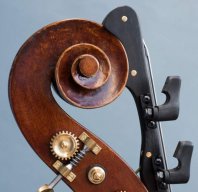
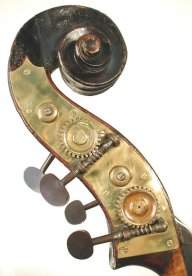
I recall a luthier telling me about 20 years ago that steel plates on the scroll add mass so the scroll doesn't vibrate and the energy goes down to the bridge instead.
I've noticed that most English basses have this feature. Maybe that is one of the reason English basses sound so good.
I've noticed that most English basses have this feature. Maybe that is one of the reason English basses sound so good.

bejoyous said:I recall a luthier telling me about 20 years ago that steel plates on the scroll add mass so the scroll doesn't vibrate and the energy goes down to the bridge instead....
Adding mass to the scroll would simply lower the resonant frequency of the head and (to an extent) neck, right? If you brought that down below the fundamental of the E, that might indeed be the effect you'd get.

mje said:Adding mass to the scroll would simply lower the resonant frequency of the head and (to an extent) neck, right? If you brought that down below the fundamental of the E, that might indeed be the effect you'd get.
One conflicting theory is that many instrument makers, especially guitar makers, prefer lightweight tuners, such as Waverly's. They argue that the added mass of tuners on the headstock absorbs too many vibrations, dissipating the energy of the string.
Here's what dobro player Jerry Douglas (admittedly not an instrument maker) says about it:
[Invalid or Expired Link Removed]
Now, this doesn't really say anything about sustain or resonant frequencies. It's kinda hard to tell since all instruments are interconnected systems, all of them a little different. Change one thing, such as the mass of the scroll, and it will have effects all over the rest of the instrument.
It also might be good to bring up that changing the mass of one piece might affect only certain frequencies, such as overtones, changing our perception of the sound while the overall energy to the top might be about the same. An example of this is heavy vs. lightweight tailpieces.
I don't really know the answer, just thinking out loud.
gp_bass said:...
I don't really know the answer, just thinking out loud.
Well, me too ;-)
There are brass plates sold designed to be fastened to the headstock of electrical guitars that are supposed to remove dead spots and improve sustain. Same idea, I would guess; get the resonance of the neck below low E.
Testing this would be simple enough. I don't have access to a lab with the right instruments any more, though. Paging DRURB....
mje said:Well, me too ;-)
Testing this would be simple enough. I don't have access to a lab with the right instruments any more, though. Paging DRURB....
That makes me remember reading about an experiment of attaching a heavy C-clamp to one of the cheeks of the scroll. It was either Bill Merchant or Chuck Traeger who wrote about this... maybe in Traeger's book? The article was talking about the benefits of a C extention to the overall sound of the bass.
Ought to be easy to try (don't forget some leather or softwood padding to avoid denting the bass with the clamp).

Charlie Nilles said:Hey cathead.
The answer to your question is very physics related ...
Peace,
Charlie
Very inetresting post and makes a great deal of sense from the point of view of physics. I'm not quite sure that forcing only the body to vibrate will always produce a more intense sound to be radiated into the air. I have to think about that one some more.
Given the "balance" you mentioned, it seems then that individual preferences might dictate that some players would prefer the old coat-hanger tailpiece wire. No? Yet, I've only heard people say how much they prefer the sound when such hangers are replaced with flexible wire and/or gut. I guess that could be the result of added sustain. Of course, what people report may not be reliable especially after they spend $$$ to make a change.
I wonder if part of the reason that cheapie basses are often built with solid hanger wire is to boost the "raw" output at the expense of sustain. Hmmm.
Anyway, thanks for your post.

Jake deVilliers
Commercial User
- May 24, 2006
- 6,349
- 607
- Disclosures
- Owner of The Bass Spa, String Repairman at Long & McQuade Vancouver
Well I can speak to the topic of lighter weight tuners on guitars. I've been 'back-dating' 1960's Martins for a few years now. One of the quickest ways to get closer to the 'punchier' sound of the earlier guitars is to replace the tuners with open back versions by Gotoh, Grover or Santa Cruz. Waverleys are nice too, but heavier than they need to be.
The reduced mass creates a big increase in volume and reduces some of the poopy sustain that muddies up the sound of these guitars.
I recently did a similar move with my wife's 1950 Kay. While I had the tuners off I gun-drilled the string shafts and filled them with Yellow Cedar, removing 135 grams in the process. The sound is much quicker now, and is easier to play because she gets the same volume with less effort.
Seeya, jake
The reduced mass creates a big increase in volume and reduces some of the poopy sustain that muddies up the sound of these guitars.
I recently did a similar move with my wife's 1950 Kay. While I had the tuners off I gun-drilled the string shafts and filled them with Yellow Cedar, removing 135 grams in the process. The sound is much quicker now, and is easier to play because she gets the same volume with less effort.
Seeya, jake

I have a new bass with a super resonant open "G" string. In order to quiet it down, I wedged a rubber ball between the bottom of the fingerboard and the body. In addition to taming the annoying octave overtone, it kind of took the "puff" out of the entire range of the instrument, giving it a drier and more focused sound. I'm not sure if I really want that or not, but it was an interesting experiment.
Chris Fitzgerald said:I have a new bass with a super resonant open "G" string. In order to quiet it down, I wedged a rubber ball between the bottom of the fingerboard and the body. In addition to taming the annoying octave overtone, it kind of took the "puff" out of the entire range of the instrument, giving it a drier and more focused sound. I'm not sure if I really want that or not, but it was an interesting experiment.
What prompted you to try the rubber ball?


