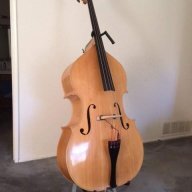
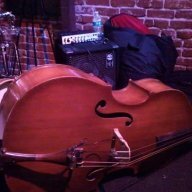
I've got a Kay from the same year, though it is in considerably worse cosmetic shape. I've never played a Thompson, but I have played a couple of new Shen plywood models during my recent bass shopping anabasis. The newer basses sound just as good as my Kay.
The Kay design had some odd characteristics. It has a fairly skinny neck, low overstand, and a low bridge. A lot of people say that a thicker neck is actually more comfortable to play due to enforcing a better hand shape. And a bass with more neck projection would be easier to get around in the upper registers, as well as providing better clearance for the bow.
The Kay also has some interesting mechanical issues. The neck is dovetailed into the neck block, rather than the more conventional straight mortise. I don't know if it's related or not, but my Kay, and others that I have seen, have required repairs to the neck joint and / or neck block. In addition, my Kay had a detached bass bar. There's a thread right now in "setup and repair" about Kay bass bars.
So I would say that at a bare minimum, you have to bring along a mirror and bright light to inspect the inside of the bass for the intactness of the bass bar, and make sure the neck is on there good and tight. Also, play it up and down every string to make sure that there are no buzzes that might indicate the need to have the fingerboard re-dressed. All of these things can be fixed, but you should read some recent threads about the anguish of getting an inexpensive bass and then discovering that it needs expensive repairs.
I don't mean to frighten you, as this is standard advice for checking out any bass. On the other hand, after getting my Kay into playable condition, it has served me for almost three decades.