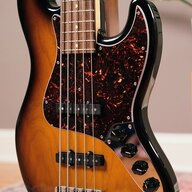
The P bass design is perfectly balanced until you add the 5th string.
I don't know about "perfectly balanced" - it does have the distinct sonic disadvantage that the strings are not all sampled at the same point - leading to endless discussions about which half of the pickup should be closer to the bridge. The P bass is a good design, but it can be improved in various ways.
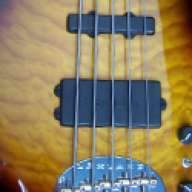
That aside, a 5 string split hum cancelling pickup can be made one of two ways - symmetrical or asymmetrical. The asymmetrical scheme has housings of unequal length, with 2 sets of magnets on one side, and 3 on the other. That way of doing it minimizes the inductance for a given output level. What that scheme gives up is hum cancellation - 3 is not equal to 2, with the net result being you get about 14dB of hum cancellation compared to a single coil. It's better than a single coil, but not as good as a balanced hum cancelling scheme.
A symmetrical 5 string P pickup has housings of the same length, with 2 sets of magnets under one side. The other side has two sets of magnets and pole pieces (or unmagnetized magnets) as well. That last bit doesn't contribute output, and it adds inductance, but it gives you complete hum cancellation - much better than the 14 dB you get from an unbalanced scheme.
5 string jazz bass pickups that do in line hum cancellation are all of the asymmetrical variety - they
will hum (at about 14 dB less hum than a single coil). They also have a "magnetic" valley - in between the 2 side and the 3 side, if you bend a string into that area, the level will drop off. The offset nature of a P pickup mitigates this; you won't notice it on a split P pickup.