• TalkBass has been independent since 1998. Add your voice.
    Create a free account to reply to discussions, view embedded media, and browse with fewer display ads.
    Join freeLog in
    Want zero display ads or expanded classifieds tools? Compare plans.

Thoughts on the Eminence Legend BP122

I was looking at the new BP112 and wanted to see what the speaker gurus here have to think of putting this into a small box as per their .pdf.

Specs:
Power handling: 250 watts RMS/500 watts max
• VCdia: 2"
• Le: 0.84 mH
• Impedance: 8 ohms
• Re: 5.66 ohms
• Frequency response: 35 to 2,300 Hz
• Fs: 35 Hz
• SPL: 94.1 dB 1W/1m
• Vas: 5.56 cu. ft.
• Qms: 9.26
• Qes: 0.57
• Qts: 0.54
• Xmax: 6.2 mm

Would vented (2.55 cu.ft.) or sealed (0.875 cu.ft.) be better?
How would it compare to say the Beta 12a or the S2012?
The cab would be used for at home practice and possibly for blues/R&B with a drummer and 1 guitar.
I have a 1x15 cab I could stack it on if I needed for volume or bottom end for jamming out in the garage.
 
I would look at the medium sealed. It's actually a bit smaller than the small vented and has a nice frequency response.

Invalid Link Removed

That driver's high Qms and Qts just screams for a sealed cab. You might be able to get a little better sound if stuffed with speaker stuffin'.
 
  • Like
Reactions: tewnty_two
I would look at the medium sealed. It's actually a bit smaller than the small vented and has a nice frequency response.

Invalid Link Removed

That driver's high Qms and Qts just screams for a sealed cab. You might be able to get a little better sound if stuffed with speaker stuffin'.

should I be worried about the 100 watts F3 at 57Hz?
I have a Fender Rumble v3 500 Head.
 
Last edited:
  • Like
Reactions: Moosehead1966
Concerning speaker damage? My take on sealed cabs is they do give more control in smaller boxes, but that can just translate to cranking it up more and getting closer to thermal/wattage limits. Generally a larger sealed box will give more LF sound with less wattage. For mechanical damage you could exceed the limit with either box, but there is a lot of warning first. Xlim is double Xmax, so you would be well into ugly distortion before hitting Xlim and damage. I think it's always best to listen to a cab by itself, away from distraction and learn how far you can crank it up before distortion. I guess your amp at 8 ohms puts out around 250 to 300 Watts?

I think either cab would be safe with your amp and the care you should give almost any cab connected. As far as which sounds best, that's more of a judgment call depending on what you want from it. I think that speaker and the Legend BP1525 are absolute bargains! I have a knock-off speaker similar to the BP1525, but not as good of specs in some areas, and it sounds way better than I imagined in a 4 cu ft box. It "wanted" 8 cu ft. So I would consider it a "medium" box more or less. I really have to hit it hard with insane bass eq to get it to fart. I wish I had seen the BP1525 if it was at that price at the time.
 
Concerning speaker damage? My take on sealed cabs is they do give more control in smaller boxes, but that can just translate to cranking it up more and getting closer to thermal/wattage limits. Generally a larger sealed box will give more LF sound with less wattage. For mechanical damage you could exceed the limit with either box, but there is a lot of warning first. Xlim is double Xmax, so you would be well into ugly distortion before hitting Xlim and damage. I think it's always best to listen to a cab by itself, away from distraction and learn how far you can crank it up before distortion. I guess your amp at 8 ohms puts out around 250 to 300 Watts?

I think either cab would be safe with your amp and the care you should give almost any cab connected. As far as which sounds best, that's more of a judgment call depending on what you want from it. I think that speaker and the Legend BP1525 are absolute bargains! I have a knock-off speaker similar to the BP1525, but not as good of specs in some areas, and it sounds way better than I imagined in a 4 cu ft box. It "wanted" 8 cu ft. So I would consider it a "medium" box more or less. I really have to hit it hard with insane bass eq to get it to fart. I wish I had seen the BP1525 if it was at that price at the time.

Thanks for the info!
The amp gets 350 watts into 8ohms but I don't plan on cranking the amp to max power at all with this or any cab. Ok, maybe a couple of times when the opportunity presents itself :bassist:.
I haven't owned a sealed cab but after listening to some video demos I want to try it out.
I would have to find someone to build it or find someone who would let me use their tools. I only have access to a skillsaw and maybe a jigsaw and a few clamps.
I was hoping to find some sound clips or anyone with firsthand experience of the bp122 in action but no luck.

Anyone out there have any experience with these bad boys?
 
Thanks for the info!
The amp gets 350 watts into 8ohms but I don't plan on cranking the amp to max power at all with this or any cab. Ok, maybe a couple of times when the opportunity presents itself :bassist:.
I haven't owned a sealed cab but after listening to some video demos I want to try it out.
I would have to find someone to build it or find someone who would let me use their tools. I only have access to a skillsaw and maybe a jigsaw and a few clamps.
I was hoping to find some sound clips or anyone with firsthand experience of the bp122 in action but no luck.

Anyone out there have any experience with these bad boys?

Sorry, the driver just came out this year. Looks good though.
 
  • Like
Reactions: tewnty_two
Ha, forgot to come back to this, but saw it on my phone when I opened the browser :D

The amp gets 350 watts into 8ohms but I don't plan on cranking the amp to max power at all with this or any cab. Ok, maybe a couple of times when the opportunity presents itself

Invalid Link Removed

I haven't owned a sealed cab but after listening to some video demos I want to try it out.

My take on sealed cabs, some others poopoo them as obsolete, yet good speaker companies like Eminence keep making new drivers for sealed cabs. To me they sound better. The coveted refrigerator is a sealed cab. The way I see it, your reflex speaker extends the bass some, at the cost of the subtle lower frequencies below tuning. Also there is a very good possibility that sound coming from the port is not something you want to hear. The sealed cab will produce frequencies well below the ported version, limited by the frequency response of the speaker itself, rather than port tuning. I say this is subtle, but also very natural, because it rolls off starting somewhere before what would be the bass extension on ported and continues down to and below the freq response spec., down to below what you can hear. Of course direct comparison A/B test is not very easy to accomplish. My Hi-fi go to speakers are sealed (2x10 + mid + Titainium tweet) Marantz from the early 80's. I also have some good KLH that are reflex and just used for full abuse mode, 301's and 901's (in disrepair ATM). The Marantz were badged as JBL or JBL's badged as Marantz. I'm not into audiofile, but those speakers held up to friends high end stuff very well, just not as loud with my lower wattage amp. The bass is outstanding. A/B'd on my room mates system and he was ashamed to admit his very expensive and larger JBLs only had better tweeters. Of course I wanted his system, I just didn't want to pay that much for something I could drive, sleep in, or sleep with :D

I would have to find someone to build it or find someone who would let me use their tools. I only have access to a skillsaw and maybe a jigsaw and a few clamps.

By skillsaw, that is a circular saw? If it has good bearing (you can't wiggle the blade back and forth) and you can cut a reasonable round hole, that's all you need. You can make a simple jig to get very straight cuts. I think it's called a sled. I made mine for $20 or less, just got an aluminum angle stock with one of the edges short (maybe 1/2") and the other longer (3/4 or 1"). I just drilled holes in the long side, screwed it down to a flat board, ran the saw across creating a perfectly straight line in the wood. Then you just clamp it onto your cut line with that edge lined up, making sure the motor will clear your clamps (don't ask how I know) and the blade is set deep enough to cut through the work (or all the way down, and you get a table saw quality cut. A long marriage has taught me one thing: practice on scrap! :D

If you can't find pics online or instructions, and you want pics of the jig I made, I can post for you. You can use a wood strip instead of angle stock. Oh, also set the angle of cut to 90 deg with a good square. Cheap ones can be good or not, just test the square on a board by marking a line, then flip the square and make sure the line matches the square with it flipped over. Works for a level too!
 
  • Like
Reactions: tewnty_two
Ha, forgot to come back to this, but saw it on my phone when I opened the browser :D


Invalid Link Removed


My take on sealed cabs, some others poopoo them as obsolete, yet good speaker companies like Eminence keep making new drivers for sealed cabs. To me they sound better. The coveted refrigerator is a sealed cab. The way I see it, your reflex speaker extends the bass some, at the cost of the subtle lower frequencies below tuning. Also there is a very good possibility that sound coming from the port is not something you want to hear. The sealed cab will produce frequencies well below the ported version, limited by the frequency response of the speaker itself, rather than port tuning. I say this is subtle, but also very natural, because it rolls off starting somewhere before what would be the bass extension on ported and continues down to and below the freq response spec., down to below what you can hear. Of course direct comparison A/B test is not very easy to accomplish. My Hi-fi go to speakers are sealed (2x10 + mid + Titainium tweet) Marantz from the early 80's. I also have some good KLH that are reflex and just used for full abuse mode, 301's and 901's (in disrepair ATM). The Marantz were badged as JBL or JBL's badged as Marantz. I'm not into audiofile, but those speakers held up to friends high end stuff very well, just not as loud with my lower wattage amp. The bass is outstanding. A/B'd on my room mates system and he was ashamed to admit his very expensive and larger JBLs only had better tweeters. Of course I wanted his system, I just didn't want to pay that much for something I could drive, sleep in, or sleep with :D


By skillsaw, that is a circular saw? If it has good bearing (you can't wiggle the blade back and forth) and you can cut a reasonable round hole, that's all you need. You can make a simple jig to get very straight cuts. I think it's called a sled. I made mine for $20 or less, just got an aluminum angle stock with one of the edges short (maybe 1/2") and the other longer (3/4 or 1"). I just drilled holes in the long side, screwed it down to a flat board, ran the saw across creating a perfectly straight line in the wood. Then you just clamp it onto your cut line with that edge lined up, making sure the motor will clear your clamps (don't ask how I know) and the blade is set deep enough to cut through the work (or all the way down, and you get a table saw quality cut. A long marriage has taught me one thing: practice on scrap! :D

If you can't find pics online or instructions, and you want pics of the jig I made, I can post for you. You can use a wood strip instead of angle stock. Oh, also set the angle of cut to 90 deg with a good square. Cheap ones can be good or not, just test the square on a board by marking a line, then flip the square and make sure the line matches the square with it flipped over. Works for a level too!

Thanks again for the follow up.
I was thinking the same thing about the sealed cab sound. I think that it would be good for the sound I'm going for.
When did ported cabs start being widely used for bass guitar?
Since I'm going for Blues, R&B and Garage rock sound I think they'll fit the bill. Plus it's a simpler design since I don't have to fiddle with tuning via port lengths.

About building the cab, I might just see if the local lumber yard could make the cuts if I give them a cut sheet.

But of course now I'm thinking of doing a 2x12 just because 2 is better than one, right?
 
  • Like
Reactions: BadExample
I think lumber yard cuts is a great idea. Save a bunch of time too. It doesn't have to be perfect, especially with the modern PL glue that will fill gaps and seal it well. I used 1 x 2 cleats inside mine to hold the shape while the glue dried. You can put some wax paper between the cleats and plywood, then remove once dry, but I didn't.

Bass reflex was probably used almost from day one. It's been around a long time, long before electric bass I'm pretty sure. I don't really know anything about MI history.

I think your right about the simplicity and the sound for your music.
 
  • Like
Reactions: tewnty_two
A speaker will 'work' in any box. So, how do you choose. Prioritize. Ergonomics (size & weight), tone, spl capability, sensitivity, etc. If you base those decisions on what others say, you will get a box optimized for their needs. Why not choose based on your needs. If you would give us your top priorities, you'll get much more useful help. We can try to second guess what these are, but it helps to know what you really want.
 
A speaker will 'work' in any box. So, how do you choose. Prioritize. Ergonomics (size & weight), tone, spl capability, sensitivity, etc. If you base those decisions on what others say, you will get a box optimized for their needs. Why not choose based on your needs. If you would give us your top priorities, you'll get much more useful help. We can try to second guess what these are, but it helps to know what you really want.
First is size, I have a peavy 2x15 but there's no space in the living room for that monster. Plus its overkill for my needs.
Second is sound, I want to play Blues, R&B and Garage Rock but of course fiddle around with all genres when practicing.
Third is loudness, I would like something that covers a broad spectrum ie sounds good at low solo practice volume but can go up against a drummer and git.
And of course I want the best speaker ever made for rock bottom prices.:thumbsup:
It will be powered by a Fender Rumble v3 500 amp with an Orange Preamp pedal, a fuzz pedal, OD pedal and a Zoom b1on.
I'm using a Gretsch G2202 with Chrome flats but looking at buying a P/J or the like.
Thanks for you help!
 
First is size, I have a peavy 2x15 but there's no space in the living room for that monster. Plus its overkill for my needs.
Second is sound, I want to play Blues, R&B and Garage Rock but of course fiddle around with all genres when practicing.
Third is loudness, I would like something that covers a broad spectrum ie sounds good at low solo practice volume but can go up against a drummer and git.
And of course I want the best speaker ever made for rock bottom prices.:thumbsup:
It will be powered by a Fender Rumble v3 500 amp with an Orange Preamp pedal, a fuzz pedal, OD pedal and a Zoom b1on.
I'm using a Gretsch G2202 with Chrome flats but looking at buying a P/J or the like.
Thanks for you help!

I know that this driver has as much displacement as a beta 15a, which is a 15" driver, and some people like them quite fine for bass, especially as a B-15 replacement driver, and they both have the same Fs of 35 hz. Their EBP values are relatively close as well, with 62 for the legend and 56 for the Beta. They have similar Qts values, of 0.54 for the legend and 0.58 for the Beta, with Vas of 5.56 cubic feet and 11.82 cubic feet respectively as well. So to get a similar low-end response you'd put the legend into a smaller box because the compliance is smaller AFAIK. As far as the legend goes, its high-end extension goes to about 2.3 khz on their spec sheet, and the Beta goes up to 3.7 khz, and the legend at 94.1 db of sensitivity has more or less 4 db less sensitivity than the beta at 98.2 db. So, in a box designed for similar low-end extension, the legend would go about as loud in the low end as the beta, but would need a bit more than twice the power for the same volume (because twice the power makes, at best, a 3 db increase), but the Beta would probably seem louder or cut through some mixes better even at the same objective volume or SPL because of its greater high-end extension. To put the 2.3 khz upper limit into perspective, the driver in my 115 cabinet is a different legend, and goes up to about 3khz if I can recall, and I would say it's a pretty "classic" tone, with a good bit of low-end focus that doesn't go too high - this driver will be even bassier. If you're okay with a good low-endy tone, that goes to a smooth midrange and not much above that (which with your Gretsch with flats I'd say you're okay with that), then it should be a great tone for you and should at least be loud enough for a dusty garage, and some smaller bars/bigger noisier cafe's. As for ported vs. sealed, you'd be able to just plain get more low-end with ported, but it'd be a bigger (and therefore also heavier) cabinet, and with as little high end as you'd have, you'd probably be making the whole sound a bit muddier with the port extending and backing up the low-end response. The small sealed design has an f3 of 70.3 hz, the small ported has an f3 of 51.6 hz, to put that into perspective, most would say that an f3 of close to 60 hz is great for a 5-string, 80 hz for a 4-string in standard tuning. So even the sealed box would have good extension for you to mess about with drop-d and such.


Okay, that was a big, and long paragraph.

TL;DR - Based on what you've said you like, this driver could be a good fit if you don't like highs, or high mids even, and should be good for at least a garage and probably small venues too, depending on how loud your drummer and guitarist are. If you want more mids/highs, a 5-8" midrange driver shouldn't be too hard to figure out, or you could just grab a beta 15 with the same displacement, more sensitivity, and a bit more mids/highs. As for sealed vs ported, it kinda doesn't matter with this driver, either way should have plenty of pillowy low end.
 
  • Like
Reactions: tewnty_two
@AstroSonic do you know the answer?
^^^ is da man, @tewnty_two ! He knows 100 X more than I ever will.

Ported cabs for bass guitar date back at least to the early 60's, when the Ampeg Portaflex series came out. They were well established by the late 60's. Kustom tuck & roll cabs with chrome plated ports were popular in the mid 60's and early 70's. Their development was about 10 years behind the development of the bass guitar (in the early 50's). I designed my first bass cab (ported 215 with Altecs) in 1968.
 
I know that this driver has as much displacement as a beta 15a, which is a 15" driver, and some people like them quite fine for bass, especially as a B-15 replacement driver, and they both have the same Fs of 35 hz. Their EBP values are relatively close as well, with 62 for the legend and 56 for the Beta. They have similar Qts values, of 0.54 for the legend and 0.58 for the Beta, with Vas of 5.56 cubic feet and 11.82 cubic feet respectively as well. So to get a similar low-end response you'd put the legend into a smaller box because the compliance is smaller AFAIK. As far as the legend goes, its high-end extension goes to about 2.3 khz on their spec sheet, and the Beta goes up to 3.7 khz, and the legend at 94.1 db of sensitivity has more or less 4 db less sensitivity than the beta at 98.2 db. So, in a box designed for similar low-end extension, the legend would go about as loud in the low end as the beta, but would need a bit more than twice the power for the same volume (because twice the power makes, at best, a 3 db increase), but the Beta would probably seem louder or cut through some mixes better even at the same objective volume or SPL because of its greater high-end extension. To put the 2.3 khz upper limit into perspective, the driver in my 115 cabinet is a different legend, and goes up to about 3khz if I can recall, and I would say it's a pretty "classic" tone, with a good bit of low-end focus that doesn't go too high - this driver will be even bassier. If you're okay with a good low-endy tone, that goes to a smooth midrange and not much above that (which with your Gretsch with flats I'd say you're okay with that), then it should be a great tone for you and should at least be loud enough for a dusty garage, and some smaller bars/bigger noisier cafe's. As for ported vs. sealed, you'd be able to just plain get more low-end with ported, but it'd be a bigger (and therefore also heavier) cabinet, and with as little high end as you'd have, you'd probably be making the whole sound a bit muddier with the port extending and backing up the low-end response. The small sealed design has an f3 of 70.3 hz, the small ported has an f3 of 51.6 hz, to put that into perspective, most would say that an f3 of close to 60 hz is great for a 5-string, 80 hz for a 4-string in standard tuning. So even the sealed box would have good extension for you to mess about with drop-d and such.


Okay, that was a big, and long paragraph.

TL;DR - Based on what you've said you like, this driver could be a good fit if you don't like highs, or high mids even, and should be good for at least a garage and probably small venues too, depending on how loud your drummer and guitarist are. If you want more mids/highs, a 5-8" midrange driver shouldn't be too hard to figure out, or you could just grab a beta 15 with the same displacement, more sensitivity, and a bit more mids/highs. As for sealed vs ported, it kinda doesn't matter with this driver, either way should have plenty of pillowy low end.


Thanks for the info!
So I gather that the BP12 will fill my needs but the 15 will give better performance.
If I had to buy a driver I would prefer the BP122 for the smaller footprint.
However, I have an Eminence CB158 that is currently in the top chamber of a old Peavy 215 cab. What are your thoughts on using that driver in a small sealed box around 1.62 cu.ft?
The first priority was having a small footprint, thats why I was looking at the BP122 but if the CB15 will work in a small enclosure then I can work with that!

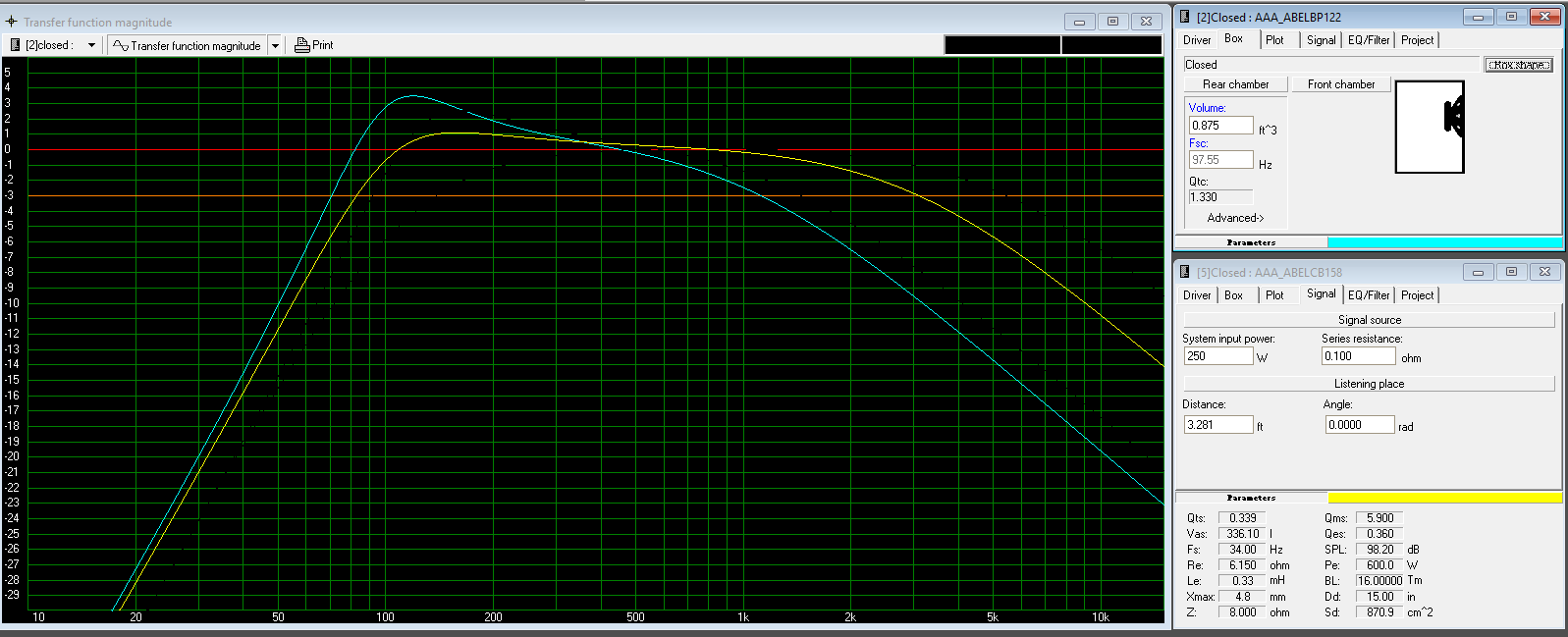
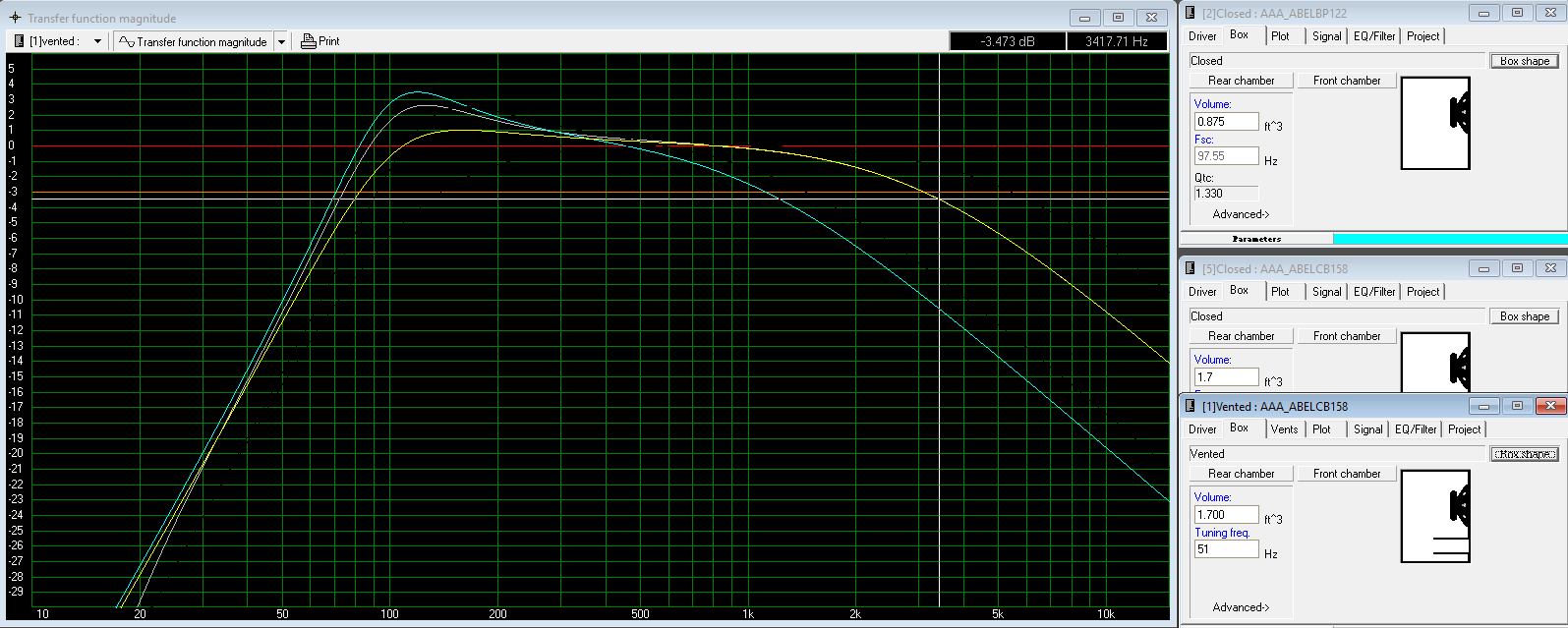
Here is a plot of the BP112 (blue) in 0.875 cu.ft. and the CB158(yellow) in 1.629 cu.ft

EDIT:
I threw the specs in for a small vented cab @ 1.7cuft. tuned to 51hz with 2 round ports 7.5" deep from the suggested builds on the eminence website.
 
Last edited:
It will probably sound good. Since you have the CB158, why not try it in a cab that would work for the 12" if you decide to go with that? Just make the baffle removable and sealed with weather strip. 1.9 to 2.3 cu ft for the CB and .8 t0 3.5 cu ft for the PB1222 by their spec sheet. You just need to account for the baffle frame, any bracing and the driver volume if you go really small cab. winISD accounts for the driver taking up space and Eminance specs it if you don't enter the physical dimensions. Do you have the pro version of winISD? It's free too and the link is on their facebook page. I think I saw it in the ohm sticky too.
 
To get similar response from WinISD(-pro) like calculated by the Eminence software there is need to block the port dimension (editor) on WinISD(-pro).
In alternative you can edit the desired cab tuning frequency directly.
Based on port dimension WinISD predicts somewhat different cabinet tuning than the Eminence design software.
While for "matching" tuning frequency and cab-volume the calculated response is very close.

Sometimes the deviations of WinISD/WinISD-pro to Eminence deigner is quite a lot (which means not insignifcant).
Not unlikely that WinISD(-pro) calculates a port length that differs about +50% in length versus Eminence designer (BassBox-pro).
To the contrary based on port dimension WinISD(pro) may predict a cab tuning which is to low in number. That's delicate/annoying if the tuning "sound goal" shall be at lowish side of reasonable tuning-frequencies.

suggestion,
you may use WinISD-pro to figure out response based on cab volume and cab tuning.
Then you may use BoxSim freeware Invalid Link Removed
to calculate the ports based on cab-volume and cab-tuning.
BoxSim ports calculator also provides the big benefit to calculate shelf-ports.

edit,
WinISD is also faulty on system impedance which is noticeable to big.
That's delicate to evaluate (reasonable) tonal interaction with tube amplifiers.
 
Last edited:
Thanks for the info!
So I gather that the BP12 will fill my needs but the 15 will give better performance.
If I had to buy a driver I would prefer the BP122 for the smaller footprint.
However, I have an Eminence CB158 that is currently in the top chamber of a old Peavy 215 cab. What are your thoughts on using that driver in a small sealed box around 1.62 cu.ft?
The first priority was having a small footprint, thats why I was looking at the BP122 but if the CB15 will work in a small enclosure then I can work with that!

Here is a plot of the BP112 (blue) in 0.875 cu.ft. and the CB158(yellow) in 1.629 cu.ft

EDIT:
I threw the specs in for a small vented cab @ 1.7cuft. tuned to 51hz with 2 round ports 7.5" deep from the suggested builds on the eminence website.

It, in all honesty, should work. The cb158 tends to like a smaller box than the beta, and has more excursion. I'm pretty sure that the driver in my cab has the 158 in it, and it sounds perfectly fine (the label axially doesn't state the model, but it looks pretty similar and is eight ohms). If you already like how it sounds, then it should work great. The bp122 is a great driver, and I think that the fact that it can compete with a 15" driver in terms of potential low end volume is impressive, and it definitely could perform well in a cabinet with a small footprint. With that said though, it's not a very sensitive speaker, this doesn't matter too much though since you have enough amp to drive the speaker into a good volume though. The cb158 does also have plenty of bass and can perform very well in a smaller cab, since its qts is lower.