
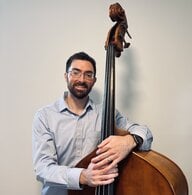
i think it's best to try to stay as much on the tip of the finger as you can. you need monster callouses to really do this though. i suggest you practice vomits everyday for a couple weeks to build callouses.
the reason you want to keep the fingers curved can be best explained by basic physics. basically, you're trying to get the string down to the board. the most efficient way to do that is to press down from directly on top of the string. when the finger collapses, you're pressing down on the top knuckle, which is then pulling the end of the finger into the string... pretty inefficient all in all. also, there is more surface area in contact with the string, which means more friction, which translates to shifting difficulties. again, inefficient.
my suggestion- use a solid hand position with the fingers curved and focus on using leverage coming through your elbow with the power coming from your back and shoulder. imagine a line running from the base of your spine to your finger tips. any kink in this line cuts off and isolates your energy to whatever is beyond that point. for example, if your wrist is bent unnaturally you isolate and overwork the hand.
also, everyone has a unique physiology. you definitely don't need to keep all the fingers in position when using an open hand fingering (or even a closed hand position for that matter). just do whatever you need to (pivot, shift, etc.) so long as you are keeping your flow of energy intact. don't think of thumb position as a difficult thing, it is only unfamiliar.
hope this helps!
Whoa! That is an awesome explanation!
I've been pondering this quite a bit in the last few days - in both the orchestral and solo registers - what constitutes proper finger placement?
I have found that, overall, I am on my pads way too much of the time. I am working on "Jesu, Joy of Man's Desiring" in Progressive Rep Book 2, and have been inadvertently muting the open G when coming from a higher position on the D string. This is due to my fingers being too flattened out.
Playing way up on the very tip of my index finger is really uncomfortable, and honestly feels unnatural. It also seems inefficient to play on the pad and flatten out my finger. I have found, however, what I think is a best thing for me - a sort of hybrid area where I am playing a little bit back from the tip, but am still able to curve my finger to give myself the proper clearance to bow any open string clearly when it is called for.
The pictures in the front of the Simandl book seem to show a similar hand position. In the close up of the left hand in first position, the index finger and pinky look like they are placed in that spot of the finger that is, for lack of a better term, right in between the tip and pad area. The second and third fingers, however, appear like they are fully curved, and the tips of those fingers are on the strings.
Square Bear, what are vomits?


