

Enjoy the benefits of a premium membership!
Upgrade Account
-
TalkBass has been independent since 1998. Add your voice.
Create a free account to reply to discussions, view embedded media, and browse with fewer display ads.
Join free Log in
Want zero display ads or expanded classifieds tools? Compare plans.
You are using an out of date browser. It may not display this or other websites correctly.
You should upgrade or use an alternative browser.
You should upgrade or use an alternative browser.
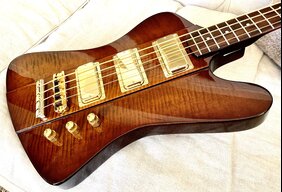
Thunderbird Club
- Thread starter TBird1958
- Start date
-
- Tags
- club thunderbird
More options
Who Replied?
LOL - Alcohol consumption and Intellegent decision making are pretty much mutually exclusive of each other.

Can't say I've ever seen dual caps on a tone pot. Looks like they're in parallel, so what does this accomplish vs just a single cap?Late 80's Seymour Duncan Hawkbucker installed back then (center 500K volume pot)
View attachment 2941972
Noticed that the tone pot right tang is broken off - hasn't affected anything so it's a none issue. Two caps, .02Z /50V each.
View attachment 2941973
for clarity
View attachment 2941975

- Jun 30, 2010
- 49,588
- 221,963
- Disclosures
- musician/artist/owner - Gildaxe
Can't say I've ever seen dual caps on a tone pot. Looks like they're in parallel, so what does this accomplish vs just a single cap?
Heck if I know - they are original from the Gibson factory in 1964. I only added the 2nd (center) volume pot.

PS. Bird pickups are usually wired with 500K pots, whereas stock Fender are 250K afaik.
This was a Fender Blacktop Precision wicj came with jazz humbuckers:
Yep, one of the best sounding Fender Precisions I ever played. I think deep down I'm just a Humbucker guy. It seems to be about the only thing in common that all of my favorite sounding basses have.

That's almost impressive.
Just did a quick check on google - if I'm understanding it correctly, caps in parallel are additive. So if you had two .022uf caps in parallel it would be about the same as using a single .047uf cap (actual would be .044uf). So I'm guessing the Gibson factory must have been out of .047uf caps that day and just doubled up, or possibly some bean counter viewed only stocking one size cap as a simplification and cost reduction method (until he figured out the additional labor involved).Heck if I know - they are original from the Gibson factory in 1964. I only added the 2nd (center) volume pot.
Your choice on the tone cap, but it does impact the tone.
Here's what your wiring should look like for a Vol, Vol, tone layout...
http://www.guitar-mod.com/wiring/jbass.gif
Thanks. The issues seems to be that the tone pot is acting as a volume pot as well.....it does have a tone cap on it. It was just on the side.
Thanks. The issues seems to be that the tone pot is acting as a volume pot as well.....it does have a tone cap on it. It was just on the side.
That's why I recommend taking things back to the simplest possible configuration and then advancing from there.

Correct, typically 500k for humbuckers and 250k for single coils but either will work for the other it just changes the tone a bit.
Edit: FWIW 250k might sound a bit warmer as it bleeds off some of the top end.
We don't need no stinkin, bleeding off top end.
- Jun 30, 2010
- 49,588
- 221,963
- Disclosures
- musician/artist/owner - Gildaxe
Just did a quick check on google - if I'm understanding it correctly, caps in parallel are additive. So if you had two .022uf caps in parallel it would be about the same as using a single .047uf cap (actual would be .044uf). So I'm guessing the Gibson factory must have been out of .047uf caps that day and just doubled up, or possibly some bean counter viewed only stocking one size cap as a simplification and cost reduction method (until he figured out the additional labor involved).
Sounds reasonable. The factory bone nut was miss-spaced also. I only realized it recently and replaced it with a property spaced brass one. Must have been a Friday bass.

Regarding caps. Lower resistance allows for more highs, is this correct?
If you have confirmed that everything is wired up as that diagram shows then I'd take Kats advice and start at the tone pot and go from there.Thanks. The issues seems to be that the tone pot is acting as a volume pot as well.....it does have a tone cap on it. It was just on the side.
I disconnected the tone pot. It seems that the the neck pick up is the culprit. Odd.
Gaolee
Official leathers tester and crash dummy
It's capacitance, not resistance. Capacitors are a way to temporarily store electrical potential. Think of it as a kind of pad. If you have a thin pad, it doesn't soak up much. If you have a big ol' floppy pad, whatever goes in gets absorbed in the mush. From an electrical standpoint, I'm not sure why caps alter the waveform like they do. But they do, and the larger the number, the more the roll-off.Regarding caps. Lower resistance allows for more highs, is this correct?
Kat could probably explain the electrical phenomena that make this work. The rest of us could probably look it up, but it might not make sense if you don't have sufficient geekery in your soul.
It's capacitance, not resistance. Think of it as a kind of pad. If you have a thin pad, it doesn't soak up much. If you have a big ol' floppy pad, whatever goes in gets absorbed in the mush. From an electrical standpoint, I'm not sure why caps alter the waveform like they do. But they do, and the larger the number, the more the roll-off.
Yup, makes sense. And thanks Will.
The geekery in my soul is beyond anybody's comprehension. But to clarify that, not in a mathematical or intellectual way.
Like I said - check the wiring diagram. It looks like you missed a ground connection on the left most tab of the neck pot. According to the diagram you should have a hot pup wire to center tab, neutral white wire to the right tab and going off to the other pot and jack, and your left tab should be grounded to the neck volume pot casing, which it currently isn't if I'm looking at your photo correctly.I disconnected the tone pot. It seems that the the neck pick up is the culprit. Odd.
Both volume pots should utilize all three tabs. Left tab grounded to the pot casing in both cases. I can't clearly see if you've done that on the bridge pot.

hillerup
There are basses, and there are Thunderbirds!
Or poke at it for sport. That's always lots of fun.
View attachment 2941574
That it beyond cool! Where is that statue situated?


