I see Paris.

I see France................

TalkBass has been independent since 1998. Add your voice.
Create a free account to reply to discussions, view embedded media, and browse with fewer display ads.
Join free Log in
Want zero display ads or expanded classifieds tools? Compare plans.
I see Paris.

It has a thundering 12 horsepower, no? Tres bien!Nah, Macron backed off when business owners started complaining about the dipping tourist business...
here's one for serious hi hp/torque muscle car enthusiasts out there..
View attachment 3247630

yeah, Miles' post reads confusing and this happens often when this is discussed..I did a bunch of that stuff many years ago in high school. Much of the knowledge is lost t the sands of time. Absolutely correct. Interesting that many/most people think that running a tube amp without a load poses a danger to the tubes. In fact it is the output transformer, which is one of the more expensive components (more so than the power tubes).
I never knew why or what the issue was with unloaded tube amps. Only that power without a load is a bad idea. Which was never a problem, because I only own tube combos that always have a load attached and solid state bass heads that do not seem to be bothered by much of anything, including heavy dewfall.I did a bunch of that stuff many years ago in high school. Much of the knowledge is lost t the sands of time. Absolutely correct. Interesting that many/most people think that running a tube amp without a load poses a danger to the tubes. In fact it is the output transformer, which is one of the more expensive components (more so than the power tubes).
because the output transformer transforms the high Z of the tubes to the low Z of the speaker, when unloaded the voltages on the primary (tube) side of said transformer will reach VERY high voltage levels that will breakdown the insulation rating of the windings causing them to short.I never knew why or what the issue was with unloaded tube amps. Only that power without a load is a bad idea. Which was never a problem, because I only own tube combos that always have a load attached and solid state bass heads that do not seem to be bothered by much of anything, including heavy dewfall.
Kinda like having two kids on kne side of the see-saw instead of one on each side. Or maybe two big kids on one side and a little one on the other. Sproing! That is my simple minded mechanical way approaching the way that happens.because the output transformer transforms the high Z of the tubes to the low Z of the speaker, when unloaded the voltages on the primary (tube) side of said transformer will reach VERY high voltage levels that will breakdown the insulation rating of the windings causing them to short.

yeah, Miles' post reads confusing and this happens often when this is discussed..
a "high" load is actually a "light" (approaching an open) load.
a "low" load is actually a "heavy" (approaching a short) load.
Part of the confusion IMHO stems from the fact that loads began to get categorized this way when low Z (SS) circuitry became prominent and folks would refer to loads from an Amperage (not Voltage) perspective.
It always surprised me that tube amp manufacturers did not make provision for a short at the output jack when no speaker was hooked up, one (the short) that would be placed in series with the speaker when it was hooked up...could have saved users loads of grief..
Except that the see saw breaks in half and catches fire.Kinda like having two kids on kne side of the see-saw instead of one on each side. Or maybe two big kids on one side and a little one on the other. Sproing! That is my simple minded mechanical way approaching the way that happens.
I like a good mouth zapping. But we may not be talking about the same thing.I should mention that playing a wedding on a plywood stage in a field when heavy fog and dew rolls in is a good mouth zapping time, but the 360 did not seem to notice at all. Go figure. So much for delicate old equipment. I would admit that I have not had to do anything except plug in and power up since I got it. But that would be tempting fate, so I won't.
you'd be surprised how many electronic problems are taught/solved using mechanical analogues..Kinda like having two kids on kne side of the see-saw instead of one on each side. Or maybe two big kids on one side and a little one on the other. Sproing! That is my simple minded mechanical way approaching the way that happens.

Went well JJR, thanks
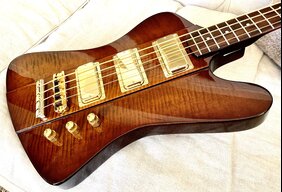
funny you should mention, thought of you when I saw this display, haven't been a Ricky fan in years but that finish......hmmmm....
View attachment 3247619

Loose nut in my head!You probably have a unicorn with a loose nut! Tighten that bugger before you tear the wires off their posts.
My PF350 is fine with no load - but heavy dewfall? I can't even leave it in the trunk for an afternoon at 2 degrees Celsius. (36 in American)I never knew why or what the issue was with unloaded tube amps. Only that power without a load is a bad idea. Which was never a problem, because I only own tube combos that always have a load attached and solid state bass heads that do not seem to be bothered by much of anything, including heavy dewfall.
Maybe it should be called the Thunderbird+ clubis this still the Thunderbird club?

or the Anything But Thunderbird clubMaybe it should be called the Thunderbird+ club


NOICE!Nah, Macron backed off when business owners started complaining about the dipping tourist business...
here's one for serious hi hp/torque muscle car enthusiasts out there..
View attachment 3247630
Regarding thread content, as a club member here I'd say we have very open minds, unfortunately that means sometimes our brains fall out.or the Anything But Thunderbird club


