
Enjoy the benefits of a premium membership!
Upgrade Account
-
TalkBass has been independent since 1998. Add your voice.
Create a free account to reply to discussions, view embedded media, and browse with fewer display ads.
Join free Log in
Want zero display ads or expanded classifieds tools? Compare plans.
You are using an out of date browser. It may not display this or other websites correctly.
You should upgrade or use an alternative browser.
You should upgrade or use an alternative browser.
Double Bass Tips for practising fast bowings
- Thread starter Julius
- Start date
More options
Who Replied?
Spiccato bowing certainly is a challenge. Watching Bozo play you can see he has played Mozart 40 so many times it’s memorized. A great spiccato is a sign of a pro. To get to this level there are no short cuts.
Bouncing the bow, if your bow can even do a spiccato, string type, left hand dexterity etc all come into it. There are a few standard bass arco books readily available for exercises. I have ‘em, but I like to just play the pieces like Mozart 40 slowly and speed things up.
Where do you start?
To copy what Bozo is doing here is kinda like a classical player saying he wants to play jazz like NHOP. So…
The obvious fast answer to learn spiccato arco is a pro symphony player who gives lessons. In Malmo Sweden Jordan Scapinello and his wife Marin Reck play bass in the local symphony. Marin is the principal. They may be a good start for you. A couple of lessons specifically targeting spiccato will be better than exercises from a book on your own. They will have examples to play. Record the lessons.
Bouncing the bow, if your bow can even do a spiccato, string type, left hand dexterity etc all come into it. There are a few standard bass arco books readily available for exercises. I have ‘em, but I like to just play the pieces like Mozart 40 slowly and speed things up.
Where do you start?
To copy what Bozo is doing here is kinda like a classical player saying he wants to play jazz like NHOP. So…
The obvious fast answer to learn spiccato arco is a pro symphony player who gives lessons. In Malmo Sweden Jordan Scapinello and his wife Marin Reck play bass in the local symphony. Marin is the principal. They may be a good start for you. A couple of lessons specifically targeting spiccato will be better than exercises from a book on your own. They will have examples to play. Record the lessons.
Last edited:

"a beginner classical double bass player?"
Yeah ... spiccato is not going to happen for a beginner, and really, it shouldn't, unless he's a real prodigy.
The Simandl I book has exercises for spiccato. Maybe I just have no talent, but I've been learning the bow for 3-1/2 years and I can't even get close to playing those.
Yeah ... spiccato is not going to happen for a beginner, and really, it shouldn't, unless he's a real prodigy.
The Simandl I book has exercises for spiccato. Maybe I just have no talent, but I've been learning the bow for 3-1/2 years and I can't even get close to playing those.
Get Galen McCormick's books, "Mastering the Art of the Bow." Volume 2 is on spiccato, but work your way through Vol 1 (slowly) first. A lot of it is
a "simplification" (maybe a "simpler presentation") of methods by others - Svejek, Zimmerman etc; but it's a good fundamental approach.
a "simplification" (maybe a "simpler presentation") of methods by others - Svejek, Zimmerman etc; but it's a good fundamental approach.
"a beginner classical double bass player?"
Yeah ... spiccato is not going to happen for a beginner, and really, it shouldn't, unless he's a real prodigy.
The Simandl I book has exercises for spiccato. Maybe I just have no talent, but I've been learning the bow for 3-1/2 years and I can't even get close to playing those.
Open question - can perseverance, attitude and willingness (which without knowing you other than from your posts you appear to have) overcome a "perceived" lack of talent? What's the saying...practice makes perfect! However, to your point, and others, we all crawled before walking (and running).
With a teacher, you will save hundreds of hours of wrongly aimed practising. I'm mostly self learned so I know it's true.
However, if you want a good book, you might try to look for Miloslav Gajdos: Bowing excersises, 1992. I've found this so check it out. I'm not sure whether the book ever was officially published, but it's a good one. I have different edition with a slightly different etudes and more excersises. It uses violinist Sevcik bowing method, but Mr. Gajdos wrote bass clef etudes for it and done some editing. Spiccato is at page 8 and you will do yourself a favor if you at least try all the earlier stuff before.
There's relevant thread here. The other book discussed is Zimmermann: A Contemporary Concept of Bowing (from 60s I think).
However, if you want a good book, you might try to look for Miloslav Gajdos: Bowing excersises, 1992. I've found this so check it out. I'm not sure whether the book ever was officially published, but it's a good one. I have different edition with a slightly different etudes and more excersises. It uses violinist Sevcik bowing method, but Mr. Gajdos wrote bass clef etudes for it and done some editing. Spiccato is at page 8 and you will do yourself a favor if you at least try all the earlier stuff before.
There's relevant thread here. The other book discussed is Zimmermann: A Contemporary Concept of Bowing (from 60s I think).
As an Amazon Associate, TalkBass may receive commissions from qualifying purchases made via links on this site.

Whole notes > 1/2 notes > 1/4 notes > 1/8 notes > triplets > 1/16 notes
Metronome set somewhere between 60-80.
All four strings but if time is short just do the E and A.
Do that for a year and then maybe get the Zimmerman string crossing book.
Metronome set somewhere between 60-80.
All four strings but if time is short just do the E and A.
Do that for a year and then maybe get the Zimmerman string crossing book.
You need to be able to play a fast detache on the string before attempting any off the string stroke.
Here is a technique I’m using at the moment to get up to speed to play some passages from the first movement of Mendelssohn No. 5.
The concert target speed is 1/8th notes @ 120bpm in cut time. In other words, blindingly fast.
Kinda nice to be accurate a bit faster than target.
How To Practice Efficiently Using Rhythms
The concert target speed is 1/8th notes @ 120bpm in cut time. In other words, blindingly fast.
Kinda nice to be accurate a bit faster than target.
How To Practice Efficiently Using Rhythms

Agreed AGCurry: oh heavens, spiccato ≠ beginner. Take all the time with a classical teacher and make beautiful long bow legato for a while, then learn to “scrub” fast and clean triplets and 16ths on string and then … it takes years for mere mortals to do it right."a beginner classical double bass player?"
Yeah ... spiccato is not going to happen for a beginner, and really, it shouldn't, unless he's a real prodigy.
The Simandl I book has exercises for spiccato. Maybe I just have no talent, but I've been learning the bow for 3-1/2 years and I can't even get close to playing those.
My teacher is good enough to "sub" for the St. Louis Symphony Orchestra. At my last lesson, he demonstrated a spiccato from Beethoven 5. He told me that he can't play it well.
Whole notes > 1/2 notes > 1/4 notes > 1/8 notes > triplets > 1/16 notes
Metronome set somewhere between 60-80.
All four strings but if time is short just do the E and A.
Do that for a year and then maybe get the Zimmerman string crossing book.
I actually had a teacher advocate for going 16ths before triplets, and to then add sextuplets on top. His argument was that it adds in the upbow, downbow motion you will eventually need, so it's an additional complication.
Thoughts?

Sevcik Op.3 has the focussed exercises but, as others have rightly pointed out, you should probably first factor in 3-5 years with a good teacher just developing the bow.

Ross Kratter
Supporting Member
- Dec 31, 2010
- 450
- 297
- 33
- Disclosures
- Artist, RS Berkeley, La Bella Strings, Phil Jones Bass Amplification, Remic, Jerry Harvey Audio
The third movement thing in 3? That’s a bear!My teacher is good enough to "sub" for the St. Louis Symphony Orchestra. At my last lesson, he demonstrated a spiccato from Beethoven 5. He told me that he can't play it well.
My teacher is good enough to "sub" for the St. Louis Symphony Orchestra. At my last lesson, he demonstrated a spiccato from Beethoven 5. He told me that he can't play it well.
I'm curious which part that is
I'm curious which part that is
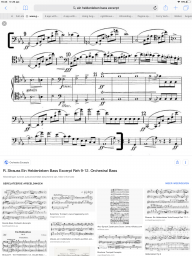
Just looking through my daughter's excerpts books, it could be this...
Starts at around 13:00 here
Last edited:
Just looking through my daughter's excerpts books, it could be this...
View attachment 4513683
@Fleo , @SteveCS :
Despite the 32nd notes, that's not spiccato. @Ross Kratter had it right: Third movement. Approximately 20:55 in the video you posted.
@Fleo , @SteveCS :
Despite the 32nd notes, that's not spiccato. @Ross Kratter had it right: Third movement. Approximately 20:55 in the video you posted.
No worries - that is the only excerpt from Beethoven 5 that I have in the house, so it was just a WAG (Wild Arsed Guess)!
It's a shame the camera focusses on the 'celli for the most part, but ~21:12 - 21:17 shows the bouncing bows quite nicely, although not so much instructional value if you play french!
Last edited:
It's a shame the camera focusses on the 'celli for the most part, but ~21:12 - 21:17 shows the bouncing bows quite nicely, although not so much instructional value if you play french!
According to my teacher, the keys to successful spiccato are:
a) contacting the string at the bow's balance point;
b) employing a shallow "U" shaped stroke, contacting the string at the nadir of the "U";
c) keeping the bow at the same attitude throughout the stroke;
d) learning the bounce of the bow off the string the same way a drummer learns the bounce of his stick off the drum head.
And of course, hours of frustrating practice.
According to my teacher, the keys to successful spiccato are:
a) contacting the string at the bow's balance point;
b) employing a shallow "U" shaped stroke, contacting the string at the nadir of the "U";
c) keeping the bow at the same attitude throughout the stroke;
d) learning the bounce of the bow off the string the same way a drummer learns the bounce of his stick off the drum head.
And of course, hours of frustrating practice.
My daughter is back from college for christmas now and she is working on this, alongside a whole load of other stuff - as you say - several hours every day. She has spent the last term ironing out some last minor tweaks to her bow hold that she finally nailed about a month ago - she told me that her tutors were at the point of suggesting she switch to german, which I think gave her a gee-up! Having her in the house playing and hearing her improving whilst I am working at home has been a total privilage!
Incidentally, do you play french or german?


