
Enjoy the benefits of a premium membership!
Upgrade Account
-
TalkBass has been independent since 1998. Add your voice.
Create a free account to reply to discussions, view embedded media, and browse with fewer display ads.
Join free Log in
Want zero display ads or expanded classifieds tools? Compare plans.
You are using an out of date browser. It may not display this or other websites correctly.
You should upgrade or use an alternative browser.
You should upgrade or use an alternative browser.
To compress or not to compress
- Thread starter trackskinz
- Start date
More options
Who Replied?

I had an MXR for a while. It was a great pedal. However, the longer I had it the less I found I was actually using it. I'm a KISS type of player so I just got rid of it. Don't miss it either.

There are a number of reasons to use compression -- or not. EDIT: this is not a comprehensive list of uses, just the first ones that popped into my head!
As for me: I often use overdrive at the gig. Overdrive by its nature provides some compression, so I rarely use a dedicated compressor when using OD. However if I'm playing a classic rock/R&B/blues gig where I won't use overdrive, then I do occasionally bring a compressor for transparent smoothing and/or vintage warmth.
- The most common reason is subtle, transparent smoothing, as done on nearly every studio recording. Done live, it can help the bass to sit better in the mix.
- Another reason is subtle production: to add tube-like/vintage "warmth" to the tone.
- Another is as an effect: to add heavy squash and/or overdrive. This was done in the studio by Led Zeppelin and many others; often with the Urei 1176 in "British Mode"
- Some compress only when playing slap style
- Some compress to hide uneven playing technique (this is not a good idea when practicing at home, but understandable when playing live)
As for me: I often use overdrive at the gig. Overdrive by its nature provides some compression, so I rarely use a dedicated compressor when using OD. However if I'm playing a classic rock/R&B/blues gig where I won't use overdrive, then I do occasionally bring a compressor for transparent smoothing and/or vintage warmth.
Last edited:
at home- fun at neighbor-friendly low volumes
at rehearsal- defeating one benefit of group rehearsal... dynamics practice
live- a useful crutch for when your plucker isn't cooperating with your brain; a sometimes useful effect for intros and solos; necessary for stringsets known to spontaneously "die"
at rehearsal- defeating one benefit of group rehearsal... dynamics practice
live- a useful crutch for when your plucker isn't cooperating with your brain; a sometimes useful effect for intros and solos; necessary for stringsets known to spontaneously "die"
Whenever I use one I always find that there's a constricting feel on my playing that just feels weird. I always end up taking the comp off the board for that reason.
I get that constricted feeling sometimes -- and it's worth noting that I can also get that feeling when using overdrive/distortion. If I feel constricted, I keep tweaking. IME it can help to use a compressor that has a clean blend: you get that additional sumthin'-sumthin' that's especially useful in the mix, along with dynamics.
I don't mean to imply that everyone should use compression. As noted earlier I don't compress when using overdrive, and often don't bother to compress even when running clean. Still, I love that little extra it can bring when I get it dialed in correctly: meaning, I don't notice it's there until I switch it off.
My White Horse does have a clean blend. I really have to try dialing it in better. I just notice that at whatever setting I try it out at, when I turn it off it's like a weight being dropped from my tone. Probably user error on my part.I get that constricted feeling sometimes -- and it's worth noting that I can also get that feeling when using overdrive/distortion. If I feel constricted, I keep tweaking. IME it can help to use a compressor that has a clean blend: you get that additional sumthin'-sumthin' that's especially useful in the mix, along with dynamics.
I don't mean to imply that everyone should use compression. As noted earlier I don't compress when using overdrive, and often don't bother to compress even when running clean. Still, I love that little extra it can bring when I get it dialed in correctly: meaning, I don't notice it's there until I switch it off.
My White Horse does have a clean blend. I really have to try dialing it in better. I just notice that at whatever setting I try it out at, when I turn it off it's like a weight being dropped from my tone. Probably user error on my part.
Maybe not: some are only satisfied by ultra-high-end compressors, some don't like compression at all. Still, I'd encourage you to experiment more with the White Horse (very cool pedal btw, it was high on my wish list but I wound up going with the Empress).
I think I will need a compressor for playing live to cover up the occasional slip, but I will avoid practicing with it.
I got my eye on an Alesis 3630 for my rack.
I got my eye on an Alesis 3630 for my rack.

To add to what @Fuzzbass already listed, compression at the end of your board can give some breathing room on volume swells / dips when you turn on / off pedals, and can give some volume lift to effects that trail off (like delays).
I think I will need a compressor for playing live to cover up the occasional slip, but I will avoid practicing with it.
I got my eye on an Alesis 3630 for my rack.
You'll probably regret it.

I have two compressors. One is small (EBS MultiComp) and sits on my board with five other pedals ranging from a POG II to overdrive. That compressor is always in use when the pedalboard itself is in use, for the purpose BrianVengeance said above. The other is larger (Markbass Compressore) and I use that for some gigs that don't involve the pedalboard, for smoothing and warming the sound. I didn't use compressors by themselves until I got the Compressore, which I like for some gigs. Depends on the type of music.

From your question my guess is that you are not looking for a slap effect, and neither for an increased sustain solo effect?! If that is true I would say that you should try to determine where the bass sits in the mix with the rest of the band. Is the perception of the bass fluctuating? Is it more evident at times and less at other times? Is the bass not noticable enough? Is the rest of the band heavily compressed (doesn't need to be compressors, could be heavy distorted guitars which will result in a compressed sound)?
I'd say that a compressors is at its best when used to place the bass correctly in the mix, in relation to the rest of the band. Pop, rock or heavy rock/metal could most likely benefit from a compressor (as long as you don't use an overdrive/distortion to that effect). It could of course work magic in lots of other genres as well.
Cheers,
Kalle
I'd say that a compressors is at its best when used to place the bass correctly in the mix, in relation to the rest of the band. Pop, rock or heavy rock/metal could most likely benefit from a compressor (as long as you don't use an overdrive/distortion to that effect). It could of course work magic in lots of other genres as well.
Cheers,
Kalle
I'm a KISS type of player so I just got rid of it. Don't miss it either.
It was only when I looked at your profile pic and saw there wasn't a Gibson Grabber that I figured out what you meant by that.

ExactlyWhenever I use one I always find that there's a constricting feel on my playing that just feels weird. I always end up taking the comp off the board for that reason.
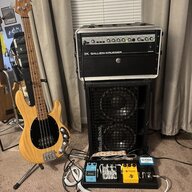
I found that a compressor is only necessary for me in situations where I'm using: 1. A bass with single coil pickups (Jazz) and 2. An amp with a large amount of untapped headroom (usually 500 watt+ solid state). However, I play a P bass through a V4B and adding a compressor on top of all of my naturally occurring compression is a big no no. But if I played a Fender Jazz through like an Aguilar DB751, you best bet I would have a Diamond Bass Comp in the chain.
I have a compressor built into my amp. It's not an amazing one but it's always on, and it does the job: I use it simply to catch peaks when playing live. It's only one knob, labelled "compression," and it's never above 9 or 10 o'clock. This way, it's not ever affecting my tone unless i'm getting heavy handed in the heat of the moment.
If I were to buy a compressor, I'd use it in the same way, on a pedalboard: Strictly to catch errant peaks.
If I were to buy a compressor, I'd use it in the same way, on a pedalboard: Strictly to catch errant peaks.