• TalkBass has been independent since 1998. Add your voice.
    Create a free account to reply to discussions, view embedded media, and browse with fewer display ads.
    Join freeLog in
    Want zero display ads or expanded classifieds tools? Compare plans.

To keep or not to keep basses in their cases

Ok, so some of you know I have a major crack on my Stingray Special and it'll cost about a grand to get it fixed via a new neck at EBMM. With that said, the repair tech I took my bass to said that I should keep my instruments in their cases at all times when not in use. Now, I have them hanging on hooks on the wall in my office. I do keep my ES-335 and my acoustic in their cases at all times, but all of my solid body instruments are left out.

I guess I'm curious what all of you suggest. I would love to keep them out and just get a room humidifier, but this is where I work where I have computers, amps, etc. I'm not sure how humid it can get without running into issues with electronics. My wife suggested we get one of those Honeywell humidifiers you attach to the furnace, which I'm not opposed to. I just don't know if that will do the trick.

My cases are crammed in my closet, and to access any of them, I need to pull a bunch of stuff out. So, I'd prefer not to have to keep them tucked away at all times. Not to mention I switch between them quite often. :)

So, what does the intelligencia say? I'm in Colorado where it's drier than a popcorn fart. I'd sure like to know what works best to protect my instruments, but would also like to avoid a huge inconvenience. Thanks!
 
My cases are crammed in my closet, and to access any of them, I need to pull a bunch of stuff out. So, I'd prefer not to have to keep them tucked away at all times. Not to mention I switch between them quite often.
I don't know nuthin' 'bout popcorn farts, but having to dig for an instrument ain't such a bad thing IMHO. I have a similar situation where there's serious work involved to access some at the back, but I have never regretted storing stuff in hard shell cases.
 
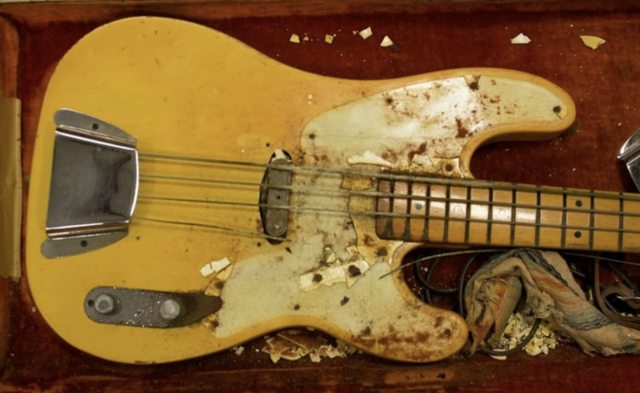
as long as they don't have any old Celluloid Nitrate stuff that gasses off or interacts with other things in the case . If left in the case they will
1Qplexol.png
 
If keeping the instrument in a case/closet reduces the likelihood of it being played then it's a big mistake, in my opinion. You should be able to grab it and play it with minimal effort. Heck, you should keep it out where you can look at it, just to remind you that it's something you enjoy.

One day all of us and all our cool basses will be nothing but dust. So we may as well play them as much as possible before then.
 
per the OP: i keep mine out and ready to plug 'n play, for the most part. it's convenient for me to do it that way in the space(s) where my music operates. i could adjust to any scenario, i think, but i like having one/them close by while i'm at my 'desk'. one or more might be in a gig bag if i just rehearsed/gigged.

i don't think it's mandatory to keep them in their cases unless special circumstances call for it. maybe you are experiencing those. (?)
 
Last edited:
The day I receive a new bass, the case goes on a shelf in my basement where it is never opened again unless I put the bass back in it to ship it off to a new owner. All of mine hang on the wall in a temperature controlled room. Low humidity is never an issue here in Tennessee as it's always 40% - 50% humidity in my house and it stays a nice 68-72 degrees in the winter and 74-78 degrees in the summer.

I seldom have to adjust my instruments unless I change strings. I have had no issues with wood cracking, warping, etc.

Instruments are tools. They are meant to be used. They are designed for bar gigs where beer is spilled on them, playing outdoors where it's 90 degrees, carried in a hot or cold car, etc. They won't disintegrate. You might have to tweak the truss rod a bit from time to time and snug up some screws...but that's about all that's required to have an instrument serve you for a lifetime.
 
I worked retail music stores where more than a few times I had to wheel and deal money off for the two little ruts in the headstock where the axe had hung for too long. Lacquered guitars can be really bad about this.

So I'd NEVER hang them at home or anywhere else.

Mine stay in their cases or bags, standing up with the big end on the floor. That's the only way, speaking for myself, I store them.
 
I used to hang everything on the wall. Now? Everything in its case.

In its case it's protected from dust and UV damage. It keeps my strings sounding fresh and helps preserve my setups.

When I stored my cases in the closet stuff didn't get played. Since I got the string swing hard case rack it's a lot easier to chose what I want to play.

One bass is kept out on its stand for home rehearsals. Stuff going to rehearsal goes in a single gig bag. Stuff going to a gig goes in a double gig bag.
 
Cases are nice but realistically they only protect against rapid changes in humidity, that is, the air in them takes longer to adjust to the new humidity or temperature level, eventually they will have he same humidity as the room but they'll shift at a slightly slower rate, which can be important if the humidity drops a lot from like flicking on the air conditioner on a 100 degree day after leaving it off while at work or something. They're great for taking instruments places for that reason

but I think you got really unlucky with that piece of wood, I think it's normally not that fickle or that kind of crack isn't the type of thing that normally happens to storing basses in bad conditions. I've heard of necks warping from being shipped on a boat that's traveling 6000 miles in 3 days. normally with necks in bad conditions, warps develop or twists or things to that effect; a hairline crack is a strange development. Not sure if those necks are laminates or not too. My assumption is that you'd probably be ok storing the same bass with a new neck in a similar way to how you're storing it now, and as long as you're periodically doing truss adjustments and such it should be ok.
 
Last edited:
Ok, so some of you know I have a major crack on my Stingray Special and it'll cost about a grand to get it fixed via a new neck at EBMM. With that said, the repair tech I took my bass to said that I should keep my instruments in their cases at all times when not in use. Now, I have them hanging on hooks on the wall in my office. I do keep my ES-335 and my acoustic in their cases at all times, but all of my solid body instruments are left out.

I guess I'm curious what all of you suggest. I would love to keep them out and just get a room humidifier, but this is where I work where I have computers, amps, etc. I'm not sure how humid it can get without running into issues with electronics. My wife suggested we get one of those Honeywell humidifiers you attach to the furnace, which I'm not opposed to. I just don't know if that will do the trick.

My cases are crammed in my closet, and to access any of them, I need to pull a bunch of stuff out. So, I'd prefer not to have to keep them tucked away at all times. Not to mention I switch between them quite often. :)

So, what does the intelligencia say? I'm in Colorado where it's drier than a popcorn fart. I'd sure like to know what works best to protect my instruments, but would also like to avoid a huge inconvenience. Thanks!
I'm in Denver (minutes away from you) and never had any issues. I have a bass hanging on the wall for over 10 years, no problems with it.
 
  • Like
Reactions: five7 and tblurker