
Enjoy the benefits of a premium membership!
Upgrade Account
-
TalkBass has been independent since 1998. Add your voice.
Create a free account to reply to discussions, view embedded media, and browse with fewer display ads.
Join free Log in
Want zero display ads or expanded classifieds tools? Compare plans.
You are using an out of date browser. It may not display this or other websites correctly.
You should upgrade or use an alternative browser.
You should upgrade or use an alternative browser.
Tone Roll Off for Pbass, which tone cap & why, .1uf or. 05uf
- Thread starter dubstylee
- Start date
More options
Who Replied?

- Aug 21, 2008
- 10,386
- 253
- 68
- Disclosures
- Owner, SGD Music Products
I like .05 (.047) uF. I think .1 takes out too much mids, and just makes a muddy rumble. I use a .033 in some of my basses.

I think the .047uF are a perfect fit for both P and J basses. I agree the .1uF caps just turn your signal into a muddy rumble--if you roll them back too much.
- Aug 21, 2008
- 10,386
- 253
- 68
- Disclosures
- Owner, SGD Music Products
I think the .047uF are a perfect fit for both P and J basses. I agree the .1uF caps just turn your signal into a muddy rumble--if you roll them back too much.
But being able to roll the control to zero and still have it usable is where all the fun is! Then you get that fat resonance boost. That's a classic P bass tone. Listen to John Deacon with Queen. A .1 wont get that sound because the boost is too low.
Also rolling a .047 uF half way back and using the bridge pickup, gets a nice fat burp.
I like the way the 0.1 uF caps sound in a P. I found that they sounded better to my ear through the full range of the tone knob. The 0.047 uF caps sound weird to me when you roll them off more than half way.
IMO/IME/YMMV
IMO/IME/YMMV
Based on a couple above comments.
In my understanding Treble is what is rolled off, not Mids. And it's always reduction, not boost.
In my understanding Treble is what is rolled off, not Mids. And it's always reduction, not boost.
- Aug 21, 2008
- 10,386
- 253
- 68
- Disclosures
- Owner, SGD Music Products
Based on a couple above comments.
In my understanding Treble is what is rolled off, not Mids. And it's always reduction, not boost.
It depends on the cut off frequency of the tone control. The larger the value of the cap, the lower the corner frequency that bleeds to ground.
If a .1 cap rolls off low enough, it will also roll off the upper midrange, Actually a .02 rolls off just the treble, and leaves the mids. A .047 takes most of the mids out, except for the low mids (around 600Hz). I have a .03 cap in one of my basses and that rolls off at a higher frequency and leaves more mids.
The boost occurs when the tone control is all the way off. That forms a resonant LC network with the pickup, and does indeed provide a small boost. The higher the impedance of the pickup, the greater the effect of the tone control. That's why active EMG's use .1 caps and the tone controls don't have as dramatic an effect.
The Fender Greasebucket tone control was developed to roll the treble off and not boost the bass.
A cool idea is to have a push/pull tone pot that selects from two different caps.

dubstylee,
Check out the Stellartone tone control, I have it in a Jazz bass and is great. Is it a micro circuit with 16 capacitors, I am not sure but I guess you may contact them and ask for a custom made unit with the cap values you like the most.
Check out the Stellartone tone control, I have it in a Jazz bass and is great. Is it a micro circuit with 16 capacitors, I am not sure but I guess you may contact them and ask for a custom made unit with the cap values you like the most.

interesting thread,
but all these cap values are a bit confusing to all us non-cap nerds
is there a conversion chart somewhere that would show is the difference ( & better yet, the similarities ) in values ?
ie;
.5 uf = .047uf ( i think )
.02 = ? would that be the same as a .022 ?
.03 = ?
when i see caps for sale i see
.1
.022
.047
have never seen a .03 what is that similar to in the real world of caps ?
or, is it just simple math in hundredths & thousandths ?
thanks in advance for your answer on this issue
Dog
but all these cap values are a bit confusing to all us non-cap nerds
is there a conversion chart somewhere that would show is the difference ( & better yet, the similarities ) in values ?
ie;
.5 uf = .047uf ( i think )
.02 = ? would that be the same as a .022 ?
.03 = ?
when i see caps for sale i see
.1
.022
.047
have never seen a .03 what is that similar to in the real world of caps ?
or, is it just simple math in hundredths & thousandths ?
thanks in advance for your answer on this issue
Dog
It depends on the cut off frequency of the tone control. The larger the value of the cap, the lower the corner frequency that bleeds to ground.
If a .1 cap rolls off low enough, it will also roll off the upper midrange, Actually a .02 rolls off just the treble, and leaves the mids. A .047 takes most of the mids out, except for the low mids (around 600Hz). I have a .03 cap in one of my basses and that rolls off at a higher frequency and leaves more mids.
The boost occurs when the tone control is all the way off. That forms a resonant LC network with the pickup, and does indeed provide a small boost. The higher the impedance of the pickup, the greater the effect of the tone control. That's why active EMG's use .1 caps and the tone controls don't have as dramatic an effect.
The Fender Greasebucket tone control was developed to roll the treble off and not boost the bass.
A cool idea is to have a push/pull tone pot that selects from two different caps.
- Aug 21, 2008
- 10,386
- 253
- 68
- Disclosures
- Owner, SGD Music Products
interesting thread,
but all these cap values are a bit confusing to all us non-cap nerds
is there a conversion chart somewhere that would show is the difference ( & better yet, the similarities ) in values ?
ie;
.5 uf = .047uf ( i think )
.02 = ? would that be the same as a .022 ?
.03 = ?
.05 =.047uF Not .5uF.
.02 = .022
.03 = .033
when i see caps for sale i see
.1
.022
.047
That's what you see used on instruments, or sold as guitar parts. But when you go to electronic parts suppliers, you will find a vast array of cap values such as; .001uF, .002uF, .0022uF, .0047uF, .005uF, .0068uF, .01uF, .015uF, .02uF, .022uF, .033uF, .047uF, .05uF, .056uF, .068uF, .1uF, .2uF, .22uF, .47uF etc. Even at Radio Shack.
have never seen a .03 what is that similar to in the real world of caps ?
I've seen .033uF caps used in instruments.
or, is it just simple math in hundredths & thousandths ?
That's it. "uF" stands for "micro-farad", and a Farad is a very large amount of capacitance, so all you encounter in electronics work is micro-Farads, pico-Farads, and now nano-farads.
You might also see something listed as "47n" which is .047uF.
47000 pico-farads = 47 or 47n nano-farads = 0.047 micro-farad, and the cap might be marked 473K.
.05 =.047uF Not .5uF.
.02 = .022
.03 = .033
That's what you see used on instruments, or sold as guitar parts. But when you go to electronic parts suppliers, you will find a vast array of cap values such as; .001uF, .002uF, .0022uF, .0047uF, .005uF, .0068uF, .01uF, .015uF, .02uF, .022uF, .033uF, .047uF, .05uF, .056uF, .068uF, .1uF, .2uF, .22uF, .47uF etc. Even at Radio Shack.
I've seen .033uF caps used in instruments.
That's it. "uF" stands for "micro-farad", and a Farad is a very large amount of capacitance, so all you encounter in electronics work is micro-Farads, pico-Farads, and now nano-farads.
You might also see something listed as "47n" which is .047uF.
47000 pico-farads = 47 or 47n nano-farads = 0.047 micro-farad, and the cap might be marked 473K.
you the man

that explained ALOT
thanks
( just subscribed to this thread for future reference )
- Aug 21, 2008
- 10,386
- 253
- 68
- Disclosures
- Owner, SGD Music Products
you the man
that explained ALOT
thanks
( just subscribed to this thread for future reference )

Happy to help.
The general rule of thumb is the larger the value the lower the frequency the tone control shunts to ground. So .02 wont remove much except the very high end, and .1 takes out a lot of the upper mids too.
And if you play a note and turn the tone control down, right when you get to zero you will notice a very slight boost. You aren't imagining things... it actually sets up a resonant circuit with the pickup, and does boost the signal slightly at the cutoff frequency.
The pickups play a big part too. The higher the impedance, the more effect the tone control will have. You can hear this on a Jazz bass. If you have the tone down all the way, and put both pickups on full, the impedance drops and the sound brightens up slightly, because the frequency has shifted higher.
my latest build is a Hoppus Jazz , ( which in all actuality is a P bass )
in original form, it came with a SD Quarter Pounder ( which i totally dislike ) a vol pot & a jack ( no tone pot )
i put in a SD SPB-1, A250k pots a .1 OrangeDrop cap & Switchcraft jack on a '62 jazz plate

i'm running TI jazz flats on it & it does indeed sound dark if you roll the tone off, but the brightness of the TI's kind of makes up for it
let me say that i'm up for some experimentation
i found this site Link Removed & it's totally about caps & tone
i'm going to order a couple of caps, a .047, & a .027 225p OrangeDrop
so which would you recommend, a 100v, 200v, or 400v ?
or does the voltage really matter ?
in original form, it came with a SD Quarter Pounder ( which i totally dislike ) a vol pot & a jack ( no tone pot )
i put in a SD SPB-1, A250k pots a .1 OrangeDrop cap & Switchcraft jack on a '62 jazz plate
i'm running TI jazz flats on it & it does indeed sound dark if you roll the tone off, but the brightness of the TI's kind of makes up for it
let me say that i'm up for some experimentation
i found this site Link Removed & it's totally about caps & tone
i'm going to order a couple of caps, a .047, & a .027 225p OrangeDrop
so which would you recommend, a 100v, 200v, or 400v ?
or does the voltage really matter ?
I reall like that bass NorCal Dog!
Invalid Link Removed for capacitor values, just to help clarify between micro, nano and pico farads.
Invalid Link Removed for capacitor values, just to help clarify between micro, nano and pico farads.
dubstylee,
Check out the Stellartone tone control, I have it in a Jazz bass and is great. Is it a micro circuit with 16 capacitors, I am not sure but I guess you may contact them and ask for a custom made unit with the cap values you like the most.
I put one in my Barker and it is a great tone control. Well worth the money.
- Aug 21, 2008
- 10,386
- 253
- 68
- Disclosures
- Owner, SGD Music Products
The voltage rating on the cap doesn't matter, so use the smallest one. Higher voltage rated caps can get quite large. The bass' pickups hardly put out a volt.
update
i ordered a .047uf Gudeman PIO cap from AxeGrinders, & also installed a new set of my fav flats, Pyramid Golds on my fav P bass
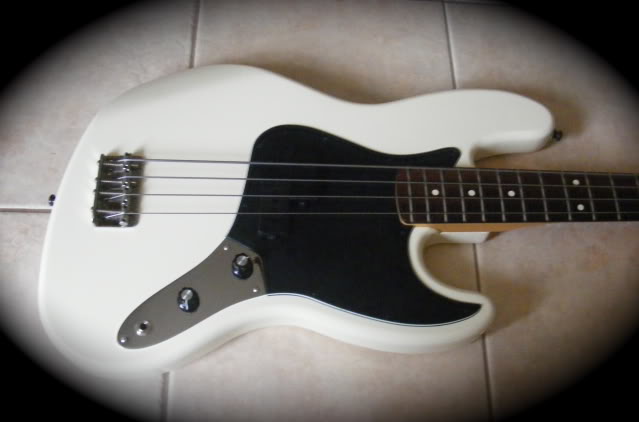
& the tone is AMAZING to say the least
i do like the .047uf better than the .1uf that was previously installed
it does indeed have a bass boost when you roll the tone off, & the mids & highs sound sweeter
i ordered a .047uf Gudeman PIO cap from AxeGrinders, & also installed a new set of my fav flats, Pyramid Golds on my fav P bass
& the tone is AMAZING to say the least
i do like the .047uf better than the .1uf that was previously installed
it does indeed have a bass boost when you roll the tone off, & the mids & highs sound sweeter

And don't waste money on "magical" capacitors which have no benefit in this application. Any $0.08 plastic cap is perfectly fine.The voltage rating on the cap doesn't matter, so use the smallest one. Higher voltage rated caps can get quite large.


