
Hello, I just started playing bass guitar, I'm studying with music theory. But as far as I looked for on the internet, I couldn't understand how the tonic works. Now, do I need to play the root note in this bass line, or the tonic notes written above, or both? Or are these chords? Thanks

Enjoy the benefits of a premium membership!
Upgrade Account
-
TalkBass has been independent since 1998. Add your voice.
Create a free account to reply to discussions, view embedded media, and browse with fewer display ads.
Join free Log in
Want zero display ads or expanded classifieds tools? Compare plans.
You are using an out of date browser. It may not display this or other websites correctly.
You should upgrade or use an alternative browser.
You should upgrade or use an alternative browser.
Tonic
- Thread starter icarus88
- Start date
More options
Who Replied?

Hello, I just started playing bass guitar, I'm studying with music theory. But as far as I looked for on the internet, I couldn't understand how the tonic works. Now, do I need to play the root note in this bass line, or the tonic notes written above, or both? Or are these chords? Thanks
It is essential that you understand the difference between tonic and root. And it all starts with the Key. Consider a C major scale - 7 notes arranged in pitch order: C, D, E, F, G, A, B then back to C one octave higher. In addition to thd letter-name, each of these notes (degrees) also has a functional name: Tonic, Supertonic, Mediant, etc - you can look these up separately. But the Tonic is the key note, the tonal centre around which melodies written using that scale (or in that key) gravitate. In this case the note C is tonic.
Now think about the notes in that same scale and make some chords from them. C, E, G makes a C major chord (of triad); D, F, A, makes a D minor chord; G, B, D, F makes a G7 chord. The most important note in each of these chords is the one giving the letter name, which is known as the Root. So you can see that within a major key there are 7 possible Roots upon which chords can be constructed, one of which is the Tonic. The chord built on the Tonic of the Key is known as the Tonic chord and takes the Tonic as its Root. Confused? Look at the triad built on G. G is the 5th note in the C major scale, and the Functional name for the 5th note is the Dominant. So instead of A Tonic chord we have a Dominant chord. But it still has a Root - G.
So Roots relate to chords (they all have one) and Functional names relate to Keys and the harmonisation of scales.
Further reading : The process of building chords from a scale is called 'harmonisation' of the scale - something else to look up.

It is essential that you understand the difference between tonic and root. And it all starts with the Key. Consider a C major scale - 7 notes arranged in pitch order: C, D, E, F, G, A, B then back to C one octave higher. In addition to thd letter-name, each of these notes (degrees) also has a functional name: Tonic, Supertonic, Mediant, etc - you can look these up separately. But the Tonic is the key note, the tonal centre around which melodies written using that scale (or in that key) gravitate. In this case the note C is tonic.
Now think about the notes in that same scale and make some chords from them. C, E, G makes a C major chord (of triad); D, F, A, makes a D minor chord; G, B, D, F makes a G7 chord. The most important note in each of these chords is the one giving the letter name, which is known as the Root. So you can see that within a major key there are 7 possible Roots upon which chords can be constructed, one of which is the Tonic. The chord built on the Tonic of the Key is known as the Tonic chord and takes the Tonic as its Root. Confused? Look at the triad built on G. G is the 5th note in the C major scale, and the Functional name for the 5th note is the Dominant. So instead of A Tonic chord we have a Dominant chord. But it still has a Root - G.
So Roots relate to chords (they all have one) and Functional names relate to Keys and the harmonisation of scales.
Further reading : The process of building chords from a scale is called 'harmonisation' of the scale - something else to look up.
Thank you for your time, I actually know what tonic is by definition but I couldn't understand how it was used in this photo.
Why did it write C sharp as A as the tonic? I don't know the scales, C sharp major, C sharp minor? Or something else?
Thank you for your time, I actually know what tonic is by definition but I couldn't understand how it was used in this photo.
Why did it write C sharp as A as the tonic? I don't know the scales, C sharp major, C sharp minor? Or something else?
In the key of D, A is dominant. C# is just a note (the 3rd) in the A major chord. In the first measure bass plays the Root. In measures 2 and 3 bass is playing the 3rds of the chords - C# from A and B from G. See how these create a stepwise motion in the bass...
In the key of D, A is dominant. C# is just a note (the 3rd) in the A major chord. In the first measure bass plays the Root. In measures 2 and 3 bass is playing the 3rds of the chords - C# from A and B from G. See how these create a stepwise motion in the bass...
So I'll play the root note first and then the tonic.
This is the Ed Friedland Bass Method book, he didn't explain it (he'll explain it in the 2nd book)
Sorry for the constant stupid questions

Why did it write C sharp as A as the tonic?
I don't where it says this.
It does say:
Let's look at this section
The explanation for this section says the bass does not always play the root...this section demonstrates notes that are not the root of the indicated chord..
The chords are D Major, A Major, G Major, D Major, G Major, A Major
In the key of D these chord correspond to I V IV I IV V
The first chord shows bass playing the root D for D Major. The D is also the tonic. Also, when a chord has the root in the bass, it's called root position
The bass does not play the root in the rest of the chords. A uses C# (3rd), G uses B (3rd), D uses A (5th), G uses B (3rd), A uses E (5th)
- When a chord has the 3rd in the bass, it's called first inversion.
- When the chord has the 5th in the bass, it's called second inversion.
- For 7th chords, you can also have the 7th in the bass and this is called third inversion.
So I'll play the root note first and then the tonic.
No. In measure 1 you are playing the Root of the chord, which happens to also be Tonic (it's the I chord) then you are playing the 3rd of the dominant A chord (look up first inversion). In measure 2 the B is 3rd of G and the A note is the 5th of the D chord (2nd inversion). Measure 3: B is 3rd of the G chord and E is 5th of the A chord. In measure 4 you get back to playing the Root of the Tonic D chord, which is D.
Remember, a key only has 1 tonic, but every note, including tonic, can be the root of a chord. Chords consist of several notes together - usually stacks of 3rds. To remain in key, those other notes are taken from the key. See how in that bass line, every note (apart from the C# in measure 6 and the B and C# in measure 8) are 'chord tones'.
Bunun nerede yazdığını bilmiyorum.
Şöyle diyor:
View attachment 5489054
Bu bölüme bakalım
View attachment 5489055
Bu bölümün açıklaması basların her zaman kökü çalmadığını söylüyor...bu bölüm belirtilen akorun kökü olmayan notaları gösteriyor.
Akorlar şunlardır: D Majör, A Majör, Sol Majör, D Majör, Sol Majör, A Majör
D anahtarında bu akor IV IV I IV V'ye karşılık gelir
İlk akor, D Majör için D kökünü çalan bası gösterir. D aynı zamanda toniktir. Ayrıca, bir akorun basta kökü varsa buna kök konumu denir.
Bas, akorların geri kalanında kökü çalmaz. A, C#'ı (3.), G, B'yi (3.), D, A'yı (5.), G, B'yi (3.), A, E'yi (5.) kullanır
- Bir akor basta 3'üncüye sahip olduğunda buna ilk inversiyon denir.
- Akor basta 5. sese sahip olduğunda buna ikinci inversiyon denir.
- 7'li akorlar için basta 7'li akorları da alabilirsiniz ve buna üçüncü inversiyon denir.
when I opened the song, I played the (d) first and then the chords. It sounded unrelated to the song, or at least that's what it seemed to me. Music theory is a difficult subject. Thank you very much. This is the best forum I've ever seen!
Last edited:
No. In measure 1 you are playing the Root of the chord, which happens to also be Tonic (it's the I chord) then you are playing the 3rd of the dominant A chord (look up first inversion). In measure 2 the B is 3rd of G and the A note is the 5th of the D chord (2nd inversion). Measure 3: B is 3rd of the G chord and E is 5th of the A chord. In measure 4 you get back to playing the Root of the Tonic D chord, which is D.
Remember, a key only has 1 tonic, but every note, including tonic, can be the root of a chord. Chords consist of several notes together - usually stacks of 3rds. To remain in key, those other notes are taken from the key. See how in that bass line, every note (apart from the C# in measure 6 and the B and C# in measure 8) are 'chord tones'.
I have great respect for people who have deep knowledge. Now I understand better, thank you!
All of these concept are very simple, but there are a lot of simple things to learn, which makes it confusing. Ideally you would have a teacher to help guide you through the learning process.

If it's not clear, the chords are the letters spelled across the top. D,A,G,D,G,A
Normally these would be labeled D Maj, A Maj, G Maj, D Maj, G Maj, A Maj
The 6 horizontal lines are part of a staff.
Counting from the bottom up, the bass cleff identifies the 4th line as F (see the two dots above and below the 4th line)

So from bottom to top, the lines of the bass staff are G,B,D,F,A. The spaces between the lines are A,C,E,G. Memorize these sequences. Eventually you will instantly recognize a note by which line or space it is written on.
One space below the staff is F and one space above the staff is B.
To go beyond F and B requires ledger lines. Going above the staff the first ledger line is C.
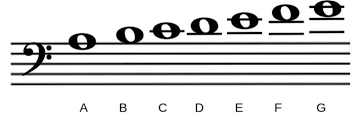
If you play a 4 string bass, you will only need one ledger line below the staff (E). If you play a 5 or 6 string bass you will need to read all the way down to B.
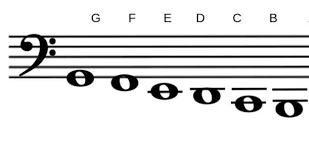
Accidentals modify notes. A sharp (#) means a note is raised 1/2 step. A flat (b) means a note is lowered 1/2 step. A natural (♮) cancels a previous accidental. I.E. it lowers a # 1/2 step and it raises a b 1/2 step.
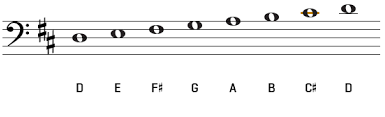
Usually a staff includes a key signature. Since the example we are discussing is in D major, the key signature would have two sharps like this:

This key signature tells you to play F# and C#. The key signature is used so you don't have to write accidentals before every F# or C#.
The following shows the notes of the D major scale.
Without the key signature, accidentals must be written before the notes.
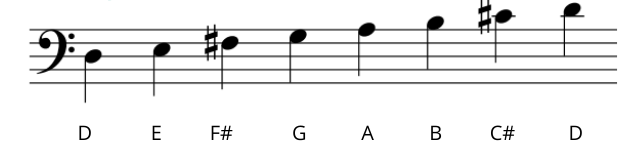
With key signature, you assume F# and C# unless a natural (♮) is written before a note to cancel the sharps (#) in the key signature.
If it's not clear, the chords are the letters spelled across the top. D,A,G,D,G,A
Normally these would be labeled D Maj, A Maj, G Maj, D Maj, G Maj, A Maj
The 6 horizontal lines are part of a staff.
Counting from the bottom up, the bass cleff identifies the 4th line as F (see the two dots above and below the 4th line)
So from bottom to top, the lines of the bass staff are G,B,D,F,A. The spaces between the lines are A,C,E,G. Memorize these sequences. Eventually you will instantly recognize a note by which line or space it is written on.
One space below the staff is F and one space above the staff is B.
To go beyond F and B requires ledger lines. Going above the staff the first ledger line is C.
If you play a 4 string bass, you will only need one ledger line below the staff (E). If you play a 5 or 6 string bass you will need to read all the way down to B.
Accidentals modify notes. A sharp (#) means a note is raised 1/2 step. A flat (b) means a note is lowered 1/2 step. A natural (♮) cancels a previous accidental. I.E. it lowers a # 1/2 step and it raises a b 1/2 step.
Usually a staff includes a key signature. Since the example we are discussing is in D major, the key signature would have two sharps like this:
This key signature tells you to play F# and C#. The key signature is used so you don't have to write accidentals before every F# or C#.
The following shows the notes of the D major scale.
Without the key signature, accidentals must be written before the notes.
With key signature, you assume F# and C# unless a natural (♮) is written before a note to cancel the sharps (#) in the key signature.
Last edited:
All of these concept are very simple, but there are a lot of simple things to learn, which makes it confusing. Ideally you would have a teacher to help guide you through the learning process.
If it's not clear, the chords are the letters spelled across the top. D,A,G,D,G,A
Normally these would be labeled D Maj, A Maj, G Maj, D Maj, G Maj, A Maj
The 6 horizontal lines are part of a staff.
Counting from the bottom up, the bass cleff identifies the 4th line as F (see the two dots above and below the 4th line)
View attachment 5489061
So from bottom to top, the lines of the bass staff are G,B,D,F,A. The spaces between the lines are A,C,E,G. Memorize these sequences. Eventually you will instantly recognize a note by which line or space it is written on.
One space below the staff is F and one space above the staff is B.
To go beyond F and B requires ledger lines. Going above the staff the first ledger line is C.
View attachment 5489063
If you play a 4 string bass, you will only need one ledger line below the staff (E). If you play a 5 or 6 string bass you will need to read all the way down to B.
View attachment 5489062
Accidentals modify notes. A sharp (#) means a note is raised 1/2 step. A flat (b) means a note is lowered 1/2 step. A natural (♮) cancels a previous accidental. I.E. it lowers a # 1/2 step and it raises a b 1/2 step.
Usually a staff includes a key signature. Since the example we are discussing is in D major, the key signature would have two sharps like this:
View attachment 5489064
This key signature tells you to play F# and C#. The key signature is used so you don't have to write accidentals before every F# or C#.
The following shows the notes of the D major scale.
Without the key signature, accidentals must be written before the notes.
View attachment 5489073
With key signature, you assume F# and C# unless a natural (♮) is written before a note to cancel the sharps (#) in the key signature.
View attachment 5489069
I live in Turkey, we write it as do re mi fa sol ... I am familiar with these because of the G key,I played flute, electric guitar and organ before. I just couldn't understand what to play in that example, I can't find a bass teacher because there are very few, the bass guitar is not an instrument that is given much importance here, for now I am progressing from books and YouTube
Last edited:
I live in Turkey, we write it as do re mi fa sol ... I am familiar with these
...
This is from Book 1 of the Chuck Rainey series 'The Complete Electric Bass Player' - you might find it useful.
Presumably you use a moveable Doh*, so whatever the key, Doh is Tonic?
* We use Doh, not Do, in the UK.
Bu, Chuck Rainey serisinin 'The Complete Electric Bass Player' 1. Kitabındandır; işinize yarayabilir.
View attachment 5489113
Muhtemelen hareketli bir Doh* kullanıyorsunuz, yani anahtar ne olursa olsun, Doh Toniktir?
* Birleşik Krallık'ta Do değil, Doh kullanıyoruz.
Ti'ye de Si diyoruz

yes this is C major and the tonic is C.
Ti'ye de Si diyoruz
yes this is C major and the tonic is C.
What I meant was, in the example you gave, in D major, you still consider D to be Doh?
Demek istediğim şuydu, verdiğiniz örnekte D majörde hâlâ D'yi Doh olarak mı görüyorsunuz?
I have memorized the letter equivalents of our notes, there is no problem with that, I just need to learn dominants etc. in more depth, and I don't know all the scales.

İbrahim,
Where in Turkey are you from? In İstanbul, Ankara, İzmir and Antalya, I am sure you can find many guys who can teach bass.
Best,
Alper
--
Türkiye'de nerede yaşıyorsunuz? İstanbul, Ankara, İzmir ve/veya Antalya'da bas hocası bulunabilir diye düşünüyorum...
Where in Turkey are you from? In İstanbul, Ankara, İzmir and Antalya, I am sure you can find many guys who can teach bass.
Best,
Alper
--
Türkiye'de nerede yaşıyorsunuz? İstanbul, Ankara, İzmir ve/veya Antalya'da bas hocası bulunabilir diye düşünüyorum...
Last edited:

tonic works better with some gin. use it after you play, not before.
İbrahim,
Where in Turkey are you from? In İstanbul, Ankara, İzmir and Antalya, I am sure you can find many guys who can teach bass.
Best,
Alper
--
Türkiye'de nerede yaşıyorsunuz? İstanbul, Ankara, İzmir ve/veya Antalya'da bas hocası bulunabilir diye düşünüyorum...
Merhaba dostum Ankara.
tonic works better with some gin. use it after you play, not before.
Yes, especially pink gin


