• TalkBass has been independent since 1998. Add your voice.
    Create a free account to reply to discussions, view embedded media, and browse with fewer display ads.
    Join freeLog in
    Want zero display ads or expanded classifieds tools? Compare plans.

Truss rod access

I generally prefer truss rod access at the heel of the neck. But I don't mind the headstock access on the 4-string Fenders because it's open and easy with nothing getting in the way.

It's the ones with screw-on covers that I hate, especially on a 5-string where the three screws are right under E, A and D...

View attachment 5438418

I went high-tech on this one...the cover & screws are in my parts bin. The bass now "breathes" better and I don't know what I'm talking about. Still have to slacken and move one string, though. BTW, the 1405 still sports the Cobalt Flats you recommended a couple years back...thank you!

Strangely enough, my mid-tier 755 has a "flip-out" cover which is far more convenient.

Riis
 
  • Like
Reactions: michael_t
I've always been able to adjust the rod with a phillips screwdriver. I did file a notch in the pickguard of my P so that I wouldn't scratch the pickguard itself, but I guess the recess is worse than
20240505_080152.jpg
the scratches on my old Jazz Bass.
 
  • Like
Reactions: Zooberwerx
Doesn’t really matter to me but………

First thing I usually do with a new bass or neck is to remove the truss rod nut and apply some Teflon synthetic grease to avoid any seizure over time.

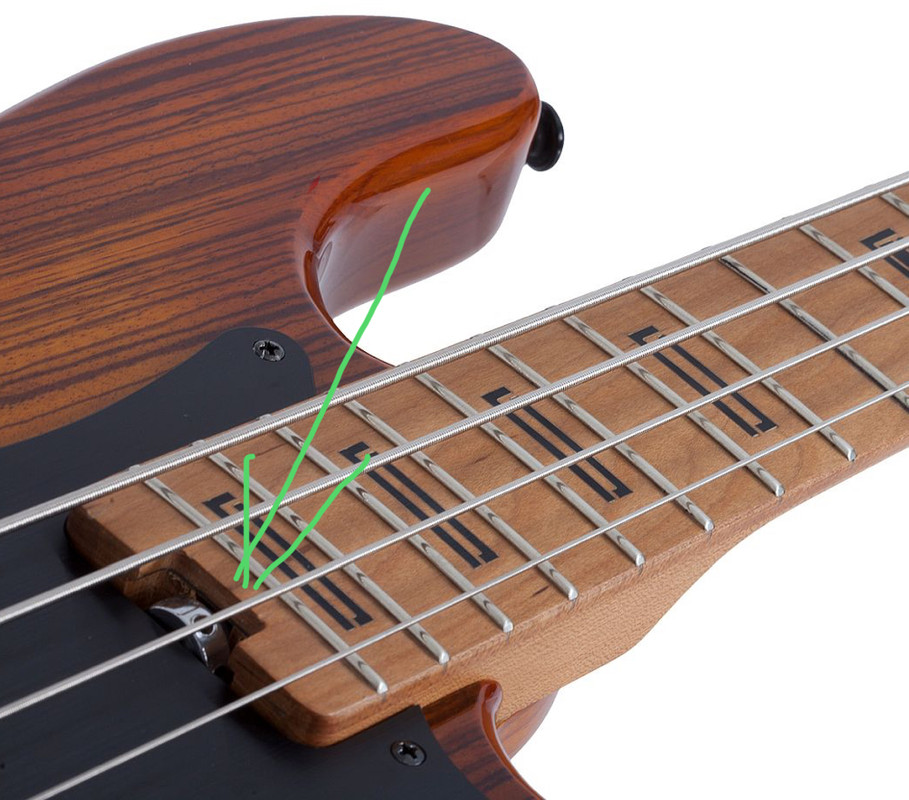
Also, I still don’t understand why manufacturers make their truss rod nut easy to use and accessible like Schecter does as per picture below. That would make our lives easier !

 
  • Like
Reactions: TheReceder
I've always been able to adjust the rod with a phillips screwdriver. I did file a notch in the pickguard of my P so that I wouldn't scratch the pickguard itself, but I guess the recess is worse than View attachment 5438557 the scratches on my old Jazz Bass.

Do yourself a favor and use a flathead next time. A paint can "key" opener also works.

Riis
 
I know people love to praise the stingray wheel, but if you have a neck that needs a lot of truss rod engagement, it can be hard to get enough purchase on the wheel with something small enough to fit it, compared to a fender 5/16 or 4 or 5mm hex wrench. I get that they’re convenient but I’m not always in love with them.
 
The correct answer is heel. :thumbsup:

There needs to be a slot to access it and either a tool that engages properly or a wheel.
String tension in that area allows for the strings to be moved out of the way, as opposed to headstock where they can lie directly in the path of the strings or at least close enough to be kinked by a moving tool.

This is one area where I'll say that Leo ALMOST got it right the first time. If he'd only spec'd a notch for easy access in that area, basses today would almost always have a proper access point.
Alas, we are stuck with "vintage correct" and "reissues" that require the most absolutely convoluted process to adjust a truss rod. And cutting a proper notch ruins the vintage value, despite being 100% the proper functional move to make adjusting the bass a simple and effective process.
 
  • Like
Reactions: Gervais Cote
Aesthetically, body position. Mechanically, body position.
Loosening the the neck screws to better access the truss rod isn't that big of deal unless pressed for time. I've always left the neck in place and used a ball end hex wrench with no ill affects. Guess I've just been lucky in that respect.
Oops forgot, on my cij Geddy I had to remove neck...still, not a big deal.
 
Last edited:
On a Fender? I prefer it at the heel. There is no need to remove the neck.

There is a small bevel on the pickguard for a reason. Use a ~1/8” width flathead screwdriver. Get the head of the screwdriver all the way into the nut. The bevel is for screwdriver shank clearance. No need to loosen or remove neck. Pickguard and truss nut damage on heel adjust Fenders was caused by someone using too big a flathead or a Phillips.

No matter the location of the truss nut, it’s not a bad idea to detune the bass a couple steps first to take tension off the rod.