• TalkBass has been independent since 1998. Add your voice.
    Create a free account to reply to discussions, view embedded media, and browse with fewer display ads.
    Join freeLog in
    Want zero display ads or expanded classifieds tools? Compare plans.

Truss rod channel advice

Hi all!

A while ago, I came across Mayones brand bass from the very beginning years of the company (I sent some pictures to the company and they managed to give a rough timeframe when it was manufactured). I was stoked to add one to the collection so I had to import that thing. Now, the bass has received an excessive amount of "love" from the previous owner, meaning it made my life a bit easier regarding not having to preserve the finish etc.


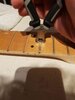
I thought it was a fun excercise to do my first proper neck repair. The skunk stripe was pushed out partially by the trussrod, and rather than gluing it back, an attempt was made filing down the wood instead... which did not work. Besides that, also at the heel the rod damaged the wood quite a bit:


I noticed that at the headstock end, a slip-up was made with the router, so the channel was slightly wider than over the rest of the length. I assume the glue did not bond properly there, and over time it gave up. As a result, to keep the neck straight the trussrod got cranked excessively, pushing it out of the other end as a result. My idea was to replace the skunk stripe with one that fit better (so slightly tapered outwards to the end) and I decided to take it out:


I guess I could have used epoxy as a glue to simply push the part back in that was sticking out, but I think that will be a horrible to take apart again, may something go wrong with the truss rod.

Simultaneously, I made some cuts in the lacquer with a scalpel to allow steam to penetrate the wood so all dents would come out too, and it worked out excellent!


The neck was quite bowed, because of having been under string tension for a long time without a functioning truss rod I assume. I decided to pull out the frets as well, sand the laqcuer off the fretboard and steam it, then clamp it on a straight board overnight:


It did a very adequate job pulling the bow out, except for the first one or two frets, it is now perfectly straight again. I am pretty content with the progress so far, I plan to plane a new skunk stripe this weekend from a piece of rosewood. I checked the truss rod and I figure it is some in-house fabricated device. It's single action, but it sort of behaves like a double action one:


It's still in excellent shape, the threads are like new, the nut looks very adequate, and it was the wood that gave in rather than the truss rod itself.

So with the backstory out of the way. I am by no means very skilled when it comes to repairing necks, or bass guitars in general for that matter. I want to put the truss rod back in, and I came across a lot of information about what the shape of a channel should be like for a single action truss rod. Though, this one is intrinsically similar to a double action one. In the neck itself, the channel doesnt have any curvature, it's the same depth all over. The skunk stripe, however, varies a lot in thickness because it has been filed down by the previous owner.

My intuition says to plane down a piece of wood as straight as possible, push the truss rod back in and clamp it down snuggly to prevent the trussrod a bit from vibrating in the channel. For the luthiers out here:

Am I right or am I wrong? How do you guys go about it?

Edit 1: By the way, is it just me or aren't the pictures showing up for everyone?
Edit 2: I now uploaded them as attachments as well.
 

Attachments

  • bas_1.jpg
    bas_1.jpg
    136.5 KB · Views: 80
  • bas_2.jpg
    bas_2.jpg
    78.5 KB · Views: 78
  • bas_3.jpg
    bas_3.jpg
    95.2 KB · Views: 74
  • bas_4.jpg
    bas_4.jpg
    89.8 KB · Views: 75
  • bas_5.jpg
    bas_5.jpg
    95.5 KB · Views: 77
  • bas_6.jpg
    bas_6.jpg
    98 KB · Views: 76
  • bas_7.jpg
    bas_7.jpg
    151.2 KB · Views: 71
  • bas_8.jpg
    bas_8.jpg
    76.8 KB · Views: 77
Last edited:
  • Like
Reactions: Max Bogosity
Hi all!

A while ago, I came across Mayones brand bass from the very beginning years of the company (I sent some pictures to the company and they managed to give a rough timeframe when it was manufactured). I was stoked to add one to the collection so I had to import that thing. Now, the bass has received an excessive amount of "love" from the previous owner, meaning it made my life a bit easier regarding not having to preserve the finish etc.


I thought it was a fun excercise to do my first proper neck repair. The skunk stripe was pushed out partially by the trussrod, and rather than gluing it back, an attempt was made filing down the wood instead... which did not work. Besides that, also at the heel the rod damaged the wood quite a bit:


I noticed that at the headstock end, a slip-up was made with the router, so the channel was slightly wider than over the rest of the length. I assume the glue did not bond properly there, and over time it gave up. As a result, to keep the neck straight the trussrod got cranked excessively, pushing it out of the other end as a result. My idea was to replace the skunk stripe with one that fit better (so slightly tapered outwards to the end) and I decided to take it out:


I guess I could have used epoxy as a glue to simply push the part back in that was sticking out, but I think that will be a horrible to take apart again, may something go wrong with the truss rod.

Simultaneously, I made some cuts in the lacquer with a scalpel to allow steam to penetrate the wood so all dents would come out too, and it worked out excellent!


The neck was quite bowed, because of having been under string tension for a long time without a functioning truss rod I assume. I decided to pull out the frets as well, sand the laqcuer off the fretboard and steam it, then clamp it on a straight board overnight:


It did a very adequate job pulling the bow out, except for the first one or two frets, it is now perfectly straight again. I am pretty content with the progress so far, I plan to plane a new skunk stripe this weekend from a piece of rosewood. I checked the truss rod and I figure it is some in-house fabricated device. It's single action, but it sort of behaves like a double action one:


It's still in excellent shape, the threads are like new, the nut looks very adequate, and it was the wood that gave in rather than the truss rod itself.

So with the backstory out of the way. I am by no means very skilled when it comes to repairing necks, or bass guitars in general for that matter. I want to put the truss rod back in, and I came across a lot of information about what the shape of a channel should be like for a single action truss rod. Though, this one is intrinsically similar to a double action one. In the neck itself, the channel doesnt have any curvature, it's the same depth all over. The skunk stripe, however, varies a lot in thickness because it has been filed down by the previous owner.

My intuition says to plane down a piece of wood as straight as possible, push the truss rod back in and clamp it down snuggly to prevent the trussrod a bit from vibrating in the channel. For the luthiers out here:

Am I right or am I wrong? How do you guys go about it?

Edit 1: By the way, is it just me or aren't the pictures showing up for everyone?
Edit 2: I now uploaded them as attachments as well.

Hello MTNB;

Good work! I'm a specialist at truss rods and truss rod replacements, and you rebuilt this neck about the same way that I would have done it.

That type of truss rod is called SADR, Single-Acting, Double Rod. The two "rods" are square steel bars which are tight together and are welded together at the far end. At the adjusting end, one of the steel bars is turned round and threaded. A barrel nut goes on with a big washer that presses on the end of the other rod. Tightening the nut (a modest amount) causes the whole assembly to bend, pushing up on the center area of the neck, helping to bend the neck back against the load of the strings. They are single-acting only. Loosening the nut does not make the neck bend forward.

The SADR design isn't used too often these days. They are most commonly seen in Rickenbacker basses, up until recently. The classic Rick 4001's and 4003's used two of them.

SADR truss rods go in a straight slot, up right against the fingerboard. There's no "droop" curve in the slot, and no anchor at the far end. They need to fit fairly tightly in the slot so they don't rattle. And they must be put in the correct way. The rod with the nut threaded onto it must be installed down, toward the back of the neck. Or it will work backward.

One of the drawbacks to the SADR design is that, if you overtighten it, it will buckle and push hard against the back of the neck in the center. If it's installed from the back under a skunk stripe, like on this bass, it may push the strip out.

And that's what happened here. The heart of the problem is that the neck warped. It bowed forward, for whatever reason. Wood not properly selected and dried, most likely. It wasn't caused by the string load or the truss rod being loose. It just warped.

And the previous owner over-tightened the truss rod, trying to correct the warp, to the point of almost breaking the truss rod. The rod buckled, pushing out the stripe and elongating the access hole. With the truss rod disabled, the neck continued bowing forward. That's how you got it.

You did the right thing: You removed the stripe and the truss rod, straightened the neck itself, repaired the damage and reinstalled the truss rod. In a case like this, you have to straighten the neck. You can't just replace the truss rod and hope the new one has enough power to pull it straight.

This wasn't the truss rod's fault. A truss rod is not designed to straighten a warped neck. I lecture that here all the time.

Yes, the new skunk stripe strip should be a nice sliding fit in the slot, whatever width it is. And it should be lightly clamped down onto the truss rod while gluing it in, to make sure there's no clearance or gap.

Now that the neck is straight, the truss rod should work fine, just moderately tight. There should be no need to over-tighten it.
 
Last edited:
  • Like
Reactions: Matt Liebenau
Hello MTNB;

Good work! I'm a specialist at truss rods and truss rod replacements, and you rebuilt this neck about the same way that I would have done it.

That type of truss rod is called SADR, Single-Acting, Double Rod. The two "rods" are square steel bars which are tight together and are welded together at the far end. At the adjusting end, one of the steel bars is turned round and threaded. A barrel nut goes on with a big washer that presses on the end of the other rod. Tightening the nut (a modest amount) causes the whole assembly to bend, pushing up on the center area of the neck, helping to bend the neck back against the load of the strings. They are single-acting only. Loosening the nut does not make the neck bend forward.

The SADR design isn't used too often these days. They are most commonly seen in Rickenbacker basses, up until recently. The classic Rick 4001's and 4003's used two of them.

SADR truss rods go in a straight slot, up right against the fingerboard. There's no "droop" curve in the slot, and no anchor at the far end. They need to fit fairly tightly in the slot so they don't rattle. And they must be put in the correct way. The rod with the nut threaded onto it must be installed down, toward the back of the neck. Or it will work backward.

One of the drawbacks to the SADR design is that, if you overtighten it, it will buckle and push hard against the back of the neck in the center. If it's installed from the back under a skunk stripe, like on this bass, it may push the strip out.

And that's what happened here. The heart of the problem is that the neck warped. It bowed forward, for whatever reason. Wood not properly selected and dried, most likely. It wasn't caused by the string load or the truss rod being loose. It just warped.

And the previous owner over-tightened the truss rod, trying to correct the warp, to the point of almost breaking the truss rod. The rod buckled, pushing out the stripe and elongating the access hole. With the truss rod disabled, the neck continued bowing forward. That's how you got it.

You did the right thing: You removed the stripe and the truss rod, straightened the neck itself, repaired the damage and reinstalled the truss rod. In a case like this, you have to straighten the neck. You can't just replace the truss rod and hope the new one has enough power to pull it straight.

This wasn't the truss rod's fault. A truss rod is not designed to straighten a warped neck. I lecture that here all the time.

Yes, the new skunk stripe strip should be a nice sliding fit in the slot, whatever width it is. And it should be lightly clamped down onto the truss rod while gluing it in, to make sure there's no clearance or gap.

Now that the neck is straight, the truss rod should work fine, just moderately tight. There should be no need to over-tighten it.

Hi Bruce,

Thank you for your reply! You gave me exactly the answer I was looking for, PLUS a lot of extra interesting details. Now I also understand why I had trouble finding information on the internet about this type of truss rod in particular, regarding it is rarely used nowadays.

I'll make sure the channel is nice, straight, snug and clean, same for the surface of the skunk stripe that is in contact with the truss rod. I'll make sure to post some follow-up pictures once the neck is finished!

Mareijn
 

Latest posts