• TalkBass has been independent since 1998. Add your voice.
    Create a free account to reply to discussions, view embedded media, and browse with fewer display ads.
    Join freeLog in
    Want zero display ads or expanded classifieds tools? Compare plans.

truss rod question

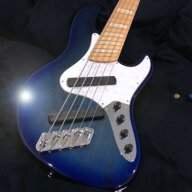
my trussrod nut is currently as tight as i can get it. but i have to much relief. just looking for advise on how to go about fixing the problem. my thought is to loosen it and retighten it. i would like to fix it my self and feel more confident in doing my own set, but i also don't want to F it up

thanks
 
Do you know if it's a dual-expanding trussrod or a vintage-type trussrod? I suppose it could be possible that if it's a vintage trussrod you may have run out of threads on the rod itself (guys, correct me if I'm wrong on this), and if that's the case you might try removing the trussrod nut and putting some metal washers as spacers and that might give you enough material to still be able to tighten the trussrod some more.
 
loosen the rod completely

put the headstock in a vice, and the neck joint in another, both attached to a bench (so the whole thing is immobilized)

push on the back of the neck till youve got the relief where you want it

while holding pressure on the neck tighten the rod

enjoy life
 
Hi.

The washer is most likely the best soluton for fixing the problem.

One word of warning though.

Since the TR nut has sunken into the bottom of the cavity, it's very important that the washer is exactly the same size as the TR nut. Otherwise the neck may split.
IIRC StewMac sells the correct washers. The ones that You'll find on the hardware store shelves need to be trimmed down.

loosen the rod completely

put the headstock in a vice, and the neck joint in another, both attached to a bench (so the whole thing is immobilized)

push on the back of the neck till youve got the relief where you want it

while holding pressure on the neck tighten the rod

enjoy life

And just how exactly is this method supposed to fix the problem:confused:.

Usually that's how an unsuspecting and/or ignorant buyer gets an unresponsive/unadjustable neck in their hands in the first place.

The TR's function is to provide adjustability, not to counteract the string pull.

Regards
Sam
 
Hi.

The TR's function is to provide adjustability, not to counteract the string pull.

Regards
Sam


From Gibson patent (Ted McHugh) patent number 1,446,758, starting on line 11:

The main objects of this invention are:
First. To provide an improved neck for stringed instruments, which is so constructed that it is not likely to spring or warp under the strains to which it is subjected in use, and one which should it become warped, may be straightened.

End quote.

The reason for the invention is to counteract the force generated by the pull of the strings. The adjustable truss rod takes the idea one step further and allows for adjustment and fine tuning that is necessary due to different string tensions and the whims of the environment.
 
And just how exactly is this method supposed to fix the problem:confused:.

Usually that's how an unsuspecting and/or ignorant buyer gets an unresponsive/unadjustable neck in their hands in the first place.

The TR's function is to provide adjustability, not to counteract the string pull.

Regards
Sam

The problem is that the neck is not straight enough, and the truss rod alone cannot supply the force to straighten it. This fixes it by straightening the neck. I'm a little :confused: as to why youre :confused:

Also, its got nothing to do with being unsuspecting or ignorant...sometimes you get a soft piece of wood. It just happens.

Also, the truss rod's function is precisely to counteract the string tension...it just so happens that they usually have a range of adjustment as to how much of that they do.
 
i don't mean to be confusing or sound ignorant, but with a proper set up and good straight neck the strings have less tension on them at least seemingly. i assumed with the truss rod holding the tension of the neck it has less force on the strings. in the past this has seemed to be the case for me.

i have tryed out the vise trick before on my mim jazz and it worked very well. i learned about doing it from bass player magazine so i trusted it.
thanks for the tips, and even if i ruin my neck i still have that meat lovers pizza in the trunk
 
i don't mean to be confusing or sound ignorant, but with a proper set up and good straight neck the strings have less tension on them at least seemingly. i assumed with the truss rod holding the tension of the neck it has less force on the strings. in the past this has seemed to be the case for me.

i have tryed out the vise trick before on my mim jazz and it worked very well. i learned about doing it from bass player magazine so i trusted it.
thanks for the tips, and even if i ruin my neck i still have that meat lovers pizza in the trunk

The problem is in the terminology. Tension is a very specific term. It relates to the physics of the instrument. In short, for a given pitch the tension on a string is constant. Nothing else matters.

The feel of a string can be different depending on what is done to the instrument, or at least this is what some folks claim. If that is your experience go with it.
 
i don't mean to be confusing or sound ignorant, but with a proper set up and good straight neck the strings have less tension on them at least seemingly. i assumed with the truss rod holding the tension of the neck it has less force on the strings. in the past this has seemed to be the case for me.

Guessing here, but it might be that the strings feel like they have more tension with high action because you have to move them further?
 

Latest posts