• TalkBass has been independent since 1998. Add your voice.
    Create a free account to reply to discussions, view embedded media, and browse with fewer display ads.
    Join freeLog in
    Want zero display ads or expanded classifieds tools? Compare plans.

Tuner Hole Too Big...Fixed!

Cut plug. Trim plug. Flush sand plug. Refinish.
Naaah, that's too time consuming.

Make a bigger bushing!
In this case the existing holes are just slightly too big for a satisfactory fit. I cut some aluminum tape strips the depth of the bushings and wound the strips onto the bushings to increase the diameter. In my case I cut the strips 10" long which proved to be a correct guess. Your strips may vary depending on the diameter increase you need.
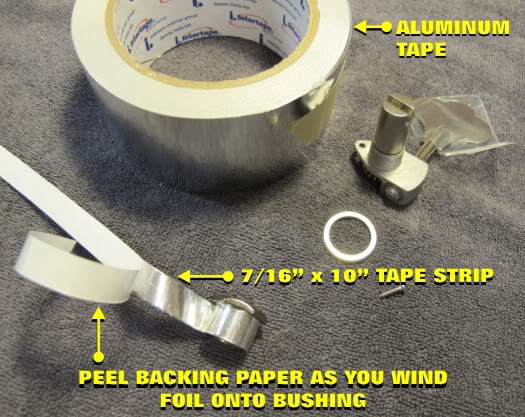
resizebushing_01.jpg
 
I used plain, cheap masking tape on a Epiphone guitar with a couple of loose tuners about a decade ago that for awhile was my main performing instrument on guitar gigs. It is still holding up.
 
I recently got some Hipshot Ultralite USA tuners in 3/8” size for my Warwick Corvette. They were a little on the loose side as mentioned in this thread, and the tip about using tape to shim the bushing was a lifesaver. It’s unfortunate that it needs to be done but it allows for a perfect fit.
 
Hi there. Dunno if that's old news, but I was recently confronted with tuner holes that were ever so slightly to large, so the bushings would wiggle in them. These were already those conversion bushings to mount vintage tuners in modern holes. However, since the guitar, that should get these new tuners, was a really cheap Tele kit, these holes were of course not drilled to well. Filling the holes and re-drilling was therefore out of the question.
I read people saying that one could use a thin strip of veneer to fill the gap, or apply super glue to the inside of the hole, but none of these suggestions clicked with me.

You guys know this Invalid Link Removed, that comes in rolls, of which you cut of the desired amount and knead it to a homogeneous mass?
Invalid Link Removed

So I plastered a little bit of that stuff around the inside of each hole, used a screwdrivers shaft to really mold it to the inside, pressed the bushings in, removed excess and waited. Even right after the procedure the bushings were tight in there, but to be safe I waited 24h before restringing. What can I say, it seems to have worked beautifully! The stuff gets rock hard, and I can't see the bushings ever coming loose again by themselves! And it was quick! It took not more than 5 minutes! I have to say I am pleased with the outcome :)

I hadn't read about people using this putty for this purpose. So I thought I'd share, so this neat little trick can be added to all the other neat little tricks people come up with in luthiery :)

However, if this is common knowledge, and only I didn't know, please forgive me for wasting your time ;)


BTW, happy new year! :)
 
No, not messy at all, and very quick. Tape didn't work so well for me, as it doesn't always stay in place, nor is one layer always enough, and the more layers the more it gets complicated...
As for perfectly centered: One can put the machines in while the stuff is still a little soft, and make sure they line up nicely. Once it's cured, everything stays perfectly in place anyway.
Oh, and did I mention it's not messy at all? Not even fiddly, as using tape is!
 
No, not messy at all, and very quick. Tape didn't work so well for me, as it doesn't always stay in place, nor is one layer always enough, and the more layers the more it gets complicated...
As for perfectly centered: One can put the machines in while the stuff is still a little soft, and make sure they line up nicely. Once it's cured, everything stays perfectly in place anyway.
Oh, and did I mention it's not messy at all? Not even fiddly, as using tape is!
I have used that product on things other than instruments and can attest that it’s really tough stuff. I was hitting some excess scraps with a hammer to test it and was surprised at how hard it was. And it really sticks well to clean metal, wood and even plastic if you rough it up well.

Now I wouldn’t go using it on a high value instrument, but for a project Like yelemusic’s There’s nothing wrong with it. His alternative was to fill and redrill : invasive, or partially fill with something tough. The epoxy putty he used filled the bill and I agree with him that on certain projects, it can be put to good use.