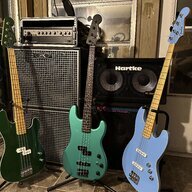
I did this for a few months on a Jazz bass. Like has been posted: use a B string for C, I'd go thicker to maintain tension on that side of the neck. Thicken up the A string too, as dropping it to G will benefit from it. {skipping D string} For the A, this is where it got tricky for me. Within the span of four strings, we're verging on the gauge difference across a six string. Such an endeavor certainly plays with the neck dynamics, and many necks are shaped conversely (as in if they are asymmetrical, the meat is behind the E and A strings). The converse is the added tension from which the higher strings usually comprise higher tension anyway, so the thinner side of the neck is under more load. To compensate, you could go with thinner strings (or strings with a thinner core for the higher strings, and a thicker core for the lower strings). This would certainly be a very "by the string" set composition.
The D string would be dependent on your taste, the composition of the rest of the set, and availability.
Beyond that and the havoc of individual neck dynamics, we're getting into somewhat uncharted territory as far as the rest of the setup goes. Anyone seen the cross section of a cello fingerboard? It's nothing like the vast majority bass finger/fret board derivations (I can't think of one, but that doesn't mean they don't exist).
Then there is the tone balance. What I noticed, as would anyone, is the ease of which playing across the board results in a dramatic thinning of the sound when playing from low to high. Combine that with the reach needed to make not only the chord shapes that do transfer over with the oddities of playing scales, and you've got one hell of a beast on your hands. If there ever were a place for multiscale fanned frets, this takes the cake. Still, many chords are lost. Many unique combos are attained.
To be honest, playing in this tuning made me think very differently. It didn't suit playing most standards, whatever that means. I suppose what I mean by that is I found many basslines I knew to be a pain to play in this tuning. That does in no way make it a bad tuning. It just takes a different approach, one that I suppose even a real cellist would break into a sweat over. I firmly believe it has a place, though. I don't know why. This is one of those demons that has its place among us, IMO.