
• TalkBass has been independent since 1998. Add your voice.
    Create a free account to reply to discussions, view embedded media, and browse with fewer display ads.
    Join freeLog in
    Want zero display ads or expanded classifieds tools? Compare plans.

Double Bass Tuning machine key failing - weld or braze?

Looks like I've got a tuning machine key getting ready to snap where it attaches to the post - older steel Klusons, nickel plated. There's evidence of a previous small brazed repair at one edge of the key, suggesting a prior failure, but the repaired portion seems to be holding OK-the rest of it flexes. Local jewelers don't want to deal with it and suggest welders. Am I OK to undertake a small MIG weld on the broken portion? I've got a small MIG and rudimentary welding skills...thanks for any advice.
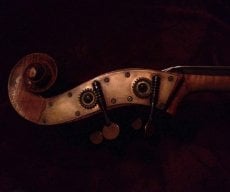
 
Here you go... Key 1.JPG
 
Welding would weaken the material too much. Soldering might work with a reinforcement plate. I might cut a new key from plate, punch out the old rivet and replace it, but riveting it correctly would require equipment. Best option is to cruise for a used Kluson set and simply replace the entire set or the individual key.

The trick to doing a single key is releasing it from the plate without breaking the clamps. You can't just knock the tabs with a cold chisel and bend them back, they're a little too brittle, btdt. I'm not sure what the best procedure is, and would love to hear suggestions, as many Kays need this kind of work.
 
Looks like I've got a tuning machine key getting ready to snap where it attaches to the post - older steel Klusons, nickel plated. There's evidence of a previous small brazed repair at one edge of the key, suggesting a prior failure, but the repaired portion seems to be holding OK-the rest of it flexes. Local jewelers don't want to deal with it and suggest welders. Am I OK to undertake a small MIG weld on the broken portion? I've got a small MIG and rudimentary welding skills...thanks for any advice.

Here's a vote in favor of having the piece welded. I don't know much about the Kluson tuners, but so long as they're steel then it's certainly possible for a competent welder to repair the crack. Just as having the the wood parts of the bass repaired by a skilled luthier, an original tuner repaired by a competent welder oughtta be trouble-free for decades while adding some mojo to the bass. There's something to be said for maintaining originality of the tuners if the rest of the instrument is likewise original.

Like you I can do basic welding, but for a job like this I'd remove the tuner plate from the bass and have a skilled pro work his/her artistry. A nicely-run bead, properly stress-relieved and dressed, should be at least as strong as the original part.

An alternative would be to take the assembly to a good machinist and have him/her fabricate and mount a new part. You might even have the new metal nickel plated to approximate the original, if you can find a company that does quality work (especially for such a small job).

Good luck.

-bob
 
My bad. The key is brass, nickel plated. Plan B is investigating replacement tuners or making a new key. This looks like a weak point in the design, particularly on the D tuner which is the highest and prone to snag on just about everything, so I think trying to braze or silver solder it would be futile. It's tempting to fight the toughness of .050" stainless to carve out a new key that would be for the ages as well as more-or-less matching the existing dull nickel look.
 
Here's how I go about replacing a tuner key:
Remove the tuner plate.
With a dremel mounted burr, and then a drill remove the rivet.
Make a new, identical key from brass or steel plate of the same thickness. I think they either used 0.050" or .062" thick material. (maybe monel would look nice...)
Come up with a new "rivet" - this can simply be a piece of 1/8" soft steel or brass rod. If it's just a small section of rod, cut that so it's slightly shorter than the diameter of the post end, that way you can squeeze everything tight before you solder it.
You could find a peened type rivet if you really want to make it look original.
Before the final assembly cover all the inside surfaces with plumbers flux. Don't get flux on anything you don't want solder on.
Heat up your parts with a torch until the flux melts, then heat only until the parts are hot enough to melt your solder. Use the hardest plumbers silver solder you can find. I use super high silver content solder that's very hard.
At the right temp the solder will draw itself into the gaps, then let it cool. If your work was tight fitting and clean, it's a permanent fix. Wash any extra flux off as it's corrosive.
I've also seen brazed repairs but it's harder to handle. You've all seen the "monkey fist" blob of braze filler. Maybe good for filling in parts of a missing brass post end.
 
Last edited:
  • Like
Reactions: fdeck
Nope.
Nope.
Nope.

Remove the entire machine from the bass. Find a decent jeweler, take the machine to them, and have it silver soldered. Jewelers have very delicate little welding tools for the detail work and silver solder has a veryvery high strength- not like the home depot or radio shack type of solders. It should cost you about $20 and take 10 minutes and you are back in the game. Traditional welding and brazing tools and the people who use them are like hitting the machine with a light saber; every time I tried it from " this guy I know who is an amazing welder and does stuff for nasa and the aircraft contractors", the machine was basically destroyed.

I will be the first to agree that the original 4:1 Kluson machines that came on old Kay basses are not my first choice for performance - except when you are using guts. On a 4:1 a quick half turn ends up being a close to a half step tightening of the string which is perfect when you are on the gig. Try turning a set of Sloan machines with their 50:1 ratio a half step up and you need about two full revolutions of the machine- impractical on any of my gigs where we are playing Django at 100 miles per hour. Keep in mind that in my local area (YMMV), the tuning machine and originality police are in full force, so swapping out the original set for a seemingly better performing Chinese set will reduce the street value of that old Kay by about $300....

That said, I have the same problem to correct this week- wanna sell me the treble side????

Good luck with the repair.

j.
www.kaybassrepair.com
www.condino.com
 
So, the brass key has been soldered before and it broke again because the parent material is way too flexible. Now the key is about to break off completely. On top of that he can't find anyone willing to help. Let's have some fun. Here's your Kobayashi Maru moment: The gig is tomorrow, what's the solution? And no, you can't use another bass.
 
My bad. The key is brass, nickel plated. Plan B is investigating replacement tuners or making a new key. This looks like a weak point in the design, particularly on the D tuner which is the highest and prone to snag on just about everything, so I think trying to braze or silver solder it would be futile. It's tempting to fight the toughness of .050" stainless to carve out a new key that would be for the ages as well as more-or-less matching the existing dull nickel look.

I agree with you that neither brazing nor soldering are likely to result in a permanent repair, but a well-executed braze might hold for as long as you own the bass. If the crack hasn't opened too far and you have access to an acetylene rig you may be able to braze it yourself. The hard part, I think, would be getting your crack clean enough (sorry, couldn't resist) to get a good bond. That said, I rather prefer your idea of fabricating a new key from stainless. You might even try using some nickel alloy stock (although it's a bit expensive).
 
Last edited:
Or punch out the rivet, file down a quarter to .050 or thereabouts, stuff it in the post slot. Voila. Updates: the key snapped off as I was removing the string in preparation for removing the machine assembly, so crack cleanliness will not be an issue. Meanwhile, local jewelers won't silver solder because it's nickel-plated. I see silver solder offered online for precisely this purpose from a brass/woodwind repair supply. My local luthier doesn't see a problem and can mess with it tomorrow so I guess we'll give it a try before cutting out a new one. Mini-vise grips are starting to sound like an elegant solution.

Thanks to everyone who has chimed in on this one!
 
  • Like
Reactions: KUNGfuSHERIFF