Hello, Mr. Manring. I must say that I've been fascinated how you can make the bass a solo instrument and really take it to it's full potential and then some. This leads me to my question though, I know that you use many different tunings, but what tuning or set of intervals you have your strings at usually when you create some of this crazy music? This is of course aside from the standard EADG tuning.

Enjoy the benefits of a premium membership!
Upgrade Account
-
TalkBass has been independent since 1998. Add your voice.
Create a free account to reply to discussions, view embedded media, and browse with fewer display ads.
Join free Log in
Want zero display ads or expanded classifieds tools? Compare plans.
You are using an out of date browser. It may not display this or other websites correctly.
You should upgrade or use an alternative browser.
You should upgrade or use an alternative browser.
Tunings in Michael Manring songs
- Thread starter Leftybass12
- Start date
More options
Who Replied?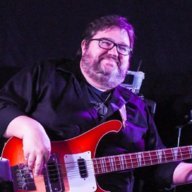
I think, in some cases, he uses multiple tunings per song... On his Zon Hyperbass, he has a hipshot D-tuner on every string and a special bridge that de-tunes every string as well...
I think he can have up to 64 different tunings by flipping levers...
Check this out!!:
I think he can have up to 64 different tunings by flipping levers...
Check this out!!:
To start with the conventional tuning for a 4 strings EADG & to begin to experiment altered tunings in a way of "sounding ala Michael" according to a minimal progression through the difficulties, i would suggest :
E G D G
D A D G
E A D A
E A E G
I am not intended to substitute Michael's explanations here but with this simple set of one altered string per set, you can freely apply the Sequencer* Tapping style which is to my sense his main concept & his touch (sounds like synthesizer pads).
A fretboard analysis of all fundamentals/open strings/octaves for a given pitch note will give an insight of what is possible (focusing on 4th intervals to the right hand).
I mainly venerate two Musicians (not technicians) : Vangelis & Manring.
Greetings to him from France.
*
PS : Michael, do you play Keyboards & further more do you write your Themes with them ?
E G D G
D A D G
E A D A
E A E G
I am not intended to substitute Michael's explanations here but with this simple set of one altered string per set, you can freely apply the Sequencer* Tapping style which is to my sense his main concept & his touch (sounds like synthesizer pads).
A fretboard analysis of all fundamentals/open strings/octaves for a given pitch note will give an insight of what is possible (focusing on 4th intervals to the right hand).
I mainly venerate two Musicians (not technicians) : Vangelis & Manring.
Greetings to him from France.
*
PS : Michael, do you play Keyboards & further more do you write your Themes with them ?

I think, in some cases, he uses multiple tunings per song... On his Zon Hyperbass, he has a hipshot D-tuner on every string and a special bridge that de-tunes every string as well...
I think he can have up to 64 different tunings by flipping levers...
Check this out!!:
This was actually the first Manring song I listened to about a year ago...amazing
Hello, Mr. Manring. I must say that I've been fascinated how you can make the bass a solo instrument and really take it to it's full potential and then some. This leads me to my question though, I know that you use many different tunings, but what tuning or set of intervals you have your strings at usually when you create some of this crazy music? This is of course aside from the standard EADG tuning.
I was a list, perhaps at www.manthing.com, of the tunings and basses he uses for many pieces. The manthing site has been updated and I can't find the list. Maybe someone else knows where this is?
I was a list, perhaps at www.manthing.com, of the tunings and basses he uses for many pieces. The manthing site has been updated and I can't find the list. Maybe someone else knows where this is?
Archive.org to the rescue!
http://web.archive.org/web/20060511015959/www.manthing.com/tunings.htm
Thank you sooooo much!!!!

Does He use Special strings? I mean a specific gauge? I'm terrified to even attempt tuning up to the Bb F Bb F in The Enormous Room That first one is the Bb ABOVE the E on the E string. Everything else is also above, I believe. That seems awfully dangerous with standard strings. it might also have to do with the scale of the bass, but Still, I won't even try. I've broken a guitar string tuning it up a whole step before, much less almost a FREAKING OCTAVE. Anyone know?
Does He use Special strings? I mean a specific gauge? I'm terrified to even attempt tuning up to the Bb F Bb F in The Enormous Room That first one is the Bb ABOVE the E on the E string. Everything else is also above, I believe. That seems awfully dangerous with standard strings. it might also have to do with the scale of the bass, but Still, I won't even try. I've broken a guitar string tuning it up a whole step before, much less almost a FREAKING OCTAVE. Anyone know?
Yes, he used very light gauge strings on the hyperbass.
Yes, that is the one. Thanks for retrieving this!
To start with the conventional tuning for a 4 strings EADG & to begin to experiment altered tunings in a way of "sounding ala Michael" according to a minimal progression through the difficulties, i would suggest :
E G D G
D A D G
E A D A
E A E G
I am not intended to substitute Michael's explanations here but with this simple set of one altered string per set, you can freely apply the Sequencer* Tapping style which is to my sense his main concept & his touch (sounds like synthesizer pads).
A fretboard analysis of all fundamentals/open strings/octaves for a given pitch note will give an insight of what is possible (focusing on 4th intervals to the right hand).
I mainly venerate two Musicians (not technicians) : Vangelis & Manring.
Greetings to him from France.
*
PS : Michael, do you play Keyboards & further more do you write your Themes with them ?
As a beginner, I'm wondering how to go about starting to learn some tapping, strumming and other techniques? any suggestions?
As a beginner, I'm wondering how to go about starting to learn some tapping, strumming and other techniques? any suggestions?
Hello,
Tapping techniques are specialized techniques, limited to particular effects. It is the same for Strumming ones & if you like strumming, you could simply study 'Flamenco' players and apply gestures on bass with two notes voicings (double-stops) or more complex voicings further.
I can't really go beyond this because of my poor english and the fact that i am not with you to explain how simple these techniques are: thats the point to remember.
There are many books on those subjects, what i know derives from many sources but what i understand comes from my own thinking. Simply choose one book (Method) & start the path.
Pleasure is the key. You could become a good & full player in one year, two years or thirty years, it all depends on you. Be confident, you are unique & so is your fate. Progress at your speed, the race is not for the swift.
As a start regarding tapping, Stu Hamm is a good teacher: https://www.youtube.com/results?search_query=stuart hamm tapping lessons
Accept the reality of possible and triumph.
All the best.
PS: also, you could take a look at this excellent French bassist, so many insights to learn from him: https://www.youtube.com/results?search_query=jean+bisello
Last edited:
Hello,
Tapping techniques are specialized techniques, limited to particular effects. It is the same for Strumming ones & if you like strumming, you could simply study 'Flamenco' players and apply gestures on bass with two notes voicings (double-stops) or more complex voicings further.
I can't really go beyond this because of my poor english and the fact that i am not with you to explain how simple these techniques are: thats the point to remember.
There are many books on those subjects, what i know derives from many sources but what i understand comes from my own thinking. Simply choose one book (Method) & start the path.
Pleasure is the key. You could become a good & full player in one year, two years or thirty years, it all depends on you. Be confident, you are unique & so is your fate. Progress at your speed, the race is not for the swift.
As a start regarding tapping, Stu Hamm is a good teacher: https://www.youtube.com/results?search_query=stuart hamm tapping lessons
Accept the reality of possible and triumph.
All the best.
PS: also, you could take a look at this excellent French bassist, so many insights to learn from him: https://www.youtube.com/results?search_query=jean bisello
Thanks Jumon, for the suggestions. The flamenco suggestion is very interesting. Its not my favorite music, but the technique could be very helpful ! Just a few days ago I went to a concert in Portland, OR where Michael Manring played with Alonso Arreolo (from Mexico he plays in styles that seemed to be like flamenco - he is Amazing !! www.alonsoarreola.com ). So I got very inspired to explore my own ideas of what I want to do, which depart from the traditional bass role in a band. As a beginner with not a lot of time to practice, I want to put my practice time to best help me realize my ideas.


