Which would you prefer - Two 150 Watt Amps or One 300W Amp. Taking Lt. & Rt. from your Multi effects Board. Does using a pair of 150's have any advantage or disadvantage over one 300 Watt amps ?

Enjoy the benefits of a premium membership!
Upgrade Account
-
TalkBass has been independent since 1998. Add your voice.
Create a free account to reply to discussions, view embedded media, and browse with fewer display ads.
Join free Log in
Want zero display ads or expanded classifieds tools? Compare plans.
You are using an out of date browser. It may not display this or other websites correctly.
You should upgrade or use an alternative browser.
You should upgrade or use an alternative browser.
Two 150 Watt Amps or One 300W Amp
- Thread starter Bassman 100
- Start date
More options
Who Replied?
-you will most likely get more clean headroom from one 300 watt amp
-two amps on stage can actually cause wavelength interference that messes with your dispersion of sound out front..do a search for details
-you will likely get ground loop hum from running 2 amps
-more gear to carry.
but
-you can get better stereo effects
I'd go with one 300 watt amp..(tube I assume)
-two amps on stage can actually cause wavelength interference that messes with your dispersion of sound out front..do a search for details
-you will likely get ground loop hum from running 2 amps
-more gear to carry.
but
-you can get better stereo effects
I'd go with one 300 watt amp..(tube I assume)

The only benefit I can see to running two rigs is if you want one with effects and one without or if the two heads are so drastically different that you have an a/b pedal for them. You can sorta do this with a lot of amps with parallel inputs though. I do it w/ my SVT (effects into one channel and clean into the other).

Great help thanks. No I was actually thinking Solid State. Perhaps a pair of MarkBass MiniMark instead of getting an extension cab. I was thinking perhaps the N/Y 604 or another MiniMark. The other + was thinking I would have my stand-by anp right there with me should I have amp failure.
im not sure youd have enough clean power to play anything remotely louder with either set up if your talking solid state...you can search that too while i 

Bassman 100:
I recommend you go with one 300 watt amp. Why? Because in order for bass to sound full, especially at the lower frequencies, you need more power. Let's look at an extreme example to make a point. Consider having 300 itty bitty 1-watt amps. It still adds up to 300 watts, just like a pair of 150 watt amps. But 300 1-watt amps obviously won't provide the low end you need. Having a pair of 150 watt amps is way better than having 300 1-watt amps, but still not as good as having one 300 watt amp.
When it comes to bass, a good rule of thumb is, always go with more wattage.
The *only* reason to consider two amps is if you want stereo effects, or one clean amp and one fuzzed amp, or something like that.
I recommend you go with one 300 watt amp. Why? Because in order for bass to sound full, especially at the lower frequencies, you need more power. Let's look at an extreme example to make a point. Consider having 300 itty bitty 1-watt amps. It still adds up to 300 watts, just like a pair of 150 watt amps. But 300 1-watt amps obviously won't provide the low end you need. Having a pair of 150 watt amps is way better than having 300 1-watt amps, but still not as good as having one 300 watt amp.
When it comes to bass, a good rule of thumb is, always go with more wattage.
The *only* reason to consider two amps is if you want stereo effects, or one clean amp and one fuzzed amp, or something like that.

- May 9, 2008
- 4,081
- 1,236
- Disclosures
- Proprietor Springvale Studios
This information contains poor engineering, there is no waveform interference or phase issues from two similar amps and cabinet sets.-you will most likely get more clean headroom from one 300 watt amp
-two amps on stage can actually cause wavelength interference that messes with your dispersion of sound out front..do a search for details
-you will likely get ground loop hum from running 2 amps
-more gear to carry.
but
-you can get better stereo effects
I'd go with one 300 watt amp..(tube I assume)
There is no power deficit to two amps of half the power of a larger one.
Next time you board an aircraft or ship or any other piece of engineering that gets embarrassing if it stops working suddenly, and you will find backup systems which are there to get you home 2 independent systems is the only intelligent way forward.

billfitzmaurice
Commercial User
- Sep 15, 2004
- 16,860
- 278
- 76
- Disclosures
- Owner, Bill Fitzmaurice Loudspeaker Design
+1, on all points. And watts get cheaper the more of them you have, so one 300 watt amp is likely to be less expensive.-you will most likely get more clean headroom from one 300 watt amp
-two amps on stage can actually cause wavelength interference that messes with your dispersion of sound out front..do a search for details
-you will likely get ground loop hum from running 2 amps
-more gear to carry.
This information contains poor engineering, there is no waveform interference or phase issues from two similar amps and cabinet sets.
Bassmec, based on what I had read in many other posts (by folks such as Bill Fitzmaurice and Greenboy and other audio engineers on TB), having speakers side by side will adversely interfere with each other due to comb filtering, and will reduce dispersion in the mid to upper frequencies by half. That is why it is preferred to have speakers vertically aligned rather than horizontally aligned. I believe this is what eyeballkid is referring to.
If the OP was planning to stack the two amps on top of each other, then cool. But I believe the OP may be thinking of having the amps next to each other, which introduces these issues.
EDIT: Wow! It didn't take long for Bill FM to chime in! I typed my message and posted it before he did, which is why I referenced Bill in my message.

Plenty of people with more acoustic understanding and WAY more diagnostic gear can show you VERY CLEARLY how the different distances between amps of the same signal onstage (especially bass frequencies) can and DO create hotspots of beaming and troughs of low volume in front of the stage due to wavelength interferences. Do a search, youll find the threads complete with PICTURES!! WOOOWEEE!!
Also, try running two amps in any place without perfectly good wiring and you WILL get a hum most likely. My house does it. Alot of clubs have the same problem.
Having a fail safe redundancy is VERY different that having sonic mismatching..
EDIT: P.S... Im not trying to bust yer balls... just dont fly off saying what I write is 'poor' unless youre dead right and can prove it. I try to be tactful in my disagreements and concede when Im wrong.. its nice for that to be standard practice, but alas, this is the interwebs.
This information contains poor engineering, there is no waveform interference or phase issues from two similar amps and cabinet sets.
There is no power deficit to two amps of half the power of a larger one.
Next time you board an aircraft or ship or any other piece of engineering that gets embarrassing if it stops working suddenly, and you will find backup systems which are there to get you home 2 independent systems is the only intelligent way forward.
Also, try running two amps in any place without perfectly good wiring and you WILL get a hum most likely. My house does it. Alot of clubs have the same problem.
+1!!
I would never run my bass into two separate amps without using a Lehle splitter to negate the ground loop hum.
Plenty of people with more acoustic understanding and WAY more diagnostic gear can show you VERY CLEARLY how the different distances between amps of the same signal onstage (especially bass frequencies) can and DO create hotspots of beaming and troughs of low volume in front of the stage due to wavelength interferences. Do a search, youll find the threads complete with PICTURES!! WOOOWEEE!!
+1000
Yep, by golly, ebk speaks the truth!
- May 9, 2008
- 4,081
- 1,236
- Disclosures
- Proprietor Springvale Studios
Assuming two similar 8 ohm cabinets stacked vertically to handle afore said 300 watts.+1, on all points. And watts get cheaper the more of them you have, so one 300 watt amp is likely to be less expensive.
Lets consider tube amps shall we.
against the same cabinets with two amps delivering 150 each.
So exactly the same result Bill?, If not where and exactly how are we suddenly getting phase issues or loss of power here?!.
Also two 150 watt for instance perfectly serviceable sound city bass amps are actually quite a bit cheeper on flea bay UK than one second hand SVT CL, VR Fender or Sunn 300 Or for that matter Mesa 400+.
So big power tube bass amps are in fact more than twice the price of two lower powered ones, thanks in part to the sort of erroneous half scientific stuff found in this thread.
Keep up the good work chaps!
In fact the 12 EL34 fixed variable biased tubes in the two sound cities develop slightly more clean power via their partridge output transformers than the 12 stock fixed bias 6L6's do in the 400+.
I am sure you are aware that troublesome earth loops in between integrated tube amps have been a thing of the past since the invention of high impedance isolation transformer boxes, such as Sowter, Lehle P Split/Dual/Little Dual, Radial aby, and little labs distro.
Thats how us internationally famous and highly sought after recording studio engineers do re-amping and multi-amping all with such good signal to noise results, Just in case you where wondering.
PS Yes I am perfectly aware that a gazillion watts of class D amplifier is now only the same price as a half chewed Hershey bar and weighs about the same.

Which would you prefer - Two 150 Watt Amps or One 300W Amp. Taking Lt. & Rt. from your Multi effects Board. Does using a pair of 150's have any advantage or disadvantage over one 300 Watt amps ?
Don't know if this is two amps powering one speaker or two amps powering two speakers, but if you do NOT understand phase cancellation and how to deal with it, do yourself a huge favor, and just go with one amp running one cab in a non-stereo configuration where you do not have to deal with phase cancellation.
its the erroneous half reading of this thread that is bothering me.
Bill was talking about the OPs watt question in relation to solid state amps where you can get say a $400 150watt amp of a certain brand, but the 1100 watt model by the same brand may be say $900.. so dollar for dollar you get more watts. The argument about Sound City vs. Ampegs or whatever is mixing lesser knowns (that are definately worthy of more honor!) that are in abundance in your country for big league standards from overseas, of course price differences can be found.
Someone using 150 watt solid state amps probably doesnt have a high impedance isolation transformer box in their arsenal more than likely... hell, Ive gone thru tons of gear and i dont have one.
Lastly what you are calling people out on bad science or what not is a product of you not reading my original post closely or any of the other follow ups. Mine was about 2 different amps spaced seperately on the stage, as was all those who agreed. NOW youre talking about cabinets stacked vertically.. Of course there no issue in that and neither I nor Bill or the others were saying so either.
Hooked on Phonics and Tact worked for me.
Bill was talking about the OPs watt question in relation to solid state amps where you can get say a $400 150watt amp of a certain brand, but the 1100 watt model by the same brand may be say $900.. so dollar for dollar you get more watts. The argument about Sound City vs. Ampegs or whatever is mixing lesser knowns (that are definately worthy of more honor!) that are in abundance in your country for big league standards from overseas, of course price differences can be found.
Someone using 150 watt solid state amps probably doesnt have a high impedance isolation transformer box in their arsenal more than likely... hell, Ive gone thru tons of gear and i dont have one.
Lastly what you are calling people out on bad science or what not is a product of you not reading my original post closely or any of the other follow ups. Mine was about 2 different amps spaced seperately on the stage, as was all those who agreed. NOW youre talking about cabinets stacked vertically.. Of course there no issue in that and neither I nor Bill or the others were saying so either.
Hooked on Phonics and Tact worked for me.

Hummm. So what is the difference if two like 150 watt combos with a 15 each are pumping out 100 watts each. Compare that with 1 amp with 300 watts and putting 200 watts out in two 1x15 cabs. Everything is stacked the same. The speakers are getting the same power, how it gets it seems immaterial. What is the difference?
The benefit of 2 amps is redundancy, one amp blows the other powers both combo speakers.
The benefit of 2 amps is redundancy, one amp blows the other powers both combo speakers.
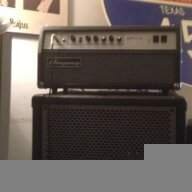
more trips maybe,but i can see some advantages....flexibility for one....a decent 150 tube amp will cover most rooms....pa support for larger rooms seems to moderate the need for super amps these days......the second head could be used as a backup,or in tandem if more stage volume is needed,as well as split clean/dirt..... but i agree if we're talking 2 150's ss then no.....i've seen more than a few svt's turned up to less than a quarter of full power in 150 seat rooms,and while i love the sound of the big fella's,i'm not so sure that the monster volumes are necessary in most situations-you will most likely get more clean headroom from one 300 watt amp
-two amps on stage can actually cause wavelength interference that messes with your dispersion of sound out front..do a search for details
-you will likely get ground loop hum from running 2 amps
-more gear to carry.
but
-you can get better stereo effects
I'd go with one 300 watt amp..(tube I assume)
Latest posts
-

-

-

-

-
Post a funnier picture than the one above - Parallel Universe Edition
- Latest: Richland123