- Apr 18, 2008
- 16,016
- 1
- 31,730
- Disclosures
- I'm highly opinionated and extremely self-assured
Hello LC friends!
While I enjoy every aspect of building from scratch, I also sometimes find interesting factory bodies for cheap, which I buy with the intent of making custom necks for. Here I share two such "half-builds".
The first one uses a Peavey Foundation body, purchased from that auction site. Factory black gloss paint with several large chips in it. I bought it thinking that it might fit a Fender-spec neck, but no. The neck pocket is just a wee bit too close to the bridge. So that opened up my options considerably.
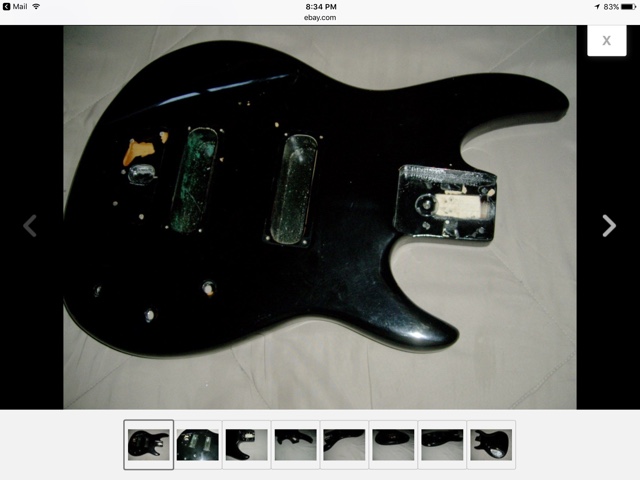
I knew from my research that the body was maple underneath. I sanded all of the factory finish off and was pleased to find a nice four-piece maple body, with three of the four sections having some impressive figuring.
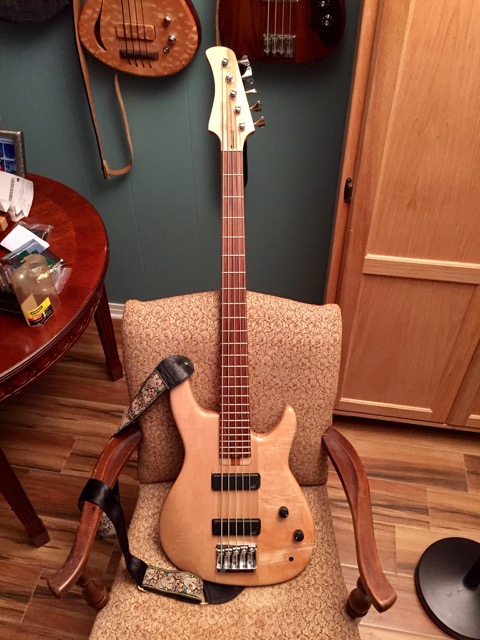
I built a deep-tenon narrow-spacing 33" scale five-string neck for it - sorry, didn't take photos of that, but it's pretty straightforward. Three-piece maple/cherry/maple, 24-fret pau ferro fretboard, scarfed tiltback headstock. I then deepened the neck pocket on the Peavey body accordingly.
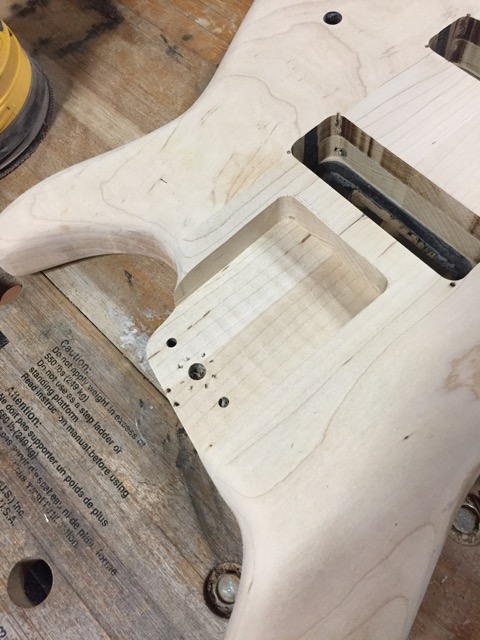
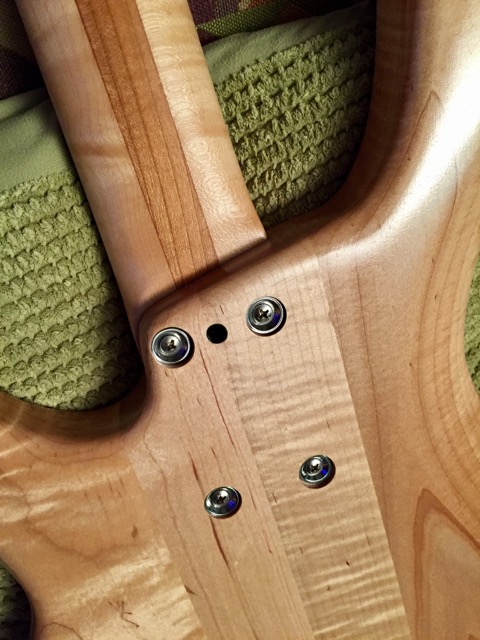
I chopped off the neck heel - one of the worst aspects of the pedestrian Fender formula in my opinion - and the rear neck bolt holes became the front holes, with new rear holes drilled further in. That fifth hole is where the Peavey micro-tilt was. A bit unsightly, but oh well.
I had a pair of Aguilar DCB pickups that I found cheap on the TB Classifieds. The pickup cavities needed a bit of enlargement to accommodate them, no sweat. Finished neck and body with gloss Formby's tung oil.
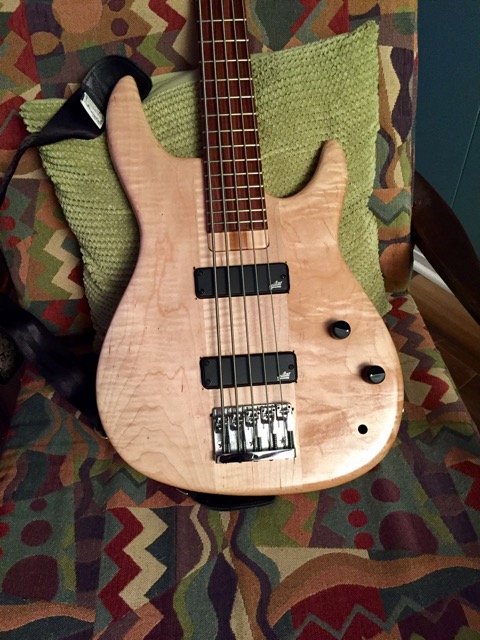
Th reverse headstock is partly just for fun, but it also lets me use regular long-scale strings on the 33" scale neck without worrying about putting full windings on the B-string tuner post.
Schaller roller bridge, John East two-band preamp, fresh Lo-Riders, and bam! A very crisp and snappy sounding five-string for the collection!
The second half-build is based on an Epiphone EB-0 body that came from the TB Classifieds. The prior owner had already routed a second pickup cavity closer to the bridge. I modified that cavity slightly to accept a TV Jones Thunder'Mag on a custom ring. The factory neck pickup cavity will probably be used as a battery compartment.
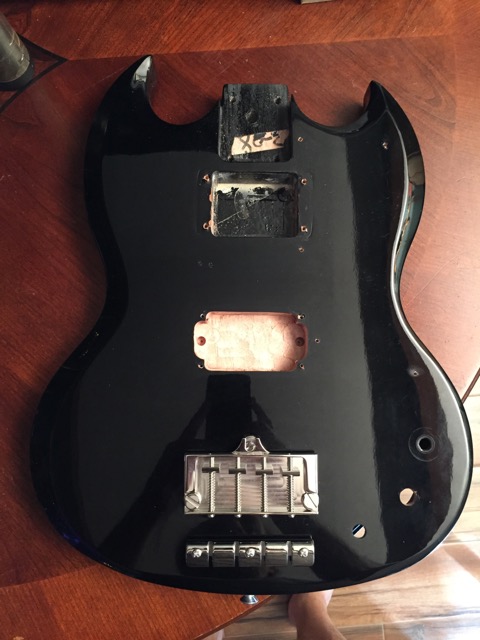
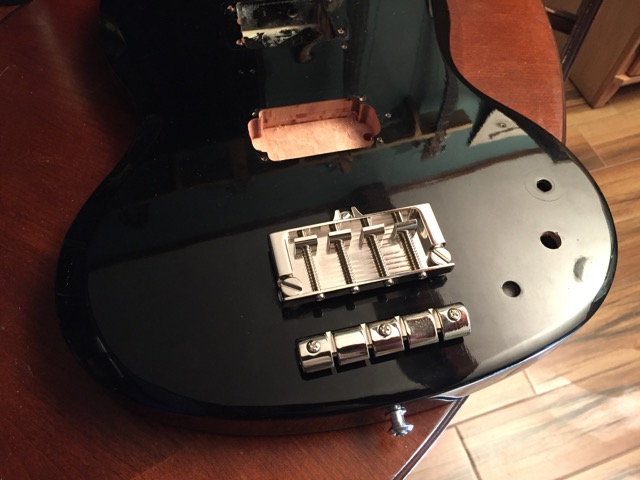
The bridge is a BadBird II, designed and built by TB's own Scott Dasson as a direct replacement for the Gibson/Epiphone three-point. It comes with a beautiful custom tailpiece.
I'm building a 32" scale neck for this one. Three-piece maple, 20-fret mac ebony fretboard, scarfed tiltback headstock. Pretty standard stuff for me. But this one has a twist!
I've been very interested in weight reduction techniques lately, having built a few oppressively heavy basses, and since the EB is already known for a bit of neck dive anyway, I was looking for a way to lighten this neck a bit. I have also recently learned about Billy Gibbons' chambered neck guitars. Our own @reverendrally mentioned this a time or two in the recent past, and ever since I've been itching to try it. I have a decent grounding in Newtonian physics, and while I don't care to actually do the math, the truth is that a cylinder is very nearly as strong as a solid beam of the same outside dimensions, provided the cylinder wall thickness isn't too thin. Most of the strength comes from the material farther away from the center.
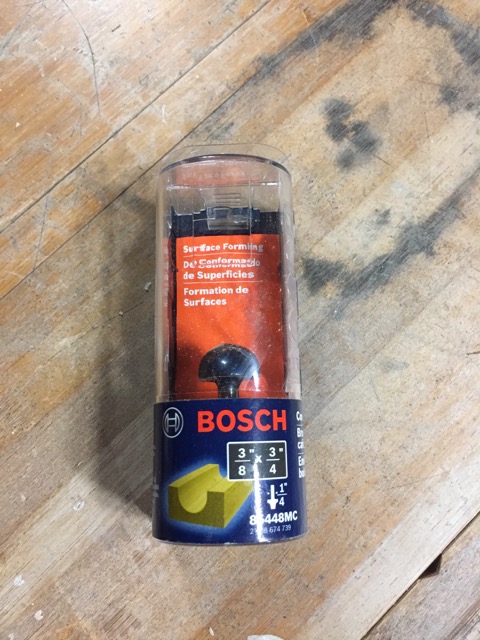
So I got myself a rounded router bit (I think they call this a "bowl bit", is that right?), and decided to actually try it! What's the worst that could happen?
After routing for the LMII truss rod, I removed material in three different sections. I decided to be somewhat conservative in my material removal, leaving plenty of material at either end of the truss rod, and two little sections in the center as additional support for the rod. I have no idea if those are actually necessary, it just seemed prudent. Depth of the chambered sections is only 3/8", the same as the truss rod channel.
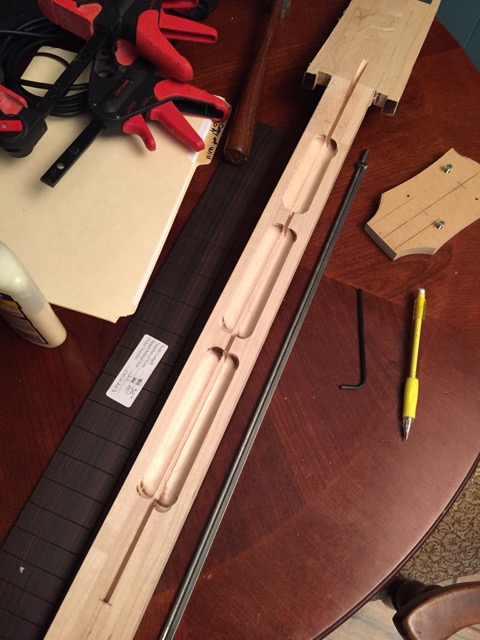
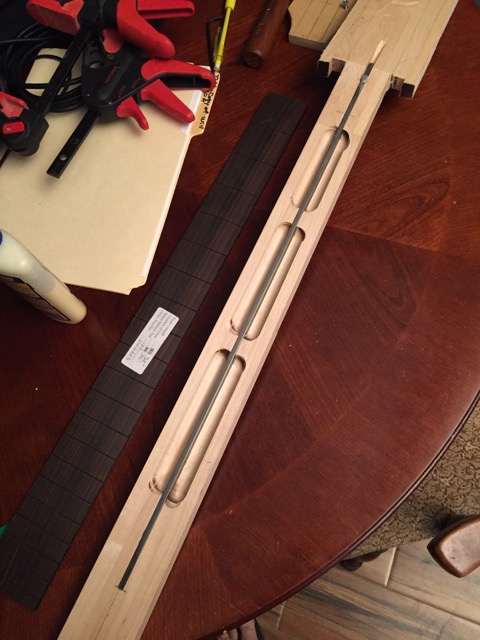
I had the foresight to weigh the neck before and after doing this chambering, and the difference was right at 50 grams. Hmm. That's not exactly a phenomenal weight-loss achievement...
Currently the fingerboard is glued on, and the neck is ready for shaping and finishing. Stay tuned!
While I enjoy every aspect of building from scratch, I also sometimes find interesting factory bodies for cheap, which I buy with the intent of making custom necks for. Here I share two such "half-builds".
The first one uses a Peavey Foundation body, purchased from that auction site. Factory black gloss paint with several large chips in it. I bought it thinking that it might fit a Fender-spec neck, but no. The neck pocket is just a wee bit too close to the bridge. So that opened up my options considerably.
I knew from my research that the body was maple underneath. I sanded all of the factory finish off and was pleased to find a nice four-piece maple body, with three of the four sections having some impressive figuring.
I built a deep-tenon narrow-spacing 33" scale five-string neck for it - sorry, didn't take photos of that, but it's pretty straightforward. Three-piece maple/cherry/maple, 24-fret pau ferro fretboard, scarfed tiltback headstock. I then deepened the neck pocket on the Peavey body accordingly.
I chopped off the neck heel - one of the worst aspects of the pedestrian Fender formula in my opinion - and the rear neck bolt holes became the front holes, with new rear holes drilled further in. That fifth hole is where the Peavey micro-tilt was. A bit unsightly, but oh well.
I had a pair of Aguilar DCB pickups that I found cheap on the TB Classifieds. The pickup cavities needed a bit of enlargement to accommodate them, no sweat. Finished neck and body with gloss Formby's tung oil.
Th reverse headstock is partly just for fun, but it also lets me use regular long-scale strings on the 33" scale neck without worrying about putting full windings on the B-string tuner post.
Schaller roller bridge, John East two-band preamp, fresh Lo-Riders, and bam! A very crisp and snappy sounding five-string for the collection!
The second half-build is based on an Epiphone EB-0 body that came from the TB Classifieds. The prior owner had already routed a second pickup cavity closer to the bridge. I modified that cavity slightly to accept a TV Jones Thunder'Mag on a custom ring. The factory neck pickup cavity will probably be used as a battery compartment.
The bridge is a BadBird II, designed and built by TB's own Scott Dasson as a direct replacement for the Gibson/Epiphone three-point. It comes with a beautiful custom tailpiece.
I'm building a 32" scale neck for this one. Three-piece maple, 20-fret mac ebony fretboard, scarfed tiltback headstock. Pretty standard stuff for me. But this one has a twist!
I've been very interested in weight reduction techniques lately, having built a few oppressively heavy basses, and since the EB is already known for a bit of neck dive anyway, I was looking for a way to lighten this neck a bit. I have also recently learned about Billy Gibbons' chambered neck guitars. Our own @reverendrally mentioned this a time or two in the recent past, and ever since I've been itching to try it. I have a decent grounding in Newtonian physics, and while I don't care to actually do the math, the truth is that a cylinder is very nearly as strong as a solid beam of the same outside dimensions, provided the cylinder wall thickness isn't too thin. Most of the strength comes from the material farther away from the center.
So I got myself a rounded router bit (I think they call this a "bowl bit", is that right?), and decided to actually try it! What's the worst that could happen?
After routing for the LMII truss rod, I removed material in three different sections. I decided to be somewhat conservative in my material removal, leaving plenty of material at either end of the truss rod, and two little sections in the center as additional support for the rod. I have no idea if those are actually necessary, it just seemed prudent. Depth of the chambered sections is only 3/8", the same as the truss rod channel.
I had the foresight to weigh the neck before and after doing this chambering, and the difference was right at 50 grams. Hmm. That's not exactly a phenomenal weight-loss achievement...
Currently the fingerboard is glued on, and the neck is ready for shaping and finishing. Stay tuned!




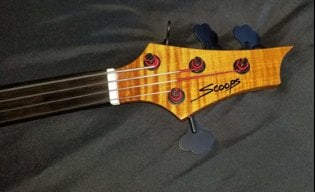
 Next time I'm getting more radical with the chambering!!