• TalkBass has been independent since 1998. Add your voice.
    Create a free account to reply to discussions, view embedded media, and browse with fewer display ads.
    Join freeLog in
    Want zero display ads or expanded classifieds tools? Compare plans.

Two series pickups with independent volume and tone controls. Two methods.

I think you could take the name WalterW off at this point

So, I guess Waltelectro is out?? :)

Yeah, I'll quit using it. Sounded cool, though LOL. Actually felt a little weird about using his name without asking first.

Besides, once the circuits bearing his name became internationally renowned, he'd have to deal with paparazzi, endless interviews, and those nasty celebrity fake pictures. I don't wanna be the cause of that. :)
and just like that my hopes for fame and fortune are dashed :p
 
  • Like
Reactions: fig
and just like that my hopes for fame and fortune are dashed

I tried, man, I tried to get you worldwide recognition. But that Killed_by_Death guy talked me out of it. :)

Just gotta say, I learned alot from your postings over time. Really appreciated.

Just curious, have you tried the following specific circuit? Just seemed natural to add two tone controls to the already established volume shunt method. I don't have parts around to try it. The VTT circuit you posted earlier indicates to me it might work to some degree, hopefully sonically pleasing LOL.:
SeriesVVTT.jpg
 
I’m interested in building a bass with two pickups, but using a single volume & tone for the neck pickup only

Could I wire the bridge pickup to a three way switch that allows for parallel and series operation? Essentially the bridge pickup would be straight to the output jack and the neck able to blend in?
 
I think I finally got it. I didn't realize it, but then it hit me. Look at that paper... And it wasn't the first. I'm going to go finish the rest of my diagram now... Or rather just plop down this missing piece. Haha, and only a 4PDT and a DPDT is needed... I thought I didn't have enough :D

IMG_20210702_195837.jpg
 
Wow, that was a disaster. Obviously very wrong. So I've decided that the push-pull (all poles up or down) that I'll be using will switch between series and parallel. If it's set to series, it bypasses the three way switch and goes into full dual humbucker mode, but if it's set to parallel, the three way switch engages and either pickup can be selected or both. I actually like this idea more than only being able to use the master series/parallel switch when the pickup selector switch is in the middle position. It also means that I can choose what humbucker or humbuckers will be on when switching back to a single pickup or both when switching out of series mode. That could be seen as a negative, I suppose, but if you know the system, I think it'd save time, and add the ability to swap settings before engaging them. Opinions?

IMG_20210703_205331.jpg
 
Last edited:
You might be overthinking it. If only one of the two pickups is in circuit, the other is neither series nor parallel. So why not try a four-way switch: Neck pickup, Bridge pickup, Parallel, Series.
 
You're right - it would be easier, and make more sense to use a four way switch, but I'm only going to be using toggles and push pulls for this design. If I had a different design/end goal, and control scheme, it might be different. In this case I'm going to look past it and have the quirk as I've got five selections to deal with, not four, due to the control scheme.
 
Last edited:
Greetings, new to the forum.

I have just tried both the Danelectro and WalterW VVTT variants in an SG with its original pots, 500k linear volume pots, 500k audio tone pots with 0.047uf capacitors.
Switch currently disconnected but I have a replacement DPDT switch once I have settled on the right wiring.

Firstly the Danelectro wiring works fairly well but volumes have interesting behaviour, as they're turned down volume gets quieter and darker as expected and then as they approach 0 both volume and brightness increase again.
This is presumably because in the inbetween positions there is a lot of series resistance dragging the signal down. I'd theorise that this is the reason why Danelectro chose 100k volume pots, to minimise this effect. (And the 1000k tone pots to try and counter the darkness).
Are the Danelectro 100k's linear or audio?

Tone controls are also interesting but useful. Bridge tone solely works on bridge and has a mild affect on treble. Neck tone affects both pickups (until neck volume is turned down), kind of like a master tone. I like this behaviour.

Next the WalterW VVTT variant which I am apparently the first to have tested and published an opinion of.

With the SG's default pot values I found the behaviour to be not useful, all 4 of the pots seem to do nothing until they're approaching 0, where the bridge or neck will suddenly cut out or the tones will get very dark. The linear 500k shunt volumes not working well doesn't really surprise me but I don't know why the 500k audio tones are bad.

I think that this wiring doesn't have the series resistance volume boost at 0 problem the Danelectro wiring has but I can't really give it a fair test with useless sweep off the pots.

Any suggestions for more appropriate pot values and taper for both volume and tone?

Maybe I will disconnect the tone pots first to see if that changes anything.
 
Welcome to the forum!! Hats and party favors all around! LOL

Firstly the Danelectro wiring works fairly well but volumes have interesting behaviour, as they're turned down volume gets quieter and darker as expected and then as they approach 0 both volume and brightness increase again.
Weird about the volume and brightness increasing again towards 0. I've never played a Dano, so no first-hand experience. There's one or two dedicated Dano threads in the forum. Might wanna post your Dano findings and questions over there also.

A couple of players in the forum have wired their non-Dano basses with this series circuit, even did some for their customers. They may have had to jink with values, like you mentioned. Maybe they'll chime in with some insight. As far as audio or linear pots, try both and see which response you like better. To me, whatever components are installed at the factory are only starting guidelines for tweaking to my preference.

Next the WalterW VVTT variant which I am apparently the first to have tested and published an opinion of.
Here's a post I did last year about the Series Shunt method.:
It was introduced in here a few years ago by member walterw. Some folk started installing it and liked it. I eventually breadboarded it to test the 3p2t switchable series/parallel circuit I came up with, just to see if the switch logic worked out. Everything worked fine. Wasn't interested in the series/parallel thing so I never installed it. Disassembled the breadboard a few hours later.

I was only interested in switching it between series and parallel with a 3p2t switch while maintaining individual volume control in both modes. I didn't use the Tone controls in the test circuit. I'm not sure the other folk that have the series shunt installed are using separate Tone controls. So I like your idea of trying it without the Tone controls to test the response.:

Sometime later, another member was able to use a 2p2t switch for series/parallel while maintaining individual volume control for each. Beat me by one pole! LOL

Hopefully some others chime in, and good luck sorting things out. Sounds like you've got some good ideas to tweak some things.
 
  • Like
Reactions: Lo-E
I have just tried both the Danelectro and WalterW VVTT variants in an SG with its original pots, 500k linear volume pots, 500k audio tone pots with 0.047uf capacitors.
Switch currently disconnected but I have a replacement DPDT switch once I have settled on the right wiring.
wait, this is a guitar? you're wiring two guitar humbuckers in series with each other?

i have a hard time seeing the usefulness of that, with two already loud and thick humbuckers in series you'd likely get a wall of muddy sludge

i'm not surprised that all the pot tapers get weird too
 
  • Like
Reactions: Lo-E
Thanks for the replies guys.

It is indeed a guitar I'm rewiring, I like series humbuckers more than parallel and they blend better. I came here because you guys have readable schematics for series wiring.

Guitarnuts2 is great but much of the information is buried in lengthy theoretical discussion and spaghetti diagrams showing push pull pots, double gang pots, super switches, rotary switches, slide switches and mini toggles doing god only knows what.

With that said I did eventually figured out that Danelectro needs treble bleeds to work properly.

Took me two weeks to find the posts but JohnH on guitarnuts did this years ago.

The values JohnH has in his Les Paul are the same 150K resistor and 1nF capacitor in parallel across the volume pot input and output that he uses for everything.

Schematic A in this drawing by JohnH is what we're looking for. Danelectro with treble bleeds.

Dano Wiring Inspiration | GuitarNutz 2

As an aside the blend pot in Schematic B made out of a modded linear 100K or 250K is brilliant in its simplicity, I will have to try that too.

To dive even deeper into the series wiring this post by JohnH has frequency graphs. It's complicated but does show the undesirable characteristics I noted with Danelectro wiring.

Blending coils in series | GuitarNutz 2

What I'm reading suggests that pot values aren't hugely critical but it may be best to stick to low 10% ish taper Log pots as the treble bleeds alter the taper closer to linear, if you start with a linear pot you end up with anti Log.

And for shunt volume or tones the lower the taper % the better, 250K generally working a bit better than 500K.

Regarding my SG specifically I measured the 500K Log tone pots and they've got a 16% taper, not great. I will replace these with 250K 10% pots.
I tried the 500K Log 16% as shunt volumes and they worked better than 500K Linear, still not happy but I don't want to drop to 250K volume pots.

It also occurred to me that the shunt volumes reducing the treble peak probably makes the tone pots less effective. For this reason I think I'm going to prefer the Danelectro type with the treble bleeds. Will order parts soon.

I still admire the shunt volume type for its simple predictable behaviour.

Sorry if this post seems a little disjointed. I've learnt a lot and am trying to distill it down.
I had to rewire the SG anyway so I might as well put in the time to get what I really want and hopefully leave something useful behind for anyone else who comes this way looking for series wiring.

If this works as well as JohnH says it's too good to be buried and forgotten.
 
I've wired many basses using what TB member @fig describes as the shunt method for series/parallel with independent volume controls. I experimented with some wiring schemes, but then years ago I discovered a nice diagram from TBmember Stealth showing the wiring for a Jazz bass using this method. I've used this as the basis for wiring a lot of basses, and have extrapolated it further to use for 3 and 4 pickup basses. In a more recent thread, @fig drew up the circuit for us, and kindly gave me permission to share it with other interested members. Note that he flipped the bridge and neck pickups in his drawings, which is what I always do when wiring a bass, as my next favorite mod is to add an in-line cap on the bridge pickup (like a RIC), so the bridge pickup should come first in the series chain. I expect you could replace the 2 volume controls with a blend pot, but I haven't tried this.
SeriesParallel.jpg

ShuntWiring_Parallel.jpg

ShuntWiring_Series.jpg

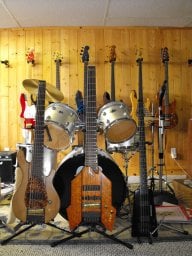
And the mandatory bass photo. All the basses in this photo are wired using the shunt method, except for the red Fender P-bass since it only has 1 pickup.
IMG_20240124_205228809_HDR.jpg
 
  • Like
Reactions: fig and Paco Leon
Thanks fig!
BTW, this isn't just for passive basses. I've used this wiring running into a preamp input many times as well.
I just realized the original drawing from Stealth is from 2011. I usually work on a couple bass projects a year, so this explains why I have about a couple dozen basses now using this wiring.
 
  • Like
Reactions: fig